| Last comments - Cleisthenes's Gallery |

1304a, Constantius I, May 305 - 25 July 306 A.D.Silvered follis, RIC 20a, S 3671, VM 25, gVF, Heraclea mint, 10.144g, 27.7mm, 180o, 297 - 298 A.D. Obverse: FL VAL CONSTANTIVS NOB CAES, laureate head right; Reverse GENIO POPVLI ROMANI, Genius standing left, modius on head, naked except for chlamys over shoulder, cornucopia in left, pouring liquor from patera, HTD in exergue; some silvering, nice portrait, well centered.
De Imperatoribus Romanis: An Online Encyclopedia of Roman Rulers and their Families
Constantius I Chlorus (305-306 A.D.)
Michael DiMaio, Jr.
Salve Regina University
Constantius' Early Life and Marriage
Born March 31st, Emperor Flavius Valerius Constantius may have come into the world ca. 250. His family was from Illyricum. In the army he served as a protector, tribunus, and a praeses Dalmatiarum. During the 270s or the 280s, he became the father of Constantine by Helena, his first spouse. By 288 he was the Praetorian Prefect of the western emperor Maximianus Herculius.
Constantius' Reign as Caesar
On 1 March 293 Diocletian appointed Galerius as his Caesar (junior emperor) in the east and Constantius as the Caesar of Maximianus Herculius. Caesar in the west. Both Caesars had the right of succession. In order to strengthen the dynastic relationship between himself and Herculius., Constantius put aside his wife Helena and married Theodora, the daughter, or perhaps stepdaughter, of Maximianus Herculius.. The union was fruitful and of it there were six issue: Flavius Dalmatius, Julius Constantius, Hannibalianus, Constantia, Anastasia, and Eutropia. To strengthen his bond with Galerius and Diocletian in the east, Constantius allowed Galerius to keep his son Constantine as a hostage for his good behavior.
In the remainder of the time that he was a Caesar, Constantius spent much of his time engaged in military actions in the west. In the summer of 293 Constantius expelled the troops of the usurper Carausius from northern Gaul; after Constantius' attack on Bononia (Boulogne), Carausius was murdered. At the same time he dealt with the unrest of the Germans. In 296 he invaded Britain and put down the revolt of the usurper Allectus. Between 300 and 305 A.D. the Caesar campaigned successfully several times with various German tribes. It is worth noting in passing, that while his colleagues rigidly enforced the "Great Persecution in 303," Constantius limited his action to knocking down a few churches.
Constantius as Augustus and His Untimely Death
On 1 May 305 Diocletian, at Nicomedia, and Maximianus Herculius, at Mediolanum (Milan), divested themselves of the purple, probably because of the almost fatal illness that Diocletian contracted toward the end of 304. Diocletian forced Maximianus to abdicate. They appointed as their successors Constantius and Galerius, with Severus and Maximinus Daia as the new Caesars. The retired emperors then returned to private life. Constantius, as had his predecessor, ruled in the west, while Galerius and Daia ruled in the east. Almost as soon as he was appointed Augustus, he crossed to Britain to face incursions by the Picts where he died at York on 25 July 306 with his son (Constantine I, known to history as “The Great”) at his side.
Copyright (C) 1996, Michael DiMaio, Jr.
Published: De Imperatoribus Romanis: An Online Encyclopedia of Roman Rulers and their Families http://www.roman-emperors.org/startup.htm. Used by permission.
Edited by J. P. Fitzgerald, Jr.Cleisthenes09/10/24 at 01:35Callimachus: Beautiful coin.
|
|

1301a, Diocletian, 284-305 A.D. (Antioch)DIOCLETIAN (284 – 305 AD) AE Antoninianus, 293-95 AD, RIC V 322, Cohen 34. 20.70 mm/3.1 gm, aVF, Antioch. Obverse: IMP C C VAL DIOCLETIANVS P F AVG, Radiate bust right, draped & cuirassed; Reverse: CONCORDIA MILITVM, Jupiter presents Victory on a globe to Diocletian, I/XXI. Early Diocletian with dusty earthen green patina.
De Imperatoribus Romanis: An Online Encyclopedia of Roman Rulers and their Families
Diocletian ( 284-305 A.D.)
Ralph W. Mathisen
University of South Carolina
Summary and Introduction
The Emperor Gaius Aurelius Valerius Diocletianus (A.D. 284-305) put an end to the disastrous phase of Roman history known as the "Military Anarchy" or the "Imperial Crisis" (235-284). He established an obvious military despotism and was responsible for laying the groundwork for the second phase of the Roman Empire, which is known variously as the "Dominate," the "Tetrarchy," the "Later Roman Empire," or the "Byzantine Empire." His reforms ensured the continuity of the Roman Empire in the east for more than a thousand years.
Diocletian's Early Life and Reign
Diocletian was born ca. 236/237 on the Dalmatian coast, perhaps at Salona. He was of very humble birth, and was originally named Diocles. He would have received little education beyond an elementary literacy and he was apparently deeply imbued with religious piety He had a wife Prisca and a daughter Valeria, both of whom reputedly were Christians. During Diocletian's early life, the Roman empire was in the midst of turmoil. In the early years of the third century, emperors increasingly insecure on their thrones had granted inflationary pay raises to the soldiers. The only meaningful income the soldiers now received was in the form of gold donatives granted by newly acclaimed emperors. Beginning in 235, armies throughout the empire began to set up their generals as rival emperors. The resultant civil wars opened up the empire to invasion in both the north, by the Franks, Alamanni, and Goths, and the east, by the Sassanid Persians. Another reason for the unrest in the army was the great gap between the social background of the common soldiers and the officer corps.
Diocletian sought his fortune in the army. He showed himself to be a shrewd, able, and ambitious individual. He is first attested as "Duke of Moesia" (an area on the banks of the lower Danube River), with responsibility for border defense. He was a prudent and methodical officer, a seeker of victory rather than glory. In 282, the legions of the upper Danube proclaimed the praetorian prefect Carus as emperor. Diocletian found favor under the new emperor, and was promoted to Count of the Domestics, the commander of the cavalry arm of the imperial bodyguard. In 283 he was granted the honor of a consulate.
In 284, in the midst of a campaign against the Persians, Carus was killed, struck by a bolt of lightning which one writer noted might have been forged in a legionary armory. This left the empire in the hands of his two young sons, Numerian in the east and Carinus in the west. Soon thereafter, Numerian died under mysterious circumstances near Nicomedia, and Diocletian was acclaimed emperor in his place. At this time he changed his name from Diocles to Diocletian. In 285 Carinus was killed in a battle near Belgrade, and Diocletian gained control of the entire empire.
Diocletian's Administrative and Military Reforms
As emperor, Diocletian was faced with many problems. His most immediate concerns were to bring the mutinous and increasingly barbarized Roman armies back under control and to make the frontiers once again secure from invasion. His long-term goals were to restore effective government and economic prosperity to the empire. Diocletian concluded that stern measures were necessary if these problems were to be solved. He felt that it was the responsibility of the imperial government to take whatever steps were necessary, no matter how harsh or innovative, to bring the empire back under control.
Diocletian was able to bring the army back under control by making several changes. He subdivided the roughly fifty existing provinces into approximately one hundred. The provinces also were apportioned among twelve "dioceses," each under a "vicar," and later also among four "prefectures," each under a "praetorian prefect." As a result, the imperial bureaucracy became increasingly bloated. He institutionalized the policy of separating civil and military careers. He divided the army itself into so-called "border troops," actually an ineffective citizen militia, and "palace troops," the real field army, which often was led by the emperor in person.
Following the precedent of Aurelian (A.D.270-275), Diocletian transformed the emperorship into an out-and-out oriental monarchy. Access to him became restricted; he now was addressed not as First Citizen (Princeps) or the soldierly general (Imperator), but as Lord and Master (Dominus Noster) . Those in audience were required to prostrate themselves on the ground before him.
Diocletian also concluded that the empire was too large and complex to be ruled by only a single emperor. Therefore, in order to provide an imperial presence throughout the empire, he introduced the "Tetrarchy," or "Rule by Four." In 285, he named his lieutenant Maximianus "Caesar," and assigned him the western half of the empire. This practice began the process which would culminate with the de facto split of the empire in 395. Both Diocletian and Maximianus adopted divine attributes. Diocletian was identified with Jupiter and Maximianus with Hercules. In 286, Diocletian promoted Maximianus to the rank of Augustus, "Senior Emperor," and in 293 he appointed two new Caesars, Constantius (the father of Constantine I ), who was given Gaul and Britain in the west, and Galerius, who was assigned the Balkans in the east.
By instituting his Tetrarchy, Diocletian also hoped to solve another problem. In the Augustan Principate, there had been no constitutional method for choosing new emperors. According to Diocletian's plan, the successor of each Augustus would be the respective Caesar, who then would name a new Caesar. Initially, the Tetrarchy operated smoothly and effectively.
Once the army was under control, Diocletian could turn his attention to other problems. The borders were restored and strengthened. In the early years of his reign, Diocletian and his subordinates were able to defeat foreign enemies such as Alamanni, Sarmatians, Saracens, Franks, and Persians, and to put down rebellions in Britain and Egypt. The easter frontier was actually expanded.
.
Diocletian's Economic Reforms
Another problem was the economy, which was in an especially sorry state. The coinage had become so debased as to be virtually worthless. Diocletian's attempt to reissue good gold and silver coins failed because there simply was not enough gold and silver available to restore confidence in the currency. A "Maximum Price Edict" issued in 301, intended to curb inflation, served only to drive goods onto the black market. Diocletian finally accepted the ruin of the money economy and revised the tax system so that it was based on payments in kind . The soldiers too came to be paid in kind.
In order to assure the long term survival of the empire, Diocletian identified certain occupations which he felt would have to be performed. These were known as the "compulsory services." They included such occupations as soldiers, bakers, members of town councils, and tenant farmers. These functions became hereditary, and those engaging in them were inhibited from changing their careers. The repetitious nature of these laws, however, suggests that they were not widely obeyed. Diocletian also expanded the policy of third-century emperors of restricting the entry of senators into high-ranking governmental posts, especially military ones.
Diocletian attempted to use the state religion as a unifying element. Encouraged by the Caesar Galerius, Diocletian in 303 issued a series of four increasingly harsh decrees designed to compel Christians to take part in the imperial cult, the traditional means by which allegiance was pledged to the empire. This began the so-called "Great Persecution."
Diocletian's Resignation and Death
On 1 May 305, wearied by his twenty years in office, and determined to implement his method for the imperial succession, Diocletian abdicated. He compelled his co-regent Maximianus to do the same. Constantius and Galerius then became the new Augusti, and two new Caesars were selected, Maximinus (305-313) in the east and Severus (305- 307) in the west. Diocletian then retired to his palace at Split on the Croatian coast. In 308 he declined an offer to resume the purple, and the aged ex-emperor died at Split on 3 December 316.
Copyright (C) 1996, Ralph W. Mathisen, University of South Carolina
Published: De Imperatoribus Romanis: An Online Encyclopedia of Roman Rulers and their Families http://www.roman-emperors.org/startup.htm. Used by permission.
Edited by J. P. Fitzgerald, Jr.
Cleisthenes05/05/19 at 07:58Jschulze: Hi there! You have this listed as Antioch when I b...
|
|

Elizabeth I, 1558 - 1603England, Elizabeth I, 1558 - 1603. Silver sixpence, Spink 2578B, North 2015, tun mintmark, VF, light scratches, toned, Tower mint, weight 2.838g, maximum diameter 27.5mm, die axis 270o, 1592. Obverse: ELIZAB D'G' ANG'FR:ET:HIB REGI, crowned bust left, rose behind; Reverse POSVI DEV ADIVTOREM MEV (I have made God my helper), quartered coat-of-arms (passant lions and fleurs-de-lis) on long cross fourchée, 1592 above shield; ex A.H. Baldwin & Sons Ltd., Autumn Argentum Auction 2009. Ex FORVM.
Elizabeth I, 1558 - 1603
Elizabeth Tudor is considered by many to be the greatest monarch in English history. When she became queen in 1558, she was twenty-five years old, a survivor of scandal and danger, and considered illegitimate by most Europeans. She inherited a bankrupt nation, torn by religious discord, a weakened pawn between the great powers of France and Spain. She was only the third queen to rule England in her own right; the other two examples, her cousin Lady Jane Grey and half-sister Mary I, were disastrous. Even her supporters believed her position dangerous and uncertain. Her only hope, they counseled, was to marry quickly and lean upon her husband for support. But Elizabeth had other ideas.
She ruled alone for nearly half a century, lending her name to a glorious epoch in world history. She dazzled even her greatest enemies. Her sense of duty was admirable, though it came at great personal cost. She was committed above all else to preserving English peace and stability; her genuine love for her subjects was legendary. Only a few years after her death in 1603, they lamented her passing. In her greatest speech to Parliament, she told them, 'I count the glory of my crown that I have reigned with your love.'
http://englishhistory.net/tudor/monarchs/eliz1.html
Edited by J.P.Fitzgerald, Jr.Cleisthenes06/26/16 at 14:54Kained but Able: Beautiful coin and great information
|
|

Constantine the Great, early 307 - 22 May 337 A.D.Silvered AE 3, RIC VII 92, EF, 3.456g, 18.1mm, 0o, Heraclea mint, 327 - 329 A.D.; Obverse: CONSTAN-TINVS AVG, diademed head right, eyes to God; Reverse: D N CONSTANTINI MAX AVG, VOT XXX in wreath, •SMHB in exergue.
As leading numismatist Joseph Sermarini notes, "The 'looking upwards' portraits of Constantine are often described as 'gazing to Heaven (or God).' The model of these portraits is of course that of the Deified Alexander the Great
(https://www.forumancientcoins.com/ssl/myforum.asp).
The Emperor Constantine I was effectively the sole ruler of the Roman world between 324 and 337 A.D.; his reign was perhaps one of the most crucial of all the emperors in determining the future course of western civilization. By beginning the process of making Christianity the religious foundation of his realm, he set the religious course for the future of Europe which remains in place to this very day. Because he replaced Rome with Constantinople as the center of imperial power, he made it clear that the city of Rome was no longer the center of power, and he also set the stage for the Middle Ages. His philosophical view of monarchy, largely spelled out in some of the works of Eusebius of Caesarea, became the foundation for the concept of the divine right of kings which prevailed in Europe.
Constantine was not a "Christian convert" in any traditional sense. He was not baptized until close to death, and while that was not an uncommon practice, the mention of Christ in his speeches and decrees is conspicuous by its absence. Eusebius, Church historian and Constantine biographer, is responsible for much of the valorization of Constantine as the Christian Emperor. The somnambulant "sign" in which Constantine was to become victor at the Milvian Bridge is, not so surprisingly, revealed to posterity long after the "fact." Throughout his reign, Constantine continues to portray himself on coins as a sun god (Freeman, Charles. Egypt, Greece and Rome: Civilizations of the Ancient Mediterranean; Second Edition. Oxford: Oxford University Press, 2004. 582). Above all, Constantine was a pragmatist. It would be cynical to egregiously disavow his commitment to Christianity, but it would be equally wrong to think that he would allow Christianity to meddle in the governance of his empire. As he reputedly told a group of bishops, "You are bishops of those within the church, but I am perhaps a bishop appointed by God of those outside." Whatever the motives for his decision to support Christianity, Christianity benefitted from the arrangement; so, too, did Constantine. It was a match made in heaven.
Which brings us to Crispus.
Whenever I am engaged in any discussion concerning Constantine I, Crispus is never far from my mind. As historian Hans Pohlsander from SUNY notes, "Crispus' end was as tragic as his career had been brilliant. His own father ordered him to be put to death. We know the year of this sad event, 326, from the Consularia Constantinopolitana, and the place, Pola in Istria, from Ammianus Marcellinus. The circumstances, however, are less clear. Zosimus (6th c.) and Zonaras (12th c.) both report that Crispus and his stepmother Fausta were involved in an illicit relationship." And Pohlsander continues with, "There may be as much gossip as fact in their reports, but Crispus must have committed, or at least must have been suspected of having committed, some especially shocking offense to earn him a sentence of death from his own father. He also suffered damnatio memoriae, his honor was never restored, and history has not recorded the fate of his wife and his child (or children)(Copyright (C) 1997, Hans A. Pohlsander. Published on De Imperatoribus Romanis;An Online Encyclopedia of Roman Emperors and their Families:http://www.roman-emperors.org/crispus.htm).
But there is something terribly illogigical about Constantinian apologetics. In 294 BC, prior to the death of his father, Seleucus I; Antiochus married his step-mother, Stratonice, daughter of Demetrius Poliorcetes. His elderly father reportedly instigated the marriage after discovering that his son was in danger of dying of lovesickness. If this is the way a "Pagan" father is able to express love for his son, then would not a saintly Christian love his son in at least similar measure? This particular Christian father, about whom St. Nectarios writes, "Hellenism spread by Alexander, paved the way for Christianity by the Emperor Constantine the Great," is unique. It is important to our discussion to take note of the fact that in the Greek Orthodox Church, Constantine the Great is revered as a Saint.
Now would be an appropriate time to recall what Joseph Sermarini noted above, "The 'looking upwards' portraits of Constantine are often described as 'gazing to Heaven (or God).' The model of these portraits is of course that of the Deified Alexander the Great(https://www.forumancientcoins.com/ssl/myforum.asp).
Isn’t it all too possible--even probable--that Constantine had been growing obsessively jealous of his ever more successful and adulated son? It is completely out of character for Constantine to merely acquiesce to being Philip to Crispus' Alexander. Remember the Constantine who has proven time and again (recall Constantine's disingenuous promise of clemency to Licinius) that he is a completely self-serving liar and a murderer, and Constantine decides to murder again. Why "must we, "as Pohlsander adamantly suggests, "resolutely reject the claim of Zosimus that it was Constantine's sense of guilt over these deeds which caused him to accept Christianity, as it alone promised him forgiveness for his sins? A similar claim had already been made by Julian the Apostate [Philosopher]."
Perhaps it is time to cease being apologists for the sometime megalomaniacal Constantine. As Michael Grant notes, "It is a mocking travesty of justice to call such a murderer Constantine the Great . . ." (Grant, Michael. The Emperor Constantine. London: Phoenix Press, 1998. 226).
Keep in mind that the obverse device of this coin shows Constantine I "gazing toward God" and was struck within a year or possibly two of Constantine I murdering his first-born son and condemning him to damnatio memoriae.
Edited by J. P. Fitzgerald, Jr.Cleisthenes02/14/16 at 13:32NORMAN K: EXACTLY!
|
|

(500a113) Roman Republic, P. Licinius Nerva, 113-112 B.C.ROMAN REPUBLIC: P. Licinius Nerva. AR denarius (3.93 gm). Rome, ca. 113-112 BC. Helmeted bust of Roma left, holding spear over right shoulder and shield on left arm, crescent above, * before, ROMA behind / P. NERVA, voting scene showing two citizens casting their ballots in the Comitium, one receiving a ballot from an attendant, the other dropping his ballot into a vessel at right. Crawford 292/1. RSC Licinia 7. RCTV 169. Nearly very fine. Ex Freeman and Sear.
Here is a denarius whose reverse device is one that celebrates the privilege and responsibility that is the foundation of a democratic society; it is a forerunner to the L. Cassius Longinus denarius of 63 B.C. Granted, humanity had a long road ahead toward egalitarianism when this coin was struck, but isn't it an interesting testimony to civil liberty's heritage? "The voter on the left (reverse) receives his voting tablet from an election officer. Horizontal lines in the background indicate the barrier separating every voting division from the others. Both voters go across narrow raised walks (pontes); this is intended to ensure that the voter is seen to cast his vote without influence" (Meier, Christian. Caesar: A Biography. Berlin: Severin and Siedler, 1982. Plate 12). This significant coin precedes the Longinus denarius by 50 years.
J. P. Fitzgerald, Jr.
Cleisthenes09/29/13 at 08:24Taras: Cool and interesting coin.
|
|

(502a) Roman Republic, L. Calpurnius Piso Frugi, 90 B.C.Silver denarius, S 235, Calpurnia 11, Crawford 340/1, Syd 663a, VF, rainbow toning, Rome mint, 3.772g, 18.5mm, 180o, 90 B.C. obverse: laureate head of Apollo right, scorpion behind; Reverse naked horseman galloping right holding palm, L PISO FRVGI and control number CXI below; ex-CNA XV 6/5/91, #443. Ex FORVM.
A portion of the following text is a passage taken from the excellent article “The Calpurnii and Roman Family History: An Analysis of the Piso Frugi Coin in the Joel Handshu Collection at the College of Charleston,” by Chance W. Cook:
In the Roman world, particularly prior to the inception of the principate, moneyers were allotted a high degree of latitude to mint their coins as they saw fit. The tres viri monetales, the three men in charge of minting coins, who served one-year terms, often emblazoned their coins with an incredible variety of images and inscriptions reflecting the grandeur, history, and religion of Rome. Yet also prominent are references to personal or familial accomplishments; in this manner coins were also a means by which the tres viri monetales could honor their forbearers. Most obvious from an analysis of the Piso Frugi denarius is the respect and admiration that Lucius Calpurnius Piso Frugi, who minted the coin, had for his ancestors. For the images he selected for his dies relate directly to the lofty deeds performed by his Calpurnii forbearers in the century prior to his term as moneyer. The Calpurnii were present at many of the watershed events in the late Republic and had long distinguished themselves in serving the state, becoming an influential and well-respected family whose defense of traditional Roman values cannot be doubted.
Lucius Calpurnius Piso Frugi, who was moneyer in 90 B.C., depicted Apollo on the obverse and the galloping horseman on the reverse, as does his son Gaius. However, all of L. Piso Frugi’s coins have lettering similar to “L-PISO-FRVGI” on the reverse, quite disparate from his son Gaius’ derivations of “C-PISO-L-F-FRV.”
Moreover, C. Piso Frugi coins are noted as possessing “superior workmanship” to those produced by L. Piso Frugi.
The Frugi cognomen, which became hereditary, was first given to L. Calpurnius Piso, consul in 133 B.C., for his integrity and overall moral virtue. Cicero is noted as saying that frugal men possessed the three cardinal Stoic virtues of bravery, justice, and wisdom; indeed in the Thesaurus Linguae Latinae, a synonym of frugalitas is bonus, generically meaning “good” but also implying virtuous behavior. Gary Forsythe notes that Cicero would sometimes invoke L. Calpurnius Piso’s name at the beginning of speeches as “a paragon of moral rectitude” for his audience.
L. Calpurnius Piso Frugi’s inclusion of the laureled head of Apollo, essentially the same obverse die used by his son Gaius (c. 67 B.C.), was due to his family’s important role in the establishment of the Ludi Apollinares, the Games of Apollo, which were first instituted in 212 B.C. at the height of Hannibal’s invasion of Italy during the Second Punic War. By that time, Hannibal had crushed Roman armies at Cannae, seized Tarentum and was invading Campania.
Games had been used throughout Roman history as a means of allaying the fears
of the populace and distracting them from issues at hand; the Ludi Apollinares were no different. Forsythe follows the traditional interpretation that in 211 B.C., when C. Calpurnius Piso was praetor, he became the chief magistrate in Rome while both consuls were absent and the three other praetors were sent on military expeditions against Hannibal.
At this juncture, he put forth a motion in the Senate to make the Ludi Apollinares a yearly event, which was passed; the Ludi Apollinares did indeed become an important festival, eventually spanning eight days in the later Republic. However, this interpretation is debatable; H.H. Scullard suggests that the games were not made permanent until 208 B.C. after a severe plague prompted the Senate to make them a fixture on the calendar. The Senators believed Apollo would serve as a “healing god” for the people of Rome.
Nonetheless, the Calpurnii obviously believed their ancestor had played an integral role in the establishment of the Ludi Apollinares and thus prominently displayed
the head or bust of Apollo on the obverse of the coins they minted.
The meaning of the galloping horseman found on the reverse of the L. Calpurnius Piso Frugi coin is more complicated. It is possible that this is yet another reference to the Ludi Apollinares. Chariot races in the Circus Maximus were a major component of the games, along with animal hunts and theatrical performances.
A more intriguing possibility is that the horseman is a reference to C. Calpurnius Piso, son of the Calpurnius Piso who is said to have founded the Ludi Apollinares. This C. Calpurnius Piso was given a military command in 186 B.C. to quell a revolt in Spain. He was victorious, restoring order to the province and also gaining significant wealth in the process.
Upon his return to Rome in 184, he was granted a triumph by the Senate and eventually erected an arch on the Capitoline Hill celebrating his victory. Of course
the arch prominently displayed the Calpurnius name. Piso, however, was not an infantry commander; he led the cavalry.
The difficulty in accepting C. Calpurnius Piso’s victory in Spain as the impetus for the galloping horseman image is that not all of C. Piso Frugi’s coins depict the horseman or cavalryman carrying the palm, which is a symbol of victory. One is inclined to believe that the victory palm would be prominent in all of the coins minted by C. Piso Frugi (the son of L. Calpurnius Piso Frugi) if it indeed signified the great triumph of C. Calpurnius Piso in 186 B.C. Yet the palm’s appearance is clearly not a direct reference to military feats of C. Piso Frugi’s day. As noted, it is accepted that his coins were minted in 67 B.C.; in that year, the major victory by Roman forces was Pompey’s swift defeat of the pirates throughout the Mediterranean.
Chrestomathy: Annual Review of Undergraduate Research at the College of Charleston. Volume 1, 2002: pp. 1-10© 2002 by the College of Charleston, Charleston SC 29424, USA.All rights to be retained by the author.
http://www.cofc.edu/chrestomathy/vol1/cook.pdf
There are six (debatably seven) prominent Romans who have been known to posterity as Lucius Calpurnius Piso:
Lucius Calpurnius Piso Frugi: (d. 261 A.D.) a Roman usurper, whose existence is
questionable, based on the unreliable Historia Augusta.
Lucius Calpurnius Piso Licinianus: deputy Roman Emperor, 10 January 69 to15 January
69, appointed by Galba.
Lucius Calpurnius Piso: Consul in 27 A.D.
Lucius Calpurnius Piso: Consul in 1 B.C., augur
Lucius Calpurnius Piso: Consul in 15 B.C., pontifex
Lucius Calpurnius Piso Caesoninus: Consul in 58 B.C. (the uncle of Julius Caesar)
Lucius Calpurnius Piso Frugi: Moneyer in 90 B.C. (our man)
All but one (or two--if you believe in the existence of "Frugi the usurper" ca. 261 A.D.) of these gentlemen lack the Frugi cognomen, indicating they are not from the same direct lineage as our moneyer, though all are Calpurnii.
Calpurnius Piso Frugi's massive issue was intended to support the war against the Marsic Confederation. The type has numerous variations and control marks.
http://en.wikipedia.org/wiki/Lucius_Calpurnius_Piso
http://www.forumancientcoins.com/catalog/indexfrm.asp?vpar=55&pos=0
Edited by J. P. Fitzgerald, Jr.
Cleisthenes09/29/13 at 08:23Taras: Great coin, and great write up! Thanks for sharing...
|
|

001a, Olbia, Sarmatia, c. 5th Century B.C.Bronze cast dolphin, SGCV 1684 var, VF, 1.322g, 24.7mm. Obverse: dolphin with raised spine, dorsal fin and tail.
Olbia
Olbia, located in what is modern-day Ukraine, was a Milesian colony at the convergence of the Hypanis and Borysthenes rivers, about 15 miles inland from the Northwest coast of the Black Sea. Well located for trade, Olbia was a prosperous trading city and major grain supplier in the 5th Century B.C.
Small bronze dolphins were cast in Olbia, beginning 550-525 B.C., first as sacrificial objects for worship of Apollo and later as a form of currency (Joseph Sermarini).Cleisthenes07/23/12 at 23:46Noah: nice dolphin
|
|

[1003c] Julia Domna, Augusta 194 - 8 April 217 A.D.AR Denarius; RIC IV 560; 16.89 mm, 3.5 grams; AD 196-202; VF, Rome mint; Obverse: IVLIA AVGVSTA, Draped bust right; Reverse: IVNO REGINA, Juno standing left holding patera and sceptre, peacock at feet. A nice denarius on a smallish flan. Ex Ancient Imports.
De Imperatoribus Romanis, An On-Line Encyclopedia of Roman Emperors
Severan Julias (A.D. 193-235)
Herbert W. Benario
Emory University
Julia Domna was born about 170 A.D., in Emesa of Syria. She was the youngest daughter of Julius Bassianus, priest of the sun god Elagabal. As such, she was part of the local aristocracy from a plebian family. Having come to the attention of Severus because of her promising horoscope, he married her, probably in 187 A.D. She gave birth to their first child, Bassianus, the future emperor M. Aurelius Antoninus, known as Caracalla, on 4 April 188. About thirteen months later, she gave birth to a second son, Geta.
When Septimius Severus claimed the empire after Didius Julianus had succeeded Pertinax in 193 A.D., two serious rivals challenged him, Pescennius Niger in the East and Clodius Albinus in the West. Julia Domna accompanied her husband in the campaign against Pescennius, having been honored with the title mater castrorum. After this successful campaign, there was another campaign in the East, against the Parthians, in 197 A.D. She was widely honored with inscriptions throughout this period, and numerous coin issues emphasized her imperial position. Julia Domna was, perhaps, more influential in the political life of the empire than any of her imperial predecessors.
She opposed Plautianus, the praetorian prefect and father-in-law of Caracalla, and was partially responsible for his downfall and his daughter Plautilla's disgrace. She was often accused of adultery; nonetheless, the emperor chose to ignore these charges, if true, and the marriage continued.
Among her passions were literature and philosophy; she gathered writers and philosophers in a kind of salon (among whom was Galen of Pergamum), and urged Philostratus to write the life of Apollonius of Tyana.
She once again accompanied her husband, with the two sons present as well, on campaign, against the Britons in 208 A.D. When Severus died at York in early 211 A.D., she returned to Rome with Caracalla and Geta, having gained the full title of mater castrorum et senatus et patriae, with the frequent addition of et Augustorum. She persuaded the two sons to share the rule, as the emperor had wished on his deathbed, but, since the brothers hated each other, this arrangement was doomed to failure. In 212 A.D., Caracalla murdered Geta while he sought succor in his mother's arms; covered with his blood, she was forbidden by Caracalla to grieve.
Her relationship with Caracalla during the six years of his reign was mixed. She had some public duties but largely devoted herself to philosophy. She accompanied Caracalla to the east on campaign against the Parthians in 217 A.D. When she learned, in Antioch, that he had been assassinated, she resolved upon death, which followed her refusal to take food. Her remains were ultimately placed in Hadrian's Mausoleum, at the insistence of Maesa, her sister. She was deified, and was known as Diva Iulia Domna or Diva Iulia Augusta. She was worshipped in various parts of the empire with local titles, such as Dea Caelestis in Carthage and Venus Caelestis in Puteoli.
By Herbert W. Benario, Emory University
Published: De Imperatoribus Romanis: An Online Encyclopedia of Roman Rulers and their Families http://www.roman-emperors.org/startup.htm. Used by permission.
Edited by J. P. Fitzgerald, Jr.
If you are interested in Julia Domna, visit Ernie Thompson’s site: The Life, Family and Coinage of Julia Domna (http://juliadomna.ancients.info/).Cleisthenes11/11/11 at 11:24neander: This is an excellent specimen for an early Rome mi...
|
|

[2000a] Taras, Calabria, Italy, c. 272 - 235 B.C.Silver nomos, Vlasto 877, gVF, Taras mint, 6.497g, 20.0mm, 45o, c. 272 - 235 BC. Obverse: DI above, API-STI/KL-HS below, nude youth on horseback right, spearing downward; Reverse: TARAS, Phalanthos on dolphin left, holding trident; nymph head behind. Ex FORVM.
As the world's foremost numismatist, David R. Sear, has said, 'Magna Graecia and Sicily . . . undoubtedly represent the finest examples of numismatic art in the ancient world. Personally, I am quite drawn to the coins of Taras (Tarentum) because of their infinite variety of types on the basic theme of horseman and dolphin-rider.'
This "variation on a theme" concept appeals to me on many levels, and I am reminded of Variations on a Theme by Joseph Haydn. This masterpiece was, in fact, not composed by Haydn but Johannes Brahms. The B-flat major theme was "borrowed" from Haydn by Brahms for his composition. But there is another nice twist; modern scholarship, for the most part, now agrees that the theme wasn't Haydn's at all. He, too, had "borrowed" it.
So what does this detour into audio art's "variation on a theme" business have to do with numismatics? The ancient Greeks have a wonderful word for art "based upon" art; the word is ekphrasis (ecphrasis). It comes from the Greek ek 'out' and phrasis 'speak'. The verb ekphrazein, means to proclaim or call. One example of ekphrasis is a painting of a sculpture: the painting is "telling the story of" the sculpture, and so becoming a storyteller, as well as a story (work of art) itself. Or it may operate the other way round. Any art may describe any other art. In a manner that I find captivating, I understand these silver nomos of Taras as numismatic art "telling the story of" numismatic art: at once the story teller and the story.
J. P. Fitzgerald, Jr. Cleisthenes09/03/11 at 19:00Enodia: good detail and clear inscriptions... a very nice ...
|
|
[2000a] Taras, Calabria, Italy, c. 272 - 235 B.C.Silver nomos, Vlasto 877, gVF, Taras mint, 6.497g, 20.0mm, 45o, c. 272 - 235 BC. Obverse: DI above, API-STI/KL-HS below, nude youth on horseback right, spearing downward; Reverse: TARAS, Phalanthos on dolphin left, holding trident; nymph head behind. Ex FORVM.
As the world's foremost numismatist, David R. Sear, has said, 'Magna Graecia and Sicily . . . undoubtedly represent the finest examples of numismatic art in the ancient world. Personally, I am quite drawn to the coins of Taras (Tarentum) because of their infinite variety of types on the basic theme of horseman and dolphin-rider.'
This "variation on a theme" concept appeals to me on many levels, and I am reminded of Variations on a Theme by Joseph Haydn. This masterpiece was, in fact, not composed by Haydn but Johannes Brahms. The B-flat major theme was "borrowed" from Haydn by Brahms for his composition. But there is another nice twist; modern scholarship, for the most part, now agrees that the theme wasn't Haydn's at all. He, too, had "borrowed" it.
So what does this detour into audio art's "variation on a theme" business have to do with numismatics? The ancient Greeks have a wonderful word for art "based upon" art; the word is ekphrasis (ecphrasis). It comes from the Greek ek 'out' and phrasis 'speak'. The verb ekphrazein, means to proclaim or call. One example of ekphrasis is a painting of a sculpture: the painting is "telling the story of" the sculpture, and so becoming a storyteller, as well as a story (work of art) itself. Or it may operate the other way round. Any art may describe any other art. In a manner that I find captivating, I understand these silver nomos of Taras as numismatic art "telling the story of" numismatic art: at once the story teller and the story.
J. P. Fitzgerald, Jr. Cleisthenes08/24/11 at 23:16Bruno V.: Beautiful
|
|

[1108a] Trajan Decius, July 249 - June or July 251 A.D. Silver antoninianus, RIC 11b, RSC 4, choice EF, Rome mint, 3.923g, 23.3mm, 0o, 249 - 251 A.D.; Obverse: IMP C M Q TRAIANVS DECIVS AVG, radiate and cuirassed bust right, from behind; Reverse: ADVENTVS AVG, Trajan Decius on horseback left, raising right hand and holding scepter. Ex FORVM.
De Imperatoribus Romanis,
An Online Encyclopedia of Roman Emperors
Trajan Decius (249-251 A.D.) and Usurpers During His Reign
Geoffrey Nathan and Robin McMahon
Geoffrey Nathan
San Diego State University
Early Life and Public Career
Any discussion of Decius (and for most third century emperors) must be prefaced by an understanding that the historical tradition is incomplete, fragmentary, and not wholly trustworthy. Any reconstruction of his life and reign will therefore be to some degree speculative. With that caveat in mind, Gaius Messius Quintus Decius was born, to a provincial yet aristocratic Senatorial family during the transitional Severan age, possibly in 201. His family may have been from Italian stock, although that is by no means certain. Attempts to describe his life previous to the consulship are problematic, although he did serve as governor in Moesia in the mid-230's. That also means that Decius probably had been a member of the Senate for some time. We know little else about his early life, other than at some point he married Herennia Cupressenia Etruscilla, apparently from the Senatorial ordo as well. His political fortunes rose in the troubled 240's. As instability grew in the mid-third century, Philip the Arab charged Decius, suffect consul for 249, with restoring order along the Danubian frontier. In addition to the border unrest, a low-level army officer, Tiberius Claudius Marinus Pacatianus, had led a rebellion of the armies in Pannonia and Moesia. For a short time, Marinus apparently claimed the imperial purple and along with movements of the Gepidae, represented a clear threat to the stability of Philip's rule.
Philip's decision to send Decius was perhaps more motivated by political expediency than by any great confidence in his military abilities. Decius had an aristocratic pedigree, and so was likely to have been a popular choice with a Senate that was increasingly doubtful of Philip's abilities. He was also a native of Sirmium in Pannonia Inferior, and so was likely familiar with the intricacies of life and politics in the region. Finally, he had, of course, served as governor of the wayward province, and thus undoubtedly had connections there among the civil and military curia--ones that Philip hoped Decius could exploit. Thus, the consul was charged with restoring order along one of the Empire's most problematic borders. Accompanied by his son, Herennius, Decius traveled to Moesia, probably to reclaim the Legio IV Flavia Felix and possibly the Legio XI, both of which were stationed in that province.
Shortly before his arrival, Marinus was killed and local troops quickly named Decius emperor, encouraging him to assert this newfound responsibility in a war against Philip. Philip's inability to deal decisively with the worsening military crises on the borders, the fear of punishment, and the opportunity for enrichment no doubt motivated the soldiers to place the purple on a local leader--a now increasingly common practice. Decius' lineage also probably appealed to traditionalists in Rome, who begrudged Philip his humble origins and his possible involvement in the death of Gordian III. Philip led out an army in June of 249 to meet his newest rival for the purple and at an unknown location (possibly Verona or Beroea) lost the battle. Whether Philip died in the fighting or was assassinated by his own troops--another increasingly common practice--is unknown. Philip's son, Philip Junior, recently made an Augustus, was quickly put to death by the Praetorian Guard in Rome. Decius was the first emperor to come from the Balkans region. How much he wanted to serve is unknown. While this account undoubtedly contains fictional elements, with several popular literary topoi, the rough outlines of the story are undoubtedly true: we have epigraphic evidence in July for support among the Pannonian Legio X, suggesting that Decius owed his accession in no small part to local troops
Publicity and Power
The victory of an established Senatorial aristocrat was one that seemed to reassert the authority and place of traditional political power, despite the means of Decius' ascension. The new emperor, no doubt aware of the perils of his position, seems to have embarked upon a highly conservative program of imperial propaganda to endear himself to the Roman aristocracy and to the troops who had thrust the purple upon him. One of his earliest acts was to take the honorific name of Trajan, whose status as the greatest of all emperors after Augustus was now becoming firmly established. The fact that Trajan had commanded legions in Upper Germany and had close links to both Pannonia and Moesia at the time of his accession invited the comparison. The name was cleverly chosen: Trajan had been an active and successful general throughout his reign, but had also established a reputation for a widely popular civil government.
Decius also served as consul in every year of his reign and took for himself traditional republican powers, another way to underscore his authority and conservatism. He even tried to revive the long defunct office of censor in 251, purportedly offering it to the future emperor, Valerian. Decius moreover portrayed himself as an activist general and soldier. In addition to leading military campaigns personally, he often directly bestowed honors upon his troops, high and low alike. He also holds the dubious distinction of being the first emperor to have died fighting a foreign army in battle. Finally, in 250, he associated his sons Herennius and Hostilianus in his rule by making them Caesars, eventually raising the former (and elder) to Augustus. Undoubtedly, Decius sought to create a dynasty in much the same way the Gordians had in the previous decade. This traditionalism may to be a large extent, however, a construction rather than a reality. When we abandon the literary tradition and look instead at other forms of evidence, his imperial aims are less clear. The legal record, extremely thin, is only vaguely supportive of a conservative policy: most of his surviving enactments deal with private law issues consistent with earlier Severan jurisprudence.
On the other hand in late 249, when Decius returned to Rome, he embarked upon an active building program in the capital. After a destructive fire, he extensively restored the Colosseum. He later commissioned the opulent Decian Baths along the Aventine. He perhaps also was responsible for the construction of the Decian Portico. Such activities contrasted to a twenty-year period of relative building inactivity. Both the kind of building projects and their stylistic qualities suggest an attempt to recall the glories of the past. The numismatic evidence also suggests some degree of traditionalism. It is there that we see the first references to Trajan Decius, as well as an association with both Pannonia and Dacia. His Liberitas and Uberitas issues, combined with his wife's Pudicitia and his sons' Princeps Iuventi coins, all seem to rearticulate traditional ideology. Legends tend to be conservative, so this is hardly surprising, but there were no great innovations to suggest a new set of ideological principles. In sum, while the literary reconstructions of Decius' life are problematic, it seems clear that traditionalism was an important factor in his administration, especially in the wake of Philip's reign.
The Persecution of Christians
Another possible aspect of this conservatism was a reported wide-scale attack on the growing Christian minority. The third century saw the slow creation of sizeable communities in the Empire's urban populations. For the first time, if we are to believe Christian sources, an Empire-wide persecution of Christians was begun under Decius. The state required all citizens to sacrifice to the state gods and be in receipt of a libellus, a certificate from a temple confirming the act. The rationale for the emperor's actions, however, is not entirely clear. Eusebius writes he did so because he hated Philip, who purportedly was a secret Christian. Probably the enmity was real, but it seems unconnected to the introduction of these policies. More likely, if Decius did indeed seek to persecute Christians, he was reacting to the growing visibility of the religion, especially in the city of Rome itself. One of the more prominent martyrs of the age was Fabian, the bishop of the imperial capital.
But the new policy of public religiosity was much more probably a program to reassert traditional public piety, consistent with some of the other conservative initiatives introduced during the emperor's short reign. The libelli themselves were largely generalized in nature and language, and there is no implication that they were directed at any one group per se. Whatever intended effect it may have had on Christianity was thus to a degree unplanned. Christians would have no doubt seen it differently. It is possible then that fourth and fifth century Christian polemicists have misinterpreted (whether purposefully or not) Decius' libelli. In the particular cases of Eusebius and Lactantius, both wrote in the wake of the great persecution of Diocletian and no doubt magnified upon the theme of the tyrant-persecutor. A hostile tradition notwithstanding, the new requirements did impact Christians most acutely, causing considerable division in the growing ranks of the new religion.
Imperial and Military Problems
Like other third century emperors, Decius was not free of threats to his authority, either from within or without. The revolt of Jotapianus, either in Syria or Cappadocia, had actually begun in Philip's reign, but was quickly quelled after Decius' accession. Probably the usurper's own soldiers murdered the would-be emperor, since the accounts state that his body was delivered to Decius while still in Rome in the summer of 249.
A potentially more serious revolt broke out while Decius was out of Rome in 250 fighting the Goths. Julius Valens Licinianus, also a member of the Senatorial aristocracy with some popular support, took the purple at the Empire's capital. It appears to have been relatively short-lived grab for power, ending in a few days with his execution. The governor of Macedon, Titus Julius Priscus, also permitted himself to be proclaimed Augustus at Philippopolis towards the end of 251, probably with Gothic collusion. The Senate declared him a public enemy almost as soon as he chose usurpation. He probably survived Decius, but is likely to have perished when Gallus became emperor.
Of greater concern than sporadic rebellions, which were relatively minor, were the vitreous northern borders. For the first time, a new and aggressive Germanic people, the Goths, crossed into and raided Roman territory in the 250's. At the time of Decius' forced accession, the Gepidae and the Carpi were both raiding deep into the Moesian provinces. They, along with the Goths, raided Pannonia and Dacia as well. Decius was forced to fight campaigns each year of his reign, doing his best to keep the borders stable.
His final campaign in 251 led to the death of his son, Herennius, and to his own. Decius led a successful attack on the Carpi, pushing them out of Dacia. But Moesia Inferior had been left largely undefended and Cniva, king of the Goths, led a sizeable portion of his army into the province. The emperor, after chasing the Germanic force around the region, engaged Cniva's forces outside of Philippopolis, which had recently been sacked by the king and held by the rebel, Priscus. It was here that his elder son was slain by an arrow and the emperor, seeking to reassure his troops, famously proclaimed that the death of one soldier was not a great loss to the Republic. Cniva then led his troops homeward, laden with the spoils of war. The loss became Decius' undoing. Trebonianus Gallus, one of the emperor's commanders, may have revolted, although it is not entirely clear. Instead of regrouping his forces and re-securing the borders, Decius unwisely sought to chase down Cniva before he left Roman territory. His decision may have been motivated by his son's death (despite his insistence otherwise) or it may have been an attempt to salvage what had been a failed campaign. In either case, it was ill-advised.
It was at Abrittus, about 100 kilometers northeast of Nicopolis that Decius finally met his death. Hoping to cut off Cniva's escape route (and perhaps minimize any help from Gallus), Decius' army was itself cut off in the marshy terrain. The details are sketchy, but Cniva divided his seventy thousand man army into three groups and surrounded the emperor's force. On July 1st, the emperor and most of his troops were slain. In the aftermath, the survivors named Trebonianus Gallus emperor, a decision subsequently confirmed by the Senate. Some contemporaries called the death tragic; others heroic. An Altar of Decius was erected where the emperor fell, still apparently famous two centuries later. Decius and Herennius may have even been deified. Christian polemicists, as might be expected, took pleasure in describing Decius' body being stripped and left on the battlefield to be devoured by animals. Whatever else, his was the first death of an emperor at the hands of an enemy of Rome. But even the account of his death, along with that of his son, must be looked on suspiciously. Their deaths bring to mind the sacrificial devotions of the famous Republican Decii father and son, P. Decius Mus senior and junior. The circumstances of Decius' death, therefore, are perhaps as opaque as those of his accession.
Assessment
In spite of gaining some modicum of praise from both ancient and modern observers, Decius' reign was not well-suited to the demands of a rapidly changing empire. Conservatism may have been popular among a certain portion of the Roman elite, but the old aristocracy's power and influence all but disappeared in the third century. Decius clearly had a broader vision of what he wanted to accomplish in his reign than many of his contemporaries, and certainly he was vigorous, but he was also a man who was not sufficiently flexible when the moment called for it. His religious policy caused major disruptions in Rome and; in contrast to some of the other barracks emperors, Decius proved himself less than apt when dealing with Rome's Germanic foes. His death may have been heroic, but it was unnecessary and unsuccessful. This best sums up Decius Trajan's reign.
Ancient Sources
Relatively little remains about Decius' reign. If there were a biography of Decius in the SHA, it no longer survives, although there are scattered references to his rule in the biographies of Claudius II Gothicus and Aurelian. Zosimus, i: 21-23, Aurelius Victor, 29-30, Zonaras 12, Eutropius 9, Jordanes Get. 17-8, and Sylvius Polemius 37-40 have brief accounts of his reign. There are fragments in John of Antioch, fr. 148 and Dexippus, fr. 18. Eusebius, vi: 39-41, vii:1, 11, 22, and viii:4, discusses his persecution, and there are passing references to his persecution in Socrates and Lactantius. Inscriptions and coinage are relatively abundant.
Copyright (C) 2002, Geoffrey Nathan and Robin McMahon. Published on De Imperatoribus Romanis, An Online Encyclopedia of the Roman Emperors and their Families; http://www.roman-emperors.org/decius.htm. Used by permission.
Edited by J. P. Fitzgerald, Jr.
Cleisthenes08/02/11 at 20:11rexesq: Beautiful example and great info! Nicely centered ...
|
|

Knidos, Caria, c. 465 - 449 B.CSilver drachm, Cahn 80 (V38/R53), SNG Keckman 132 (same dies), SNG Cop 232 (same dies), aVF, toned, Knidos mint, weight 6.057g, maximum diameter 16.5mm, die axis 270o, c. 465 - 449 B.C.; obverse forepart of roaring lion right; reverse archaic head of Aphrodite right, hair bound with taenia, within incuse square; ex Barry P. Murphy
CARIA, Knidos. Circa 465-449 BC. AR Drachm - 16mm (6.06 g). Obverse: forepart of roaring lion right; Reverse: archaic head of Aphrodite right, hair bound with taenia. Cahn 80 (V38/R53); SNG Helsinki 132 (same dies); SNG Copenhagen 232 (same dies). Toned, near VF, good metal. Ex Barry P. Murphy.
While this coin falls within the time frame that numismatists call "Classical" Greek coinage, I have chosen to place it in both the "Archaic" (coin 020a) and "Classical" Greek sections of my collection. This specimen is one of those wonderful examples of transition--it incorporates many elements of the "Archaic" era, although it is struck during the "Classical" Greek period and anticipates characteristics of the later period.
As noted art historian Patricia Lawrence has pointed out, "[this specimen portrays] A noble-headed lion, a lovely Late Archaic Aphrodite, and [is made from]. . . beautiful metal." The Archaic Aphrodite is reminiscent of certain portraits of Arethusa found on tetradrachms produced in Syracuse in the first decade of the 5th century BC.
Knidos was a city of high antiquity and as a Hellenic city probably of Lacedaemonian colonization. Along with Halicarnassus (present day Bodrum, Turkey) and Kos, and the Rhodian cities of Lindos, Kamiros and Ialyssos it formed the Dorian Hexapolis, which held its confederate assemblies on the Triopian headland, and there celebrated games in honour of Apollo, Poseidon and the nymphs.
The city was at first governed by an oligarchic senate, composed of sixty members, and presided over by a magistrate; but, though it is proved by inscriptions that the old names continued to a very late period, the constitution underwent a popular transformation. The situation of the city was favourable for commerce, and the Knidians acquired considerable wealth, and were able to colonize the island of Lipara, and founded a city on Corcyra Nigra in the Adriatic. They ultimately submitted to Cyrus, and from the battle of Eurymedon to the latter part of the Peloponnesian War they were subject to Athens.
In their expansion into the region, the Romans easily obtained the allegiance of Knidians, and rewarded them for help given against Antiochus by leaving them the freedom of their city.
During the Byzantine period there must still have been a considerable population: for the ruins contain a large number of buildings belonging to the Byzantine style, and Christian sepulchres are common in the neighbourhood.
Eudoxus, the astronomer, Ctesias, the writer on Persian history, and Sostratus, the builder of the celebrated Pharos at Alexandria, are the most remarkable of the Knidians mentioned in history.
http://en.wikipedia.org/wiki/Cnidus
Edited by J. P. Fitzgerald, Jr.Cleisthenes10/22/10 at 15:05Randygeki(h2): nice
|
|

002a, Aigina, Islands off Attica, Greece, c. 510 - 490 B.C.Silver stater, S 1849, SNG Cop 503, F, 12.231g, 22.3mm, Aigina (Aegina) mint, c. 510 - 490 B.C.; Obverse: sea turtle (with row of dots down the middle); Reverse: incuse square of “Union Jack” pattern; banker's mark obverse. Ex FORVM.
Greek Turtles, by Gary T. Anderson
Turtles, the archaic currency of Aegina, are among the most sought after of all ancient coins. Their early history is somewhat of a mystery. At one time historians debated whether they or the issuances of Lydia were the world's earliest coins. The source of this idea comes indirectly from the writings of Heracleides of Pontus, a fourth century BC Greek scholar. In the treatise Etymologicum, Orion quotes Heracleides as claiming that King Pheidon of Argos, who died no later than 650 BC, was the first to strike coins at Aegina. However, archeological investigations date the earliest turtles to about 550 BC, and historians now believe that this is when the first of these intriguing coins were stamped.
Aegina is a small, mountainous island in the Saronikon Gulf, about midway between Attica and the Peloponnese. In the sixth century BC it was perhaps the foremost of the Greek maritime powers, with trade routes throughout the eastern half of the Mediterranean. It is through contacts with Greeks in Asia Minor that the idea of coinage was probably introduced to Aegina. Either the Lydians or Greeks along the coast of present day Turkey were most likely the first to produce coins, back in the late seventh century. These consisted of lumps of a metal called electrum (a mixture of gold and silver) stamped with an official impression to guarantee the coin was of a certain weight. Aegina picked up on this idea and improved upon it by stamping coins of (relatively) pure silver instead electrum, which contained varying proportions of gold and silver. The image stamped on the coin of the mighty sea power was that of a sea turtle, an animal that was plentiful in the Aegean Sea. While rival cities of Athens and Corinth would soon begin limited manufacture of coins, it is the turtle that became the dominant currency of southern Greece. The reason for this is the shear number of coins produced, estimated to be ten thousand yearly for nearly seventy years. The source for the metal came from the rich silver mines of Siphnos, an island in the Aegean. Although Aegina was a formidable trading nation, the coins seemed to have meant for local use, as few have been found outside the Cyclades and Crete. So powerful was their lure, however, that an old proverb states, "Courage and wisdom are overcome by Turtles."
The Aeginean turtle bore a close likeness to that of its live counterpart, with a series of dots running down the center of its shell. The reverse of the coin bore the imprint of the punch used to force the face of the coin into the obverse turtle die. Originally this consisted of an eight-pronged punch that produced a pattern of eight triangles. Later, other variations on this were tried. In 480 BC, the coin received its first major redesign. Two extra pellets were added to the shell near the head of the turtle, a design not seen in nature. Also, the reverse punch mark was given a lopsided design.
Although turtles were produced in great quantities from 550 - 480 BC, after this time production dramatically declines. This may be due to the exhaustion of the silver mines on Siphnos, or it may be related to another historical event. In 480 BC, Aegina's archrival Athens defeated Xerxes and his Persian armies at Marathon. After this, it was Athens that became the predominant power in the region. Aegina and Athens fought a series of wars until 457 BC, when Aegina was conquered by its foe and stripped of its maritime rights. At this time the coin of Aegina changed its image from that of the sea turtle to that of the land tortoise, symbolizing its change in fortunes.
The Turtle was an object of desire in ancient times and has become so once again. It was the first coin produced in Europe, and was produced in such great quantities that thousands of Turtles still exist today. Their historical importance and ready availability make them one of the most desirable items in any ancient coin enthusiast's collection.
(Greek Turtles, by Gary T. Anderson .Cleisthenes08/01/10 at 16:31rover1.3: A very nice axample of a desirable type!
|
|

[18H649] Pontius Pilate Prefect under Tiberius Prutah, "LIZ", 30 BCPONTIUS PILATE PRUTAH, 'LIZ;' Hendin 649, VF, 15.5mm, 1.90 grams. Struck 30 C.E. Nice historic coin.
THE COINS OF PONTIUS PILATE
Jean-Philippe Fontanille
INTRODUCTION
They are not really beautiful, or truly rare, nor are they of very great monetary value. Yet these apparently modest coins carry in their weight an era and an act which would have immense consequence to the history of the world. Indeed, they are closely associated with three basic factors which saw the foundation of Christianity :
1 - The temporal proximity : Most modern experts agree in recognising that the year now designated 30 C.E. marked the trial and the death of Jesus. Given that time-frame, Pilate's coins were minted in 29, 30 and 31 C.E.
2 - The geographic proximity : The most credible hypothesis indicates that these particular coins where struck in Jerusalem, the city in which the significant events took place.
3 - The human proximity : Pontius Pilate himself designed and put the coins into circulation, and of course he was the man who conducted the trial and ordered the crucifixion of Jesus.
So it is that everyone, whether a believer or simply a lover of history or of numismatics, will find in these coins direct evidence of and witness to an episode the memory of which has survived 2000 years : A momentous event which has to a great extent fashioned the world we know.
Throughout this article we will also note the exceptional character of Pilate's coins: Exceptional in the nature of the images they bear, for the numerous variants they offer, for the presence of countermarks, and above all for the part their originator played in history. The putative appearance of these coins imprints on the Turin shroud has yet to be confirmed by more solid scientific proofs.
Pilate's coins are Roman coins, the words on them are Greek, they were circulated in Judea, and today they are to be found distributed among world-wide collectors after having spent 2000 years buried in the earth. They were minted and used during a period which produced an event destined to change the face of the world, and issued at the command of one of the principal actors in that event. An amazing and dramatic destiny for apparently such humble and unassuming little coins !
For 35 years Pilate's coins were passed from hand to hand every day. They knew the scent of spice-stalls, heard the merchants' ranting, smelled the sweat and dust of daily works. They were alive to the sounds of Hebrew, Aramaic, Greek and Latin voices ¬ now haggling over a price, now offering prayers to YHVH, Jesus or Jupiter.
Nobody prays to Jupiter any more [?], but Pilate's coins are surviving witnesses to a time when the first Christians were considered as a messianic sect among several others in the midst of Judaism in crisis. The absolute split between Judaism and Christianity took place from about 70 C.E, the year which marked the tragic ending of the first Jewish rebellion. It was from that time, too, that Pilate's money ceased to be used.
Like each one of us, who carries always a few small coins in the bottom of our pockets; there is no doubt that some of Pilate's coins resonated to the last words of the most famous of all supplicants. A very long story had its beginning...
2. MANUFACTURE AND CIRCULATION
LOCATION OF MINTS
Although the prefects had their residencies in Cesarea, the administrative capital of the province, it seems that their money was minted in Jerusalem. Indeed, a specimen dated year 31 has been found in this town in an incomplete state of manufacture.
DURATION OF USE
It would seem that Pilate's money was in current use for at least 35 years. Indeed, some of it has been discovered among other coins during the excavation of remains of dwellings destroyed by the Romans during the first Jewish revolt, which is evidence that they were still in use at that time.
AREA OF CIRCULATION
These coins circulated far beyond the frontiers of Judea. Some samples have been discovered as far away as Antioch in present-day Turkey, nearly 500 kilometres from Jerusalem where they were minted. Others have also been found in Jordan. These limits represent a circulation area of at least 100.000 square kilometres, that is five times larger than the size of the state of Israel. Taking into account that it was a time when distances were expressed in terms of days of march, one begins to see the important influence of these coins.
3. THE IMAGES AND THE TEXTS
THE SIMPULUM
A fairly frequent symbol from the Roman religion of the time, the simpulum was a utensil used by the priests during their religious ceremonies. This little ladle, provided with shaft and a handle, allowed the priests to taste the wine which they poured onto the head of an animal destined for sacrifice, after which the soothsayer was empowered to examine the animal's entrails for signs and portents sent to men by the Gods through the medium of the interpreter. As I pointed, none of this would have been obvious at first sight of the motif except perhaps to a Roman citizen. However, it throws some light on the theory put forward by F.A. Banks [Coins of the Bible Days].
This wasn't the first time that the simpulum appeared on Roman coins, but it is the first time it figured alone. This fact gives an additional specificity to Pilate's coins, not only in the context of Judea but also in comparison with all the other coins of the Empire.
THE THREE EARS OF BARLEY
The three ears or barley are featured on the opposing face of the simpulum. Unlike the simpulum, these ears of barley are not in contravention of the Jewish Law. The motif is nevertheless distinctive because it is the first time it appears on a Judean coin. The motif would reappear twelve years later on one of Herod Agrippa's coin, then on another, much rarer, of Agrippa II (ears of barley held in a hand). After that, the motif disappeared altogether from ancient Jewish coins.
THE LITUUS
The lituus was the wooden staff which the augurs held in the right hand; it symbolised their authority and their pastoral vocation. It was raised toward heavens while the priests invoked the Gods and made their predictions. Legend records that Romulus used it at the time of Rome's foundation in 753 B.C.E. It is interesting to note that the cross used in present times is the direct descendant of the lituus. As with the simpulum, Pilate's coinage is exceptional in that it alone displays the lituus as the sole object illustrated on the face.
THE WREATH
The laurel wreath is a symbol of power and victory, and figures on various ancient Greek and Roman coins. In Judea it can be found during the reign of John Hyrcanus I (134 to 104 B.C.E.). After that, Herod Antipas, speaker for Pilate, used it on all his coins. On Pilate's coins, the laurel wreath figures on the reverse side of the lituus, framing the date.
THE DATES
The notation of dates uses a code invented by the Greeks whereby each letter of the alphabet was assigned a number. This code would be used again in Judaism under the name of Guematria. The system is simple : the first ten letters of the alphabet are linked to units (1,2,3...), the following ten letters to tens (10,20,30...) and the four remaining letters to the first four hundreds. The "L" is an abbreviation meaning "year". Tiberius became emperor on September 17 of year 14 C.E, so we have :
LIS = Year 29 C.E. * LIZ = Year 30 C.E. * LIH = Year 31 C.E.
THE TEXTS
The legends on Pontius Pilate's coins are written in Greek. Judea, governed by the Ptolemy dynasty (301 to 198 B.C.E) then by the Syrians until 63 B.C.E, came under the same powerful influence of the Hellenic culture which touched the other territories of the ancient Persian Empire won by Alexander the Great. In spite of a certain amount of resistance, this Hellenistic heritage eventually crept into every aspect of daily life. Apart from the dates, the texts on Pilate's coinage consisted of only three different words : - TIBEPIOY KAICAPOC (Of Tiberius Emperor) on all three coins; - IOYLIA KAICAPOC (Empress Julia) added to the coin of year 29.
http://www.numismalink.com/fontanille1.html
Pontius Pilate
After the deposition of the eldest son of Herod, Archelaus (who had succeeded his father as ethnarch), Judea was placed under the rule of a Roman procurator. Pilate, who was the fifth, succeeding Valerius Gratus in A.D. 26, had greater authority than most procurators under the empire, for in addition to the ordinary duty of financial administration, he had supreme power judicially. His unusually long period of office (A.D. 26-36) covers the whole of the active ministry both of St. John the Baptist and of Jesus Christ.
As procurator Pilate was necessarily of equestrian rank, but beyond that we know little of his family or origin. Some have thought that he was only a freedman, deriving his name from pileus (the cap of freed slaves) but for this there seems to be no adequate evidence, and it is unlikely that a freedman would attain to a post of such importance. The Pontii were a Samnite gens. Pilate owed his appointment to the influence of Sejanus. The official residence of the procurators was the palace of Herod at Cæsarea; where there was a military force of about 3,000 soldiers. These soldiers came up to Jerusalem at the time of the feasts, when the city was full of strangers, and there was greater danger of disturbances, hence it was that Pilate had come to Jerusalem at the time of the Crucifixion. His name will be forever covered with infamy because of the part which he took in this matter, though at the time it appeared to him of small importance.
Pilate is a type of the worldly man, knowing the right and anxious to do it so far as it can be done without personal sacrifice of any kind, but yielding easily to pressure from those whose interest it is that he should act otherwise. He would gladly have acquitted Christ, and even made serious efforts in that direction, but gave way at once when his own position was threatened.
The other events of his rule are not of very great importance. Philo (Ad Gaium, 38) speaks of him as inflexible, merciless, and obstinate. The Jews hated him and his administration, for he was not only very severe, but showed little consideration for their susceptibilities. Some standards bearing the image of Tiberius, which had been set up by him in Jerusalem, caused an outbreak which would have ended in a massacre had not Pilate given way. At a later date Tiberius ordered him to remove certain gilt shields, which he had set up in Jerusalem in spite of the remonstrances of the people. The incident mentioned in St. Luke 13:1, of the Galilaeans whose blood Pilate mingled with the sacrifices, is not elsewhere referred to, but is quite in keeping with other authentic events of his rule. He was, therefore, anxious that no further hostile reports should be sent to the emperor concerning him.
The tendency, already discernible in the canonical Gospels, to lay stress on the efforts of Pilate to acquit Christ, and thus pass as lenient a judgment as possible upon his crime, goes further in the apocryphal Gospels and led in later years to the claim that he actually became a Christian. The Abyssinian Church reckons him as a saint, and assigns 25 June to him and to Claudia Procula, his wife. The belief that she became a Christian goes back to the second century, and may be found in Origen (Hom., in Mat., xxxv). The Greek Church assigns her a feast on 27 October. Tertullian and Justin Martyr both speak of a report on the Crucifixion (not extant) sent in by Pilate to Tiberius, from which idea a large amount of apocryphal literature originated. Some of these were Christian in origin (Gospel of Nicodemus), others came from the heathen, but these have all perished.
His rule was brought to an end through trouble which arose in Samaria. An imposter had given out that it was in his power to discover the sacred vessels which, as he alleged, had been hidden by Moses on Mount Gerizim, whither armed Samaritans came in large numbers. Pilate seems to have thought the whole affair was a blind, covering some other more important design, for he hurried forces to attack them, and many were slain. They appealed to Vitellius, who was at that time legate in Syria, saying that nothing political had been intended, and complaining of Pilate's whole administration. He was summoned to Rome to answer their charges, but before he could reach the city the Emperor Tiberius had died.
Catholic Encyclopedia: http://www.newadvent.org/cathen/12083c.htm
As the man who presided over the trial of Jesus, who found no fault with the defendant and washed his hands of the affair by referring it back to the Jewish mob, but who signed the final death warrant, Pontius Pilate represents almost a byword for ambivalence.
He appears in a poor light in all four Gospels and in a favourable light in the apocryphal Gospel of Peter where the Jews take all the blame for Jesus' death.
In the later Acts of Pilate, he is both cleared of responsibility for the Crucifixion and is said to have converted to Christianity.
In the drama of the Passion, Pilate is a ditherer who drifts towards pardoning Jesus, then drifts away again. He tries to pass the buck several times, makes the decision to save Jesus, then capitulates.
The former Archbishop of Canterbury, the late Robert Runcie once wrote, "It would have been better for the moral health of Christianity if the blame had stayed with Pilate."
In a poignant moment in the course of the trial, Pontius Pilate responds to an assertion by Jesus by asking "What is truth?"
The truth about Pilate is difficult to ascertain since records are few. Legends say he was a Spaniard or a German, but most likely he was a natural-born Roman citizen from central Italy.
But the fact that he was definitely the Procurator of Judea from 26 to 36 AD helps to establish Jesus as a real person and fixes him in time.
The official residence of the procurators was the palace of Herod at Caesarea, a mainly non-Jewish city where a force of some 3,000 Roman soldiers were based.
These would come to Jerusalem during the time of feasts when there was a greater danger of disturbances. This would explain Pilate's presence in the city during the time of the Crucifixion.
Pilate is recorded by several contemporary historians; his name is inscribed on Roman coins and on a stone dug up in Caesarea in the 1960s with the words, PONTIUS PILATUS PRAEFECTUS PROVINCIAE JUDAEAE.
The governorship of Judea was only a second-rate posting, though having the Jewish religious capital, Jerusalem, on its patch would have increased its importance.
Pilate ruled in conjunction with the Jewish authorities and was under orders from Emperor Tiberius, to respect their culture. He was a soldier rather than a diplomat.
The Jews relied on the Romans to keep their own rebellious factions under control. But they appeared to hate Pilate.
One contemporary Jewish historian Philo, describes him as a violent thug, fond of executions without trial. Another, Josephus, records that, at the start of his term, Pilate provoked the Jews by ordering the imperial standards to be carried into Jerusalem.
But he backed off from an all-out confrontation. On the other hand, later, he helped himself to Jewish revenues to build an aqueduct.
When, according to Josephus, bands of resistance fighters, supported by crowds of ordinary people, sabotaged the project by getting in the way of Pilate's workmen, he sent in his soldiers. Hundreds were massacred.
Anne Wroe, author of a recent book Pilate: the Biography of an Invented Man, says that for some modern scholars, given this propensity for violence when the occasion warranted, the idea of Pilate as a waverer is nonsense.
A Roman governor, they point out, would not have wasted two minutes thinking about a shabby Jewish villain, one among many. Wroe's depiction of Pilate, however, suggests he was something of a pragmatist.
His first duty was to keep the peace in Judea and to keep the revenues flowing back to Rome. "Should I have jeopardised the peace for the sake of some Jew who may have been innocent?", she has Pilate asking. "Should I have defied a furious crowd, maybe butchered them, to save one life?"
Whatever the truth about the real Pontius Pilate, such dilemmas are what he has come to symbolise.
Anne Wroe makes the modern comparisons of Neville Chamberlain in 1938. Bill McSweeney, of the Irish School of Ecumenics suggests that "without the Pilates of Anglo-Irish politics, we might never have had the Good Friday Agreement".
Tony Blair has said of Pilate: "It is possible to view Pilate as the archetypal politician, caught on the horns of a dilemma."
Even if, in reality, the Jesus affair was nothing but a small side-show in the career of Pontius Pilate, it had monumental repercussions for his image.
His inclusion in the Christian creeds, in the words of Robert Runcie, "binds the eternal realms to the stumbling, messy chronology of earthly time and place".
BBC: http://news.bbc.co.uk/2/hi/uk_news/1273594.stm
The Ethiopian Church recognized Pilate as a saint in the sixth century, based on the account in the Acts of Pilate
Although historians can pinpoint the exact date of death of many distinguished historical figures, the date of the crucifixion of Jesus Christ remains a matter of scholarly debate. Christ’s birth is most often dated between 7-5 BC (some scholars have suggested, however, His birth was as early as 20 BC). Christ’s Death and Resurrection is dated between 29-36 AD.
Edited by J. P. Fitzgerald, Jr.
Cleisthenes07/18/10 at 18:01srukke: Not BC but CE
|
|
|

Macedonian Kingdom, Philip II, 359 - 336 B.C., Lifetime IssueSilver tetradrachm, Le Rider 233 (D130/R188); SNG ANS 385 ff., VF, Pella, 14.163g, 25.4mm, 225o, 342 - 336 B.C.; obverse laureate head of Zeus right; reverse "FILIPPOU", naked youth on horse pacing right on horseback holding palm, thunderbolt below; ex CNG 214, 82; very high relief sculptural portrait, nice style, lifetime issue. Ex FORVM.
Philip II expanded the size and influence of the Macedonian Kingdom, but is perhaps best known as the father of Alexander the Great. He personally selected the design of his coins.
Philip II of Macedon (382 BC–336 BC; in Greek Φίλιππος = φίλος (friend) + ίππος (horse), transliterated Philippos) was the King of Macedon from 359 BC until his assassination. He was the father of Alexander the Great, Phillip III Arrhidaeus, and possibly Ptolemy I Soter, founder of the Ptolemaic dynasty.
Born in Pella, Philip was the youngest son of King Amyntas III and Eurydice. In his youth, (ca. 368 BC–365 BC) Philip was a hostage in Thebes, which was the leading city of Greece during the Theban hegemony. While a captive there, Philip received a military and diplomatic education from Epaminondas, was involved in a pederastic relationship with Pelopidas and lived with Pammenes, who was an enthusiastic advocate of the Sacred Band of Thebes. In 364 BC, Philip returned to Macedonia. The deaths of Philip's elder brothers, King Alexander II and Perdiccas III, allowed him to take the throne in 359 BC. Originally appointed regent for his infant nephew Amyntas IV, who was the son of Perdiccas III, Philip managed to take the kingdom for himself that same year.
Philip's military skills and expansionist vision of Macedonian greatness brought him early success. The hill tribes were broken by a single battle in 358 BC, and Philip established his authority inland as far as Lake Ohrid. He used the Social War as an opportunity for expansion. In 357 BC, he took the Athenian colony of Amphipolis, which commanded the gold mines of Mount Pangaion. That same year Philip married the Epirote princess Olympias, who was the daughter of the king of the Molossians. In 356 BC, Philip conquered the town of Crenides and changed its name to Philippi. Philip also attacked Abdera and Maronea, on the Thracian sea-board. Also in 356 Alexander was born and his race horse won in the Olympics in He took Methone in 354 BC, a town which had belonged to Athens. During the siege of Methone, Philip lost an eye.
Not until his armies were opposed by Athens at Thermopylae in 352 BC did Philip face any serious resistance. Philip did not attempt to advance into central Greece because the Athenians had occupied Thermopylae. Also in 352 BC, the Macedonian army won a complete victory over the Phocians at the Battle of Crocus Field. This battle made Philip tagus of Thessaly, and he claimed as his own Magnesia, with the important harbour of Pagasae.
Hostilities with Athens did not yet take place, but Athens was threatened by the Macedonian party which Philip's gold created in Euboea. From 352 to 346 BC, Philip did not again come south. He was active in completing the subjugation of the Balkan hill-country to the west and north, and in reducing the Greek cities of the coast as far as the Hebrus (Maritza). For the chief of these coastal cities, Olynthus, Philip continued to profess friendship until its neighboring cities were in his hands.
In 349 BC, Philip started the siege of Olynthus. Olynthus at first allied itself with Philip, but later shifted its allegiance to Athens. The Athenians did nothing to help Olynthus. Philip finally took Olynthus in 348 BC and razed the city to the ground. In 346 BC, he intervened effectively in the war between Thebes and the Phocians, but his wars with Athens continued intermittently.
Macedonia and the regions adjoining it having now been securely consolidated, Philip celebrated his Olympic games at Dium. In 347 BC, Philip advanced to the conquest of the eastern districts about the Hebrus, and compelled the submission of the Thracian prince Cersobleptes. Meanwhile, Athens had made overtures for peace, and when Philip, in 346 BC, again moved south, peace was sworn in Thessaly. With key Greek city-states in submission, Philip turned to Sparta; he sent them a message, "You are advised to submit without further delay, for if I bring my army into your land, I will destroy your farms, slay your people, and raze your city." Their reply was "If." Philip and Alexander would both leave them alone. Later, the Macedonian arms were carried across Epirus to the Adriatic Sea. In 342 BC, Philip led a great military expedition north against the Scythians, conquering the Thracian fortified settlement Eumolpia to give it his name, Philippoupolis (modern Plovdiv).
In 340 BC, Philip started the siege of Perinthus. Philip began another siege in 339 BC of the city of Byzantium. After unsuccessful sieges of both cities, Philip's influence all over Greece was compromised. However, Philip successfully reasserted his authority in the Aegean by defeating an alliance of Thebans and Athenians at the Battle of Chaeronea in 338 BC. He erected a memorial of a marble lion to the Sacred Band of Thebes for their bravery that still stands today. Philip created and led the League of Corinth in 337 BC. Members of the League agreed never to wage war against each other, unless it was to suppress revolution. Philip was elected as leader (hegemon) of the army of invasion against the Persian Empire. In 336 BC, when the invasion of Persia was in its very early stage, Philip was assassinated, and was succeeded on the throne of Macedon by his son Alexander the Great.
Philip’s Assassination
The murder happened in October of 336 BC, at Aegae, the ancient capital of the kingdom of Macedon. The court had gathered there for the celebration of the marriage between Alexander of Epirus and Philip's daughter. While the king was entering unprotected into the town's theatre (highlighting his approachability to the Greek diplomats present), he was killed by Pausanias of Orestis, one of Philip's seven bodyguards. The assassin immediately tried to escape and reach his associates who were waiting for him with horses at the entrance of Aegae. He was pursued by three of Philip's bodyguards and died by their hands.
The reasons for Pausanias' assassination of Phillip are difficult to fully expound, since there was controversy already among ancient historians. The only contemporary account in our possession is that of Aristotle, who states rather tersely that Philip was killed because Pausanias had been offended by the followers of Attalus, the king's father-in-law.
Whatever else that may be written about Philip II it must be recognized that he was responsible for making Macedon the ascendant Greek power. He reorganized the Macedonian army. It was this army that Alexander the Great inherited. Phillip II trained some of Alexander’s best generals: Antigonus Cyclops, Antipater, Nearchus, Parmenion, and Perdiccas.
According to the Greek historian Theopompus of Chios, Europe had never seen a man like king Philip of Macedonia, and he called his history of the mid-fourth century BCE the Philippic History. Theopompus had a point. Not even his better known son Alexander has done so much to change the course of Greek history. Philip reorganized his kingdom, gave it access to the sea, expanded its power so that it could defeat the Achaemenid Empire, and subdued the Greek city-states, which never regained their independence again. To achieve this, he modernized the Macedonian economy, improved the army, and concluded several marital alliances. The result was a superpower with one weakness: it was as strong as its king. When Philip's son Alexander died, the institutions were too weak, and Macedonia never recovered.
http://en.wikipedia.org/wiki/Philip_II_of_Macedon
http://www.livius.org/phi-php/philip/philip_ii.htm
Ed. by J. P. Fitzgerald, Jr.Cleisthenes06/30/10 at 02:52Randygeki(h2): really nice one
|
|
|
|
|
|
|
|
|
|
|

[1007c] Elagabalus, 16 May 218 - 11 March 222 A.D.Elagabalus AE 26; 26.62mm, 12.7g; Nicopolis ad Istrum, 218-222 A.D. Obverse: Radiate bust of Elagabalus right; Reverse: Aequitas left; VF/aVF; portrait of superb style . Ex Ancient Imports.
On his website, Doug Smith says, "Coin style, if judged as good or bad, must be judged only on how well it reflects the spirit of the times that produced it"
(http://dougsmith.ancients.info/style.html).
I have several coins struck during the reign of Elagabalus (not all are shown), and this bronze has two distinctions: it is the least expensive, and it is my favorite. In this portrait, I think that the die cutter captured in his compositon of Elagabalus's face a glimpse of self-awareness, a reflection of the insecurity of being a teenage emperor.
De Imperatoribus Romanis: An Online Encyclopedia of Roman Rulers and their Families
ELAGABULUS (218-222 A.D.)
Michael L. Meckler
Ohio State University
Marcus Aurelius Antoninus, the "last of the Antonines," is better known to history as Elagabalus, the name of the sun-god of the Syrian city of Emesa. Elagabalus, the emperor, was a high-priest of this deity, and his active promotion of the god was among several actions that made him an object of scorn and ridicule among the Roman aristocracy. As a youth, living in Emesa with his mother in the household of his grandmother, Julia Maesa, he began to perform in the hereditary family role of high-priest at the temple of the god Elagabalus. Leading Syrian families used their teenager's public displays as high-priest to channel soldiers' discontent with the emperor Macrinus into sedition. Elagabalus's promotion of the cult of the Emesene sun-god was certainly ridiculed by contemporary observers, but this cult was popular among soldiers and would remain so. Moreover, the cult continued to be promoted by later emperors of non-Syrian ethnicity, notably Constantine the Great, calling the god The Unconquered Sun (Sol Invictus).
Much has been made by many historians concerning Elagabalus’ behavior. His three marriages, two to the same Vestal virgin, produced no heir and received considerable contemporary derision. The paramours of his homosexual infatuations, the topics of notorious rumors, became skoffed-at administrative appointees whose favor insulted the aristocracy. His bizarre habit of carrying a large stone while walking backwards through the streets of the capital was considered possible insanity. If there is any understanding of “Elagabalus’ rock,” it rests with the knowledge that both Elagabalus, the sun-god of the Syrian city of Emesa and the source of the emperor’s adopted name, and the Carthgenian goddess Tanit possessed, as was common in Semitic religions, a large stone that was the focus of worship. Elagabalus (the emperor) brought these stones together in a ritualistic “marriage of the gods.” The Elagabalus (god of Emesa) stone was a focus of devotion for Elagabalus the Emperor.
The beginning of the 222 found the emperor ever more closed in. Elagabalus increasingly refused to have contact with his advisors. Government was approaching gridlock as officials were unable to figure out who had authority. A failed attempt by Elagabalus to persuade soldiers to kill his cousin, Marcus Julius Gessius Alexianus (the future emperor Severus Alexander), proved his undoing. Elagabalus and his mother were murdered the evening of 11 March 222. Their bodies were dumped into the Tiber and their memories condemned. Marcus Julius Gessius Alexianus was proclaimed emperor but did not take the name Antoninus, connected as it was with the failed reign of his predecessor.
Scholars have often viewed the failure of Elagabalus' reign as a clash of cultures between "Eastern" (Syrian) and "Western" (Roman), but this dichotomy is not very useful. The criticisms of the emperor's effeminacy and sexual behavior mirror those made of earlier emperors (such as Nero) and do not need to be explained through ethnic stereotypes. Elagabalus is best understood as a teenager who was raised near the luxury of the imperial court and who then suffered a drastic change of fortune brought about by the sudden deaths -- probably within one year -- of his father, his grandfather and his cousin, the emperor Caracalla. Thrust upon the throne, Elagabalus lacked the required discipline. For a while, Romans may well have been amused by his "Merrie Monarch" behavior, but he ended up offending those he needed to inspire. His reign tragically demonstrated the difficulties of having a teenage emperor.
Copyright (C) 1997, Michael L. Meckler.
Published: De Imperatoribus Romanis: An Online Encyclopedia of Roman Rulers and their Families http://www.roman-emperors.org/startup.htm. Used by permission.
Edited by J. P. Fitzgerald, Jr.
Cleisthenes03/21/10 at 21:14Jochen: H/J 8.26.35.8
|
|

1409a, Julian II "the Philosopher," February 360 - 26 June 363 A.D.Julian II, A.D. 360-363; RIC 167; VF; 2.7g, 20mm; Constantinople mint; Obverse: DN FL CL IVLIANVS P F AVG, helmeted & cuirassed bust right, holding spear & shield; Reverse: VOT X MVLT XX in four lines within wreath; CONSPB in exergue; Attractive green patina. Ex Nemesis.
De Imperatoribus Romanis,
An Online Encyclopedia of Roman Emperors
Julian the Apostate (360-363 A.D.)
Walter E. Roberts, Emory University
Michael DiMaio, Jr., Salve Regina University
Introduction
The emperor Flavius Claudius Julianus reigned from 360 to 26 June 363, when he was killed fighting against the Persians. Despite his short rule, his emperorship was pivotal in the development of the history of the later Roman empire. This essay is not meant to be a comprehensive look at the various issues central to the reign of Julian and the history of the later empire. Rather, this short work is meant to be a brief history and introduction for the general reader. Julian was the last direct descendent of the Constantinian line to ascend to the purple, and it is one of history's great ironies that he was the last non-Christian emperor. As such, he has been vilified by most Christian sources, beginning with John Chrysostom and Gregory Nazianzus in the later fourth century. This tradition was picked up by the fifth century Eusebian continuators Sozomen, Socrates Scholasticus, and Theodoret and passed on to scholars down through the 20th century. Most contemporary sources, however, paint a much more balanced picture of Julian and his reign. The adoption of Christianity by emperors and society, while still a vital concern, was but one of several issues that concerned Julian.
It is fortunate that extensive writings from Julian himself exist, which help interpret his reign in the light of contemporary evidence. Still extant are some letters, several panegyrics, and a few satires. Other contemporary sources include the soldier Ammianus Marcellinus' history, correspondence between Julian and Libanius of Antioch, several panegyrics, laws from the Theodosian Code, inscriptions, and coinage. These sources show Julian's emphasis on restoration. He saw himself as the restorer of the traditional values of Roman society. Of course much of this was rhetoric, meant to defend Julian against charges that he was a usurper. At the same time this theme of restoration was central to all emperors of the fourth century. Julian thought that he was the one emperor who could regain what was viewed as the lost glory of the Roman empire. To achieve this goal he courted select groups of social elites to get across his message of restoration. This was the way that emperors functioned in the fourth century. By choosing whom to include in the sharing of power, they sought to shape society.
Early Life
Julian was born at Constantinople in 331. His father was Julius Constantius, half-brother of the emperor Constantine through Constantius Chlorus, and his mother was Basilina, Julius' second wife. Julian had two half-brothers via Julius' first marriage. One of these was Gallus, who played a major role in Julian's life. Julian appeared destined for a bright future via his father's connection to the Constantinian house. After many years of tense relations with his three half-brothers, Constantine seemed to have welcomed them into the fold of the imperial family. From 333 to 335, Constantine conferred a series of honors upon his three half-siblings, including appointing Julius Constantius as one of the consuls for 335. Julian's mother was equally distinguished. Ammianus related that she was from a noble family. This is supported by Libanius, who claimed that she was the daughter of Julius Julianus, a Praetorian Prefect under Licinius, who was such a model of administrative virtue that he was pardoned and honored by Constantine.
Despite the fact that his mother died shortly after giving birth to him, Julian experienced an idyllic early childhood. This ended when Constantius II conducted a purge of many of his relatives shortly after Constantine's death in 337, particularly targeting the families of Constantine's half-brothers. ulian and Gallus were spared, probably due to their young age. Julian was put under the care of Mardonius, a Scythian eunuch who had tutored his mother, in 339, and was raised in the Greek philosophical tradition, and probably lived in Nicomedia. Ammianus also supplied the fact that while in Nicomedia, Julian was cared for by the local bishop Eusebius, of whom the future emperor was a distant relation. Julian was educated by some of the most famous names in grammar and rhetoric in the Greek world at that time, including Nicocles and Hecebolius. In 344 Constantius II sent Julian and Gallus to Macellum in Cappadocia, where they remained for six years. In 351, Gallus was made Caesar by Constantius II and Julian was allowed to return to Nicomedia, where he studied under Aedesius, Eusebius, and Chrysanthius, all famed philosophers, and was exposed to the Neo-Platonism that would become such a prominent part of his life. But Julian was most proud of the time he spent studying under Maximus of Ephesus, a noted Neo-Platonic philospher and theurgist. It was Maximus who completed Julian's full-scale conversion to Neo-Platonism. Later, when he was Caesar, Julian told of how he put letters from this philosopher under his pillows so that he would continue to absorb wisdom while he slept, and while campaigning on the Rhine, he sent his speeches to Maximus for approval before letting others hear them. When Gallus was executed in 354 for treason by Constantius II, Julian was summoned to Italy and essentially kept under house arrest at Comum, near Milan, for seven months before Constantius' wife Eusebia convinced the emperor that Julian posed no threat. This allowed Julian to return to Greece and continue his life as a scholar where he studied under the Neo-Platonist Priscus. Julian's life of scholarly pursuit, however, ended abruptly when he was summoned to the imperial court and made Caesar by Constantius II on 6 November 355.
Julian as Caesar
Constantius II realized an essential truth of the empire that had been evident since the time of the Tetrarchy--the empire was too big to be ruled effectively by one man. Julian was pressed into service as Caesar, or subordinate emperor, because an imperial presence was needed in the west, in particular in the Gallic provinces. Julian, due to the emperor's earlier purges, was the only viable candidate of the imperial family left who could act as Caesar. Constantius enjoined Julian with the task of restoring order along the Rhine frontier. A few days after he was made Caesar, Julian was married to Constantius' sister Helena in order to cement the alliance between the two men. On 1 December 355, Julian journeyed north, and in Augusta Taurinorum he learned that Alamannic raiders had destroyed Colonia Agrippina. He then proceeded to Vienne where he spent the winter. At Vienne, he learned that Augustudunum was also under siege, but was being held by a veteran garrison. He made this his first priority, and arrived there on 24 June 356. When he had assured himself that the city was in no immediate danger, he journeyed to Augusta Treverorum via Autessioduram, and from there to Durocortorum where he rendezvoused with his army. Julian had the army stage a series of punitive strikes around the Dieuse region, and then he moved them towards the Argentoratum/Mongontiacum region when word of barbarian incursions reached him.
From there, Julian moved on to Colonia Agrippina, and negotiated a peace with the local barbarian leaders who had assaulted the city. He then wintered at Senonae. He spent the early part of the campaigning season of 357 fighting off besiegers at Senonae, and then conducting operations around Lugdunum and Tres Tabernae. Later that summer, he encountered his watershed moment as a military general. Ammianus went into great detail about Julian's victory over seven rogue Alamannic chieftains near Argentoratum, and Julian himself bragged about it in his later writing. After this battle, the soldiers acclaimed Julian Augustus, but he rejected this title. After mounting a series of follow-up raids into Alamannic territory, he retired to winter quarters at Lutetia, and on the way defeated some Frankish raiders in the Mosa region. Julian considered this campaign one of the major events of his time as Caesar.
Julian began his 358 military campaigns early, hoping to catch the barbarians by surprise. His first target was the Franks in the northern Rhine region. He then proceeded to restore some forts in the Mosa region, but his soldiers threatened to mutiny because they were on short rations and had not been paid their donative since Julian had become Caesar. After he soothed his soldiers, Julian spent the rest of the summer negotiating a peace with various Alamannic leaders in the mid and lower Rhine areas, and retired to winter quarters at Lutetia. In 359, he prepared once again to carry out a series of punitive expeditions against the Alamanni in the Rhine region who were still hostile to the Roman presence. In preparation, the Caesar repopulated seven previously destroyed cities and set them up as supply bases and staging areas. This was done with the help of the people with whom Julian had negotiated a peace the year before. Julian then had a detachment of lightly armed soldiers cross the Rhine near Mogontiacum and conduct a guerilla strike against several chieftains. As a result of these campaigns, Julian was able to negotiate a peace with all but a handful of the Alamannic leaders, and he retired to winter quarters at Lutetia.
Of course, Julian did more than act as a general during his time as Caesar. According to Ammianus, Julian was an able administrator who took steps to correct the injustices of Constantius' appointees. Ammianus related the story of how Julian prevented Florentius, the Praetorian Prefect of Gaul, from raising taxes, and also how Julian actually took over as governor for the province of Belgica Secunda. Hilary, bishop of Poitiers, supported Ammianus' basic assessment of Julian in this regard when he reported that Julian was an able representative of the emperor to the Gallic provincials. There is also epigraphic evidence to support Julian's popularity amongst the provincial elites. An inscription found near Beneventum in Apulia reads:
"To Flavius Claudius Julianus, most noble and sanctified Caesar, from the caring Tocius Maximus, vir clarissimus, for the care of the res publica from Beneventum".
Tocius Maximus, as a vir clarissimus, was at the highest point in the social spectrum and was a leader in his local community. This inscription shows that Julian was successful in establishing a positive image amongst provincial elites while he was Caesar.
Julian Augustus
In early 360, Constantius, driven by jealousy of Julian's success, stripped Julian of many troops and officers, ostensibly because the emperor needed them for his upcoming campaign against the Persians. One of the legions ordered east, the Petulantes, did not want to leave Gaul because the majority of the soldiers in the unit were from this region. As a result they mutinied and hailed Julian as Augustus at Lutetia. Julian refused this acclamation as he had done at Argentoratum earlier, but the soldiers would have none of his denial. They raised him on a shield and adorned him with a neck chain, which had formerly been the possession of the standard-bearer of the Petulantes and symbolized a royal diadem. Julian appeared reluctantly to acquiesce to their wishes, and promised a generous donative. The exact date of his acclamation is unknown, but most scholars put it in February or March. Julian himself supported Ammianus' picture of a jealous Constantius. In his Letter to the Athenians, a document constructed to answer charges that he was a usurper, Julian stated that from the start he, as Caesar, had been meant as a figurehead to the soldiers and provincials. The real power he claimed lay with the generals and officials already present in Gaul. In fact, according to Julian, the generals were charged with watching him as much as the enemy. His account of the actual acclamation closely followed what Ammianus told us, but he stressed even more his reluctance to take power. Julian claimed that he did so only after praying to Zeus for guidance.
Fearing the reaction of Constantius, Julian sent a letter to his fellow emperor justifying the events at Lutetia and trying to arrange a peaceful solution. This letter berated Constantius for forcing the troops in Gaul into an untenable situation. Ammianus stated that Julian's letter blamed Constantius' decision to transfer Gallic legions east as the reason for the soldiers' rebellion. Julian once again asserted that he was an unwilling participant who was only following the desire of the soldiers. In both of these basic accounts Ammianus and Julian are playing upon the theme of restoration. Implicit in their version of Julian's acclamation is the argument that Constantius was unfit to rule. The soldiers were the vehicle of the gods' will. The Letter to the Athenians is full of references to the fact that Julian was assuming the mantle of Augustus at the instigation of the gods. Ammianus summed up this position nicely when he related the story of how, when Julian was agonizing over whether to accept the soldiers' acclamation, he had a dream in which he was visited by the Genius (guardian spirit) of the Roman state. The Genius told Julian that it had often tried to bestow high honors upon Julian but had been rebuffed. Now, the Genius went on to say, was Julian's final chance to take the power that was rightfully his. If the Caesar refused this chance, the Genius would depart forever, and both Julian and the state would rue Julian's rejection. Julian himself wrote a letter to his friend Maximus of Ephesus in November of 361 detailing his thoughts on his proclamation. In this letter, Julian stated that the soldiers proclaimed him Augustus against his will. Julian, however, defended his accession, saying that the gods willed it and that he had treated his enemies with clemency and justice. He went on to say that he led the troops in propitiating the traditional deities, because the gods commanded him to return to the traditional rites, and would reward him if he fulfilled this duty.
During 360 an uneasy peace simmered between the two emperors. Julian spent the 360 campaigning season continuing his efforts to restore order along the Rhine, while Constantius continued operations against the Persians. Julian wintered in Vienne, and celebrated his Quinquennalia. It was at this time that his wife Helena died, and he sent her remains to Rome for a proper burial at his family villa on the Via Nomentana where the body of her sister was entombed. The uneasy peace held through the summer of 361, but Julian concentrated his military operations around harassing the Alamannic chieftain Vadomarius and his allies, who had concluded a peace treaty with Constantius some years earlier. By the end of the summer, Julian decided to put an end to the waiting and gathered his army to march east against Constantius. The empire teetered on the brink of another civil war. Constantius had spent the summer negotiating with the Persians and making preparations for possible military action against his cousin. When he was assured that the Persians would not attack, he summoned his army and sallied forth to meet Julian. As the armies drew inexorably closer to one another, the empire was saved from another bloody civil war when Constantius died unexpectedly of natural causes on 3 November near the town of Mopsucrenae in Cilicia, naming Julian -- the sources say-- as his legitimate successor.
Julian was in Dacia when he learned of his cousin's death. He made his way through Thrace and came to Constantinople on 11 December 361 where Julian honored the emperor with the funeral rites appropriate for a man of his station. Julian immediately set about putting his supporters in positions of power and trimming the imperial bureaucracy, which had become extremely overstaffed during Constantius' reign. Cooks and barbers had increased during the late emperor's reign and Julian expelled them from his court. Ammianus gave a mixed assessment of how the new emperor handled the followers of Constantius. Traditionally, emperors were supposed to show clemency to the supporters of a defeated enemy. Julian, however, gave some men over to death to appease the army. Ammianus used the case of Ursulus, Constantius' comes sacrum largitionum, to illustrate his point. Ursulus had actually tried to acquire money for the Gallic troops when Julian had first been appointed Caesar, but he had also made a disparaging remark about the ineffectiveness of the army after the battle of Amida. The soldiers remembered this, and when Julian became sole Augustus, they demanded Ursulus' head. Julian obliged, much to the disapproval of Ammianus. This seems to be a case of Julian courting the favor of the military leadership, and is indicative of a pattern in which Julian courted the goodwill of various societal elites to legitimize his position as emperor.
Another case in point is the officials who made up the imperial bureaucracy. Many of them were subjected to trial and punishment. To achieve this goal, during the last weeks of December 361 Julian assembled a military tribunal at Chalcedon, empanelling six judges to try the cases. The president of the tribunal was Salutius, just promoted to the rank of Praetorian Prefect; the five other members were Mamertinus, the orator, and four general officers: Jovinus, Agilo, Nevitta, and Arbetio. Relative to the proceedings of the tribunal, Ammianus noted that the judges, " . . . oversaw the cases more vehemently than was right or fair, with the exception of a few . . .." Ammianus' account of Julian's attempt at reform of the imperial bureaucracy is supported by legal evidence from the Theodosian Code. A series of laws sent to Mamertinus, Julian's appointee as Praetorian Prefect in Italy, Illyricum, and Africa, illustrate this point nicely. On 6 June 362, Mamertinus received a law that prohibited provincial governors from bypassing the Vicars when giving their reports to the Prefect. Traditionally, Vicars were given civil authority over a group of provinces, and were in theory meant to serve as a middle step between governors and Prefects. This law suggests that the Vicars were being left out, at least in Illyricum. Julian issued another edict to Mamertinus on 22 February 362 to stop abuse of the public post by governors. According to this law, only Mamertinus could issue post warrants, but the Vicars were given twelve blank warrants to be used as they saw fit, and each governor was given two. Continuing the trend of bureaucratic reform, Julian also imposed penalties on governors who purposefully delayed appeals in court cases they had heard. The emperor also established a new official to weigh solidi used in official government transactions to combat coin clipping.
For Julian, reigning in the abuses of imperial bureaucrats was one step in restoring the prestige of the office of emperor. Because he could not affect all elements of society personally, Julian, like other Neo-Flavian emperors, decided to concentrate on select groups of societal elites as intercessors between himself and the general populace. One of these groups was the imperial bureaucracy. Julian made it very clear that imperial officials were intercessors in a very real sense in a letter to Alypius, Vicar of Britain. In this letter, sent from Gaul sometime before 361, the emperor praises Alypius for his use of "mildness and moderation with courage and force" in his rule of the provincials. Such virtues were characteristic of the emperors, and it was good that Alypius is representing Julian in this way. Julian courted the army because it put him in power. Another group he sought to include in his rule was the traditional Senatorial aristocracy. One of his first appointments as consul was Claudius Mamertinus, a Gallic Senator and rhetorician. Mamertinus' speech in praise of Julian delivered at Constantinople in January of 362 is preserved. In this speech, Claudius presented his consular selection as inaugurating a new golden age and Julian as the restorer of the empire founded by Augustus. The image Mamertinus gave of his own consulate inaugurating a new golden age is not merely formulaic. The comparison of Julian to Augustus has very real, if implicit, relevance to Claudius' situation. Claudius emphasized the imperial period as the true age of renewal. Augustus ushered in a new era with his formation of a partnership between the emperor and the Senate based upon a series of honors and offices bestowed upon the Senate in return for their role as intercessor between emperor and populace. It was this system that Julian was restoring, and the consulate was one concrete example of this bond. To be chosen as a consul by the emperor, who himself had been divinely mandated, was a divine honor. In addition to being named consul, Mamertinus went on to hold several offices under Julian, including the Prefecture of Italy, Illyricum, and Africa. Similarly, inscriptional evidence illustrates a link between municipal elites and Julian during his time as Caesar, something which continued after he became emperor. One concrete example comes from the municipal senate of Aceruntia in Apulia, which established a monument on which Julian is styled as "Repairer of the World."
Julian seems to have given up actual Christian belief before his acclamation as emperor and was a practitioner of more traditional Greco-Roman religious beliefs, in particular, a follower of certain late antique Platonist philosophers who were especially adept at theurgy as was noted earlier. In fact Julian himself spoke of his conversion to Neo-Platonism in a letter to the Alexandrians written in 363. He stated that he had abandoned Christianity when he was twenty years old and been an adherent of the traditional Greco-Roman deities for the twelve years prior to writing this letter.
(For the complete text of this article see: http://www.roman-emperors.org/julian.htm)
Julian’s Persian Campaign
The exact goals Julian had for his ill-fated Persian campaign were never clear. The Sassanid Persians, and before them the Parthians, had been a traditional enemy from the time of the Late Republic, and indeed Constantius had been conducting a war against them before Julian's accession forced the former to forge an uneasy peace. Julian, however, had no concrete reason to reopen hostilities in the east. Socrates Scholasticus attributed Julian's motives to imitation of Alexander the Great, but perhaps the real reason lay in his need to gather the support of the army. Despite his acclamation by the Gallic legions, relations between Julian and the top military officers was uneasy at best. A war against the Persians would have brought prestige and power both to Julian and the army.
Julian set out on his fateful campaign on 5 March 363. Using his trademark strategy of striking quickly and where least expected, he moved his army through Heirapolis and from there speedily across the Euphrates and into the province of Mesopotamia, where he stopped at the town of Batnae. His plan was to eventually return through Armenia and winter in Tarsus. Once in Mesopotamia, Julian was faced with the decision of whether to travel south through the province of Babylonia or cross the Tigris into Assyria, and he eventually decided to move south through Babylonia and turn west into Assyria at a later date. By 27 March, he had the bulk of his army across the Euphrates, and had also arranged a flotilla to guard his supply line along the mighty river. He then left his generals Procopius and Sebastianus to help Arsacius, the king of Armenia and a Roman client, to guard the northern Tigris line. It was also during this time that he received the surrender of many prominent local leaders who had nominally supported the Persians. These men supplied Julian with money and troops for further military action against their former masters. Julian decided to turn south into Babylonia and proceeded along the Euphrates, coming to the fortress of Cercusium at the junction of the Abora and Euphrates Rivers around the first of April, and from there he took his army west to a region called Zaitha near the abandoned town of Dura where they visited the tomb of the emperor Gordian which was in the area. On April 7 he set out from there into the heart of Babylonia and towards Assyria.
Ammianus then stated that Julian and his army crossed into Assyria, which on the face of things appears very confusing. Julian still seems to be operating within the province of Babylonia between the Tigris and Euphrates rivers. The confusion is alleviated when one realizes that,for Ammianus, the region of Assyria encompassed the provinces of Babylonia and Assyria. On their march, Julian's forces took the fortress of Anatha, received the surrender and support of several more local princes, and ravaged the countryside of Assyria between the rivers. As the army continued south, they came across the fortresses Thilutha and Achaiachala, but these places were too well defended and Julian decided to leave them alone. Further south were the cities Diacira and Ozogardana, which the Roman forces sacked and burned. Soon, Julian came to Pirisabora and a brief siege ensued, but the city fell and was also looted and destroyed. It was also at this time that the Roman army met its first systematic resistance from the Persians. As the Romans penetrated further south and west, the local inhabitants began to flood their route. Nevertheless, the Roman forces pressed on and came to Maiozamalcha, a sizable city not far from Ctesiphon. After a short siege, this city too fell to Julian. Inexorably, Julian's forces zeroed in on Ctesiphon, but as they drew closer, the Persian resistance grew fiercer, with guerilla raids whittling at Julian's men and supplies. A sizable force of the army was lost and the emperor himself was almost killed taking a fort a few miles from the target city.
Finally, the army approached Ctesiphon following a canal that linked the Tigris and Euphrates. It soon became apparent after a few preliminary skirmishes that a protracted siege would be necessary to take this important city. Many of his generals, however, thought that pursuing this course of action would be foolish. Julian reluctantly agreed, but became enraged by this failure and ordered his fleet to be burned as he decided to march through the province of Assyria. Julian had planned for his army to live off the land, but the Persians employed a scorched-earth policy. When it became apparent that his army would perish (because his supplies were beginning to dwindle) from starvation and the heat if he continued his campaign, and also in the face of superior numbers of the enemy, Julian ordered a retreat on 16 June. As the Roman army retreated, they were constantly harassed by guerilla strikes. It was during one of these raids that Julian got caught up in the fighting and took a spear to his abdomen. Mortally wounded he was carried to his tent, where, after conferring with some of his officers, he died. The date was 26 June 363.
Conclusion
Thus an ignominious end for a man came about who had hoped to restore the glory of the Roman empire during his reign as emperor. Due to his intense hatred of Christianity, the opinion of posterity has not been kind to Julian. The contemporary opinion, however, was overall positive. The evidence shows that Julian was a complex ruler with a definite agenda to use traditional social institutions in order to revive what he saw as a collapsing empire. In the final assessment, he was not so different from any of the other emperors of the fourth century. He was a man grasping desperately to hang on to a Greco-Roman conception of leadership that was undergoing a subtle yet profound change.
Copyright (C) 2002, Walter E. Roberts and Michael DiMaio, Jr. Used by permission.
In reality, Julian worked to promote culture and philosophy in any manifestation. He tried to reduce taxes and the public debts of municipalities; he augmented administrative decentralisation; he promoted a campaign of austerity to reduce public expenditure (setting himself as the example). He reformed the postal service and eliminated the powerful secret police.
by Federico Morando; JULIAN II, The Apostate, See the Julian II Page on NumisWiki
Flavius Claudius Iulianus was born in 331 or maybe 332 A.D. in Constantinople. He ruled the Western Empire as Caesar from 355 to 360 and was hailed Augustus by his legions in Lutetia (Paris) in 360. Julian was a gifted administrator and military strategist. Famed as the last pagan emperor, his reinstatement of the pagan religion earned him the moniker "the Apostate." As evidenced by his brilliant writing, some of which has survived to the present day, the title "the Philosopher" may have been more appropriate. He died from wounds suffered during the Persian campaign of 363 A.D. Joseph Sermarini, FORVM.
Edited by J. P. Fitzgerald, Jr.
Cleisthenes03/16/10 at 09:15Randygeki(h2): very impresive patina
|
|

[1006a] Macrinus, 11 April 217 - 8 June 218 A.D.; Diadumenian, mid May - 8 June 218 A.D.Macrinus and Diadumenian, AMNG 750, 217-218 AD, 12.4 g, 27.25 mm; Moesia Inferior Marcianopolis; aVF; Obverse: Busts of Macrinus and Diadumenian facing each other; Reverse: Rv.: Asklepios standing left, with snake coiled on staff, lovely jade green patina; Ex Colosseum; Ex Ancient Imports.
De Imperatoribus Romanis,
An Online Encyclopedia of Roman Emperors
Macrinus (217-218 A.D.)
Michael L. Meckler
Ohio State University
Marcus Opellius Macrinus was the first emperor who was neither a senator nor of a senatorial family at the time of his accession. His 14-month reign was spent entirely in the East, where he proved unable to maintain the influence gained in the region by the campaigns of his predecessor, Caracalla, nor was Macrinus able to shake the suspicion that he was responsible for Caracalla's murder.
Macrinus was born in Caesarea in Mauretania around the year 165 AD. While it is highly conjectural that, as a young man, the future emperor was the dedicatee of Ampelius' encyclopedic Liber memoralis, Macrinus undoubtedly received a literary education that enabled him to rise high as a bureaucrat in the imperial service during the reign of the emperor Severus. Caracalla made Macrinus a praetorian prefect, an equestrian post that was second to the emperor in power. Macrinus shared the position with the experienced soldier Adventus, and the pair served Caracalla during the emperor's campaigns in the East.
By the end of the second campaigning season in the winter of 216-17, rumors were flying both in Rome and in the East that Macrinus was promoting himself as a possible future emperor. Caracalla must have been aware of the rumors concerning Macrinus, for the contemporary historian Cassius Dio notes the emperor was already reassigning members of Macrinus' staff. Such personnel moves may have accelerated Macrinus' plot.
Shortly before the campaigning season was to begin, Caracalla paid a visit to a temple near Carrhae. The emperor was accompanied by a hand-picked corps of bodyguards. The guards returned with Caracalla's murdered body, along with the body of one of the guards and a story that the dead guard killed the dead emperor. Not everyone was convinced, but Macrinus was able to translate his authority as praetorian prefect into that of emperor, being proclaimed by the troops on 11 April 217. Macrinus soon named his son, Diadumenianus, as Caesar and heir. The new emperor also got his former colleague, Adventus, out of the way by sending him back to Rome as urban prefect.
Macrinus straightaway sent conciliatory messages to the Parthian ruler Artabanus V, but Artabanus sensed weakness and raised an army to avenge his losses from the previous year's campaign. Macrinus hoped to avoid a battle with the Parthians, but fighting erupted between the armies while both sides were encamped around Nisibis. The Parthians gained victory and, during the following autumn and winter, peace negotiations were held. Macrinus ended up paying the Parthians large bribes and reparations. Settlements were also reached with the Armenians, and, in the lower Danube, with the Dacians, who had launched attacks on the Romans after learning of Caracalla's death.
By not returning to Rome in 217, Macrinus opened himself to criticism. Dissatisfaction was especially high in the city after a particularly violent, late-August thunderstorm started a fire that damaged much of the Colosseum and caused widespread flooding, especially in the Forum. Adventus proved himself incompetent as urban prefect and had to be replaced.
But grumblings in Rome were insignificant compared to the growing unease among the soldiers on campaign in the East. The defeat at Nisibis disheartened troops. Macrinus also introduced an unpopular, two-tier pay system in which new recruits received less money than veterans. The move was a way to save money after the pay raise granted by Caracalla, but it lowered morale as well.
Earlier, Caracalla's mother, Julia Domna, had toyed with the idea of raising a rebellion against Macrinus shortly after her son's murder, but the empress was uncertain of success and already suffering from breast cancer. She chose to starve herself to death instead.
The grandchildren of her sister, Julia Maesa, would become the focus of the successful uprising that began on 15 May 218. Her 14-year-old grandson Avitus (known to history as Elagabalus) was proclaimed emperor by one the legions camped near the family's hometown of Emesa. Other troops quickly joined the rebellion, but Macrinus marshalled loyal soldiers to crush the revolt. Macrinus also promoted his son to the rank of emperor.
The forces met in a village outside Antioch on 8 June 218. Despite the inexperience of the leaders of the rebel army, Macrinus was defeated. He sent his son, Diadumenianus, with an ambassador to the Parthian king, while Macrinus himself prepared to flee to Rome. Macrinus traveled across Asia Minor disguised as a courier and nearly made it to Europe, but he was captured in Chalcedon. Macrinus was transported to Cappadocia, where he was executed. Diadumenianus had also been captured (at Zeugma) and was similarly put to death.
Contemporaries tended to portray Macrinus as a fear-driven parvenu who was able to make himself emperor but was incapable of the leadership required by the job. An able administrator, Macrinus lacked the aristocratic connections and personal bravado that might have won him legitimacy. His short reign represented a brief interlude of Parthian success during what would prove the final decade of the Parthian empire.
Copyright (C) 1997, Michael L. Meckler. Published on De Imperatoribus Romanis, An Online Encyclopedia of Roman Emperors;http://www.roman-emperors.org/macrinus.htm. Used by permission.
Diadumenian
Much of what we know of Diadumenianus comes to us from the unreliable Scriptores Historiae Augustae. While it is true that Curtius does give the boy-Emperor some copy, suffice it to say that Diadumenian was the son of Macrinus and made Caesar at the age of nine in 217 A.D. and Augustus in 218. After his father's defeat he fled towards Parthia but was overtaken and executed.
http://www.forumancientcoins.com/catalog/roman-and-greek-coins.asp?vpar=573&pos=0
A very minor player in the history of Rome, Diadumenian is most conspicuous because of his impressive issue of Greek Imperial (Roman Privincial) coinage, most notably in Moesia Inferior.
Edited by J. P. Fitzgerald, Jr.
Cleisthenes02/18/10 at 10:25Jochen: Probably Hristova/Jekov No.6.24.20.1
|
|
|
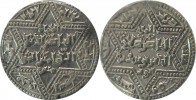
1701a, Saladin, 1169-1193AYYUBID: Saladin, 1169-1193, AR dirham (2.92g), Halab, AH580, A-788, lovely struck, well-centered & bold, Extremely Fine, Scarce.
His name in Arabic, in full, is SALAH AD-DIN YUSUF IBN AYYUB ("Righteousness of the Faith, Joseph, Son of Job"), also called AL-MALIK AN-NASIR SALAH AD-DIN YUSUF I (b. 1137/38, Tikrit, Mesopotamia--d. March 4, 1193, Damascus), Muslim sultan of Egypt, Syria, Yemen, and Palestine, founder of the Ayyubid dynasty, and the most famous of Muslim heroes.
In wars against the Christian crusaders, he achieved final success with the disciplined capture of Jerusalem (Oct. 2, 1187), ending its 88-year occupation by the Franks. The great Christian counterattack of the Third Crusade was then stalemated by Saladin's military genius.
Saladin was born into a prominent Kurdish family. On the night of his birth, his father, Najm ad-Din Ayyub, gathered his family and moved to Aleppo, there entering the service of 'Imad ad-Din Zangi ibn Aq Sonqur, the powerful Turkish governor in northern Syria. Growing up in Ba'lbek and Damascus, Saladin was apparently an undistinguished youth, with a greater taste for religious studies than military training.
His formal career began when he joined the staff of his uncle Asad ad-Din Shirkuh, an important military commander under the amir Nureddin, son and successor of Zangi. During three military expeditions led by Shirkuh into Egypt to prevent its falling to the Latin-Christian (Frankish) rulers of the states established by the First Crusade, a complex, three-way struggle developed between Amalric I, the Latin king of Jerusalem, Shawar, the powerful vizier of the Egyptian Fatimid caliph, and Shirkuh. After Shirkuh's death and after ordering Shawar's assassination, Saladin, in 1169 at the age of 31, was appointed both commander of the Syrian troops and vizier of Egypt.
His relatively quick rise to power must be attributed not only to the clannish nepotism of his Kurdish family but also to his own emerging talents. As vizier of Egypt, he received the title king (malik), although he was generally known as the sultan. Saladin's position was further enhanced when, in 1171, he abolished the Shi'i Fatimid caliphate, proclaimed a return to Sunnah in Egypt, and consequently became its sole ruler.
Although he remained for a time theoretically a vassal of Nureddin, that relationship ended with the Syrian emir's death in 1174. Using his rich agricultural possessions in Egypt as a financial base, Saladin soon moved into Syria with a small but strictly disciplined army to claim the regency on behalf of the young son of his former suzerain.
Soon, however, he abandoned this claim, and from 1174 until 1186 he zealously pursued a goal of uniting, under his own standard, all the Muslim territories of Syria, northern Mesopotamia, Palestine, and Egypt.
This he accomplished by skillful diplomacy backed when necessary by the swift and resolute use of military force. Gradually, his reputation grew as a generous and virtuous but firm ruler, devoid of pretense, licentiousness, and cruelty. In contrast to the bitter dissension and intense rivalry that had up to then hampered the Muslims in their resistance to the crusaders, Saladin's singleness of purpose induced them to rearm both physically and spiritually.
Saladin's every act was inspired by an intense and unwavering devotion to the idea of jihad ("holy war")-the Muslim equivalent of the Christian crusade. It was an essential part of his policy to encourage the growth and spread of Muslim religious institutions.
He courted its scholars and preachers, founded colleges and mosques for their use, and commissioned them to write edifying works especially on the jihad itself. Through moral regeneration, which was a genuine part of his own way of life, he tried to re-create in his own realm some of the same zeal and enthusiasm that had proved so valuable to the first generations of Muslims when, five centuries before, they had conquered half the known world.
Saladin also succeeded in turning the military balance of power in his favour-more by uniting and disciplining a great number of unruly forces than by employing new or improved military techniques. When at last, in 1187, he was able to throw his full strength into the struggle with the Latin crusader kingdoms, his armies were their equals. On July 4, 1187, aided by his own military good sense and by a phenomenal lack of it on the part of his enemy, Saladin trapped and destroyed in one blow an exhausted and thirst-crazed army of crusaders at Hattin, near Tiberias in northern Palestine.
So great were the losses in the ranks of the crusaders in this one battle that the Muslims were quickly able to overrun nearly the entire Kingdom of Jerusalem. Acre, Toron, Beirut, Sidon, Nazareth, Caesarea, Nabulus, Jaffa (Yafo), and Ascalon (Ashqelon) fell within three months.
But Saladin's crowning achievement and the most disastrous blow to the whole crusading movement came on Oct. 2, 1187, when Jerusalem, holy to both Muslim and Christian alike, surrendered to the Sultan's army after 88 years in the hands of the Franks. In stark contrast to the city's conquest by the Christians, when blood flowed freely during the barbaric slaughter of its inhabitants, the Muslim reconquest was marked by the civilized and courteous behaviour of Saladin and his troops. His sudden success, which in 1189 saw the crusaders reduced to the occupation of only three cities, was, however, marred by his failure to capture Tyre, an almost impregnable coastal fortress to which the scattered Christian survivors of the recent battles flocked. It was to be the rallying point of the Latin counterattack.
Most probably, Saladin did not anticipate the European reaction to his capture of Jerusalem, an event that deeply shocked the West and to which it responded with a new call for a crusade. In addition to many great nobles and famous knights, this crusade, the third, brought the kings of three countries into the struggle.
The magnitude of the Christian effort and the lasting impression it made on contemporaries gave the name of Saladin, as their gallant and chivalrous enemy, an added lustre that his military victories alone could never confer on him.
The Crusade itself was long and exhausting, and, despite the obvious, though at times impulsive, military genius of Richard I the Lion-Heart, it achieved almost nothing. Therein lies the greatest-but often unrecognized--achievement of Saladin. With tired and unwilling feudal levies, committed to fight only a limited season each year, his indomitable will enabled him to fight the greatest champions of Christendom to a draw. The crusaders retained little more than a precarious foothold on the Levantine coast, and when King Richard set sail from the Orient in October 1192, the battle was over.
Saladin withdrew to his capital at Damascus. Soon, the long campaigning seasons and the endless hours in the saddle caught up with him, and he died. While his relatives were already scrambling for pieces of the empire, his friends found that the most powerful and most generous ruler in the Muslim world had not left enough money to pay for his own grave.
BIBLIOGRAPHY
H.A.R. Gibb, "The Arabic Sources for the Life of Saladin," Speculum, 25:58-72 (1950). C.W. Wilson's English translation of one of the most important Arabic works, The Life of Saladin (1897), was reprinted in 1971. The best biography to date is Stanley Lane-Poole, Saladin and the Fall of the Kingdom of Jerusalem, new ed. (1926, reprinted 1964), although it does not take account of all the sources.Cleisthenes01/08/10 at 15:56Noah: very cool
|
|
|

[1616b] Heraclius, 5 Oct 610 - 11 Jan 641 A.D.BYZANTINE EMPIRE. Heraclius AD 610-641. AE.Follis. Ref:Sear 833; 12.91g. VF; Nicomedia mint. Obverse: Facing bust of Heracliu, holding cross in right hand. Reverse: Incial letter M, ANNO to left, II to right ( Year 2 AD 611/612), officia letter A betweem limbs of M, above cross; mint-signature NIKO in exergue . Very fine, earthern deposit in fields-not as yellow as picture suggest. Ex Pavlos S Pavlou.
De Imperatoribus Romanis
An Online Encyclopedia of Roman Emperors
Heraclius (October 5, 610 - February 641 A.D.)
R. Scott Moore
Indiana University of Pennsylvania
Accession
The last years of Phocas' reign were troubled ones with many foreign threats, such as the Slavic incursions, and internal threats, such as violent religious conflicts and even unsuccessful rebellions. In 608, the exarch of Carthage revolted and dispatched a fleet under the command of his son, Heraclius, to Constantinople. Along the way, in Egypt, Heraclius joined forces with his cousin Nicetas who was able to capture Cyrenaica and Egypt from Phocas' general Bonosos. Heraclius' fleet continued on to Constantinople where he entered into secret negotiations with one of Phocas' top military leaders, Priscus. He was married to Phocas' daughter Domentzia. With the support of Priscus, the patriarch Sergius I, and the faction of the Greens, Heraclius was able to seize the city, have Phocas beheaded and became emperor on October 5, 610 AD.
Private Life
Heraclius, the son of the exarch of Carthage, Heraclius, and Epiphania was born around the year 575. When he was crowned as emperor in 610 AD, he married Fabia, who then took the name Eudocia. From this marriage, Heraclius had a daughter, Eudocia, and a son Heraclius Constantine, who was proclaimed as co-emperor in 613. Suffering from epilepsy, Fabia died in 612 and Heraclius married his niece Martina in 613. With Martina, Heraclius had nine children of which four died in infancy. Heraclius' marriage to Martina was never received favorably by either the people of Constantinople or the Church.
Foreign Affairs
When Heraclius first came to the throne in 610, the Byzantine Empire was being attacked from numerous sides. In the west, the Avars and Slavs were expanding into the northern Balkans. The Slavs controlled the Danube regions, Thrace, Macedonia, and were soon invading Central Greece and the Peloponnesus. In the east, meanwhile, the Persians under the rule of Chosroes had begun a series of successful attacks on the empire resulting in the loss of Damascus in 613, Jerusalem in 614 (destroying the Church of the Holy Sepulchre and capturing the Holy Cross) and Egypt in 619. Recognizing the difficulty in fighting on two opposing fronts at the same time, Heraclius signed a peace treaty with the Avars in 619, and focused on the eastern half of the empire. In the spring of 622, Heraclius left Constantinople for Asia Minor and began training his troops over the summer, focusing on a more involved role for the Byantine cavalry.
In the autumn, Heraclius' army invaded Armenia and soon won several victories over the Persians. The Avars, in the meantime, became restless and Heraclius was forced to renegotiate the peace treaty with them at a much higher tribute level. Heraclius then returned to the army and for the next several years unsuccessfully attempted to break through the Persian army and into Persia. In August of 626 while Heraclius and his army were in Lazica away from Constantinople, a Persian army attacked the city from the east while an army of Avars, Slavs, and Bulgars attacked from the west and from the sea. On August 10, the Byzantine navy was able to defeat the opposing fleet and then rout the combined Slav and Avar land force. With the defeat of their allies, the Persians retreated to Syria.
In the autumn of 627, Heraclius began to work his way into Persian territory winning an important battle in December at Nineveh during which most of the Persian army was destroyed. As Heraclius continued to move further into Persian territory, Chosroes was deposed and succeeded by his son Kavadh-Siroe whose first act was to secure a treaty with Heraclius. The treaty was very favorable to the Byzantines and returned all the former Byzantine territories to the empire. Within a few short months, Kavadh-Siroe fell ill and died after naming Heraclius as guardian of his son, Chosroes II. For all practical purposes, the Persian Empire no longer existed. In 630 Heraclius traveled to Jerusalem where he returned the Holy Cross to the city among much acclaim.
The defeat of the Persians created a larger problem for the Byzantine empire. The struggle between the Byzantines and the Persians had worn down both sides and the defeat of the Persians allowed the Arabs to quickly absorb what remained of the Persian empire. It also removed the buffer between the Arabs and the Byzantines allowing the two empires to come into contact and conflict. In 634 the Arab armies invaded Syria and defeated Theodore, the emperor's brother, in a string of battles. Heraclius raised a large army that attacked the Arabs near the Yarmuk, a tributary of the Jordan, in the fall of 636. After a successful beginning, the larger Byzantine army was defeated allowing the conquest of Syria. The Byzantine defeat also led to the Arabs quickly taking Mesopotamia, Armenia and eventually Egypt.
Internal Affairs
While Heraclius enjoyed military success, major changes occurred internally under his rule. Greek replaced Latin as the official language of the empire and Heraclius adopted the Greek title of in place of the Latin Caesar, Augustus, or Imperator. The recovery of the eastern areas of the Byzantine Empire from the Persians once again raised the problem of religious unity, centering around the understanding of the true nature of Christ. The eastern areas, particularly Armenia, Syria, and Egypt believed in monophysitism, Christ having one nature composed of both divine and human elements. The other areas of the empire followed the orthodox view expressed at the Council of Chalcedon in 451 that decreed Christ had two natures united in one person. In an effort to bridge the gap between the two views and bring them back together, the Patriarch of Constantinople, Sergius, promoted the concept of monoenergism which proposed that the two natures of Christ had one energy. While this was received favorably at first, monoenergism soon had vocal opponents, among them the monk Sophronius who became patriarch of Jerusalem in 634 AD. The opposition to monoenergism led Sergius to propose a new doctrine that of monotheletism, the belief in a single will in Christ. Heraclius supported the new doctrine of Sergius and put it forth in an edict known as the Ekthesis, and posted it in the narthex of Hagia Sophia in 638. This failed to settle the controversy as it was rejected by the Orthodox, the Monophysites, and even the Church of Rome.
Succession
During the last years of Heraclius' life, it became evident that a struggle was taking place between Heraclius' son from his first marriage, Heraclius Constantine, and his second wife Martina who was trying to position her son Heraclonas in line for the throne. On the 11th of February 641, Heraclius died and in his will left the empire to both Heraclius Constantine and Heraclonas to rule jointly with Martina as Empress and mother of both.
Copyright (C) 1997, R. Scott Moore. Published: De Imperatoribu Romanis, http://www.roman-emperors.org/heraclis.htm Used by permission.
Edited by J. P. Fitzgerald, Jr.
Cleisthenes01/08/10 at 15:55Noah: nice highlighting patina
|
|

Constantine the Great, early 307 - 22 May 337 A.D.AE 3: RIC VI 282, 312-313 AD, 3.3 g, 22 mm; London, EF; Obverse: IMP CONSTANTINVS P AVG, Laureate draped cuirassed bust right; Reverse: SOLI INV-IC-TO COMITI, Sol standing facing, right hand raised, globe in left hand, PLN in ex., star in left field; an attractive bronze with great detail. Ex Ancient Imports.
As I have noted elsewhere, I have chosen the date 395 AD, with the emperor Arcadius, to mark the beginning of the Byzantine Empire in my collection.
That said, it seems appropriate to display a couple of coins struck for the man whose decision made Byzantium possible. As historian John Julius Norwich has writen, “The Byzantine Empire, from its foundation by Constantine the Great on Monday, 11 May 330 to its conquest by the Ottoman Sultan Mehmet II on Tuesday, 29 May 1453, lasted for a total of 1,123 years and 18 days – a period of time comfortably longer than that which separates us from the Norman conquest of England in 1066. For everyone except astronomers and geologists, such a period must be considered a long time . . ." (Norwich, John Julius. A Short History of Byzantium. New York: Vintage Books, 1999. xxxvii).
Flavius Valerius Constantinus, Constantine the Great, is as controversial as he is "great."
From John Julius Norwich:
"The first thing to be said is that no ruler in all history--not Alexander nor Alfred, not Charles nor Catherine, not Fredrick nor even Gregory--has ever more fully merited his title of "the Great . . . [he has] a serious claim to be considered--excepting only Jesus Christ, the Prophet Mohammed and the Buddha--the most influential man who ever lived" (Norwich, John Julius. The Middle Sea: A History of the Mediterranean. New York: Doubleday, 2006. 50-1).
From Michael Grant:
". . . But he was also murderous, and the many whom he murdered, or executed, included not only his rival Licinius (to whom he had promised survival) but also his own eldest son and his own second wife Fausta. There is no excusing those deaths, at any time or in any society . . . There are, and remain, certain absolute standards, and by his death-dealing Constantine offended signally against them. . . It is a mocking travesty of justice to call such a murderer Constantine the Great . . . (Grant, Michael. The Emperor Constantine. London: Phoenix Press, 1998. 226).
J. P. Fitzgerald, Jr.
Cleisthenes01/08/10 at 15:55Noah: nice high relief strike & attractive patina
|
|

City of Constantinople Commemorative, 330 - 333 A.D.Bronze AE 3, RIC 63, VF, Constantinople, 2.524g, 18.5mm, 0o, 330 - 333 A.D.; Obverse: CONSTAN-TINOPOLI, Constantinopolis' helmeted bust left in imperial cloak and holding scepter across left shoulder; Reverse: Victory standing left, right foot on prow, scepter in right, resting left on grounded shield, CONSZ in exergue; nice style. Ex FORVM.
Constantinople Commemoratives minted by the actual city of Constantinople mint are much scarcer than those minted by other Eastern mints.
The village that was to become the site of Byzantium/Constantinople/Istambul was founded c. 658 B. C. by a Greek colony from Megara; the site was then occupied by the Thracian village of Lygos. The chief of the Megarian expedition was Byzas, after whom the city was naturally called Byzantion (Lat. Byzantium). Despite its perfect situation, the colony did not prosper at first; it suffered much during the Medic wars, chiefly from the satraps of Darius and Xerxes. Later on, its control was disputed by Lacedæmonians and Athenians; for two years (341-339 B. C.) it held out against Philip of Macedon. It succeeded in maintaining its independence even against victorious Rome, was granted the title and rights of an allied city, and its ambassadors were accorded at Rome the same honours as those given to allied kings; it enjoyed, moreover, all transit duties on the Bosporus. Cicero defended it in the Roman Senate, and put an end to the exactions of Piso.
The city continued prosperous to the reign of Septimius Severus, when it sided with his rival, Pescennius Niger. After a siege of three years (193-196) Severus razed to the ground its walls and public monuments, and made it subject to Perinthus or Heraclea in Thrace. But he soon forgave this resistance, restored its former privileges, built there the baths of Zeuxippus, and began the hippodrome. It was devastated again by the soldiers of Gallienus in 262, but was rebuilt almost at once. In the long war between Constantine and Licinius (314-323) it embraced the fortunes of the latter, but, after his defeat at Chrysopolis (Scutari), submitted to the victor.
Constantine had chosen this city as the new capital of the Roman Empire, but owing to his wars and the needs of the State, he rarely resided there.
(The Catholic Encyclopedia, Volume IV; Copyright © 1908 by Robert Appleton Company;Online Edition Copyright © 2003 by K. Knight).
Edited by J. P. Fitzgerald, Jr.Cleisthenes01/08/10 at 15:54Noah: splendid portrait
|
|

1502h, Valens, 364-378 A.D. (Heraclea)Valens, 364-378 A.D., Heraclea mint, VF, Chi-Rho standard reverse.
De Imperatoribus Romanis, An Online Encyclopedia of the Roman Emperors and their Families
Valens (365-369 AD.)
Noel Linski, University of Colorado
Valens was the brother of Valentinian I. On March 28, 364, precisely one month after his accession by Roman reckoning, Valentinian appointed his brother Flavius Valens co-emperor at the Hebdomon, the first in a long line of emperors proclaimed there. Themistius was present and later recounted the occasion in his Or. 6. After only two months of co-rulership, the two departed from Constantinople for their native Illyricum. Outside Naissus, in Moesia, they divided their administrative staff between them and at Sirmium they did the same with their mobile forces. Valens was to rule the east, from Thrace in the North and Cyrenaica in the South eastward to the Persian frontier. Valentinian ruled the west. They did not spend long in Sirmium. By late August 365 Valentinian had moved on toward Milan, where he resided for the following year before moving on to Trier, which remained his capital until 375. Similarly, Valens was back in Constantinople by December 364.and he was declared Augustus in 364 A.D. He was given command of the Eastern provinces, where he spent much of his time campaigning against the Goths and Persians.
In 376 A.D., Valens allowed Gothic tribes, who were being driven forward by the Huns to settle in the Danube provinces. The Goths were so badly treated by the Romans that they rebelled. Valens marched against the confederated barbarian army, and on August 9, 378, the two forces met at Adrianople. Although negotiations were attempted, these broke down when a Roman unit sallied forth and carried both sides into battle. The Romans held their own early on but were crushed by the surprise arrival of Greuthungi cavalry which split their ranks.
In one historical account, Valens was wounded in battle but escaped to a nearby farmstead where he was burned to death in a tower by Gothic marauders. The fourth century A.D. Roman historian Ammianus Marcellinus does not seem to concur with this story. Regardless, when the battle was over Valens' body was never recovered, 10,000 roman soldiers lay dead and the perception of Roman military invincibility had been destroyed.
Adrianople was the most significant event in Valens' career. Though he displayed some talent as an administrator, Valens' persecutions of Nicene Christians and pagan philosophers, his halting efforts at military achievement and his obtuse personality rendered him a less than glorious emperor. To have died in so inglorious a battle has thus come to be regarded as the nadir of an unfortunate career. This is especially true because of the profound consequences of Valens' defeat.
Adrianople spelled the beginning of the end for Roman territorial integrity in the late empire and this fact was recognized even by contemporaries. The Roman historian Ammianus (325-391 AD) understood that it was the worst defeat in Roman history since Cannae. Rufinus (340–410 CE), monk, historian, and theologian; called it "the beginning of evils for the Roman empire then and thereafter."
Noel Lenski, University of Colorado
Published: De Imperatoribus Romanis: An Online Encyclopedia of Roman Rulers and their Families http://www.roman-emperors.org/startup.htm. Used by permission.
Edited by J. P. Fitzgerald, Jr. Cleisthenes01/08/10 at 15:53Noah: bold portrait
|
|

1501s, Valentinian I, 25 February 364 - 17 November 375 A.D. (Siscia)Valentinian I, 25 February 364 - 17 November 375 A.D., Bronze AE 3, S 4103, VF, Siscia mint, 2.012g, 18.7mm, 180o, 24 Aug 367 - 17 Nov 375 A.D.obverse D N VALENTINI-ANVS P F AVG, pearl-diademed, draped and cuirassed bust right; reverse SECVRITAS - REIPVBLICAE, Victory advancing left, wreath in right and palm in left, symbols in fields, mintmark in exergue.
De Imperatoribus Romanis, An Online Encyclopedia of the Roman Emperors and their Families
Valentinian I (364-375 AD.)
Walter E. Roberts, Emory University
Valentinian was one of Rome's last great warrior emperors. Flavius Valentinianus, was born in A.D. 321 at Cibalis (modern Vinkovci) in southern Pannonia. His father Gratian was a soldier renowned for his strength and wrestling skills. Gratian had an illustrious career in the army, rising from staff officer to tribune, to comes Africae, and finally [i/comes Britanniae.
The emperor Jovian died on 17 February 364, apparently of natural causes, on the border between Bithynia and Galatia. The army marched on to Nicaea, the nearest city of any consequence, and a meeting of civil and military officials was convened to choose a new emperor. The assembly finally agreed upon Valentinian.
On 26 February 364, Valentinian accepted the office offered to him. As he prepared to make his accession speech, the soldiers threatened to riot, apparently uncertain as to where his loyalties lay. Valentinian reassured them that the army was his greatest priority. Furthermore, to prevent a crisis of succession if he should die prematurely, he agreed to pick a co-Augustus. According to Ammianus, the soldiers were astounded by Valentinian’s bold demeanor and his willingness to assume the imperial authority. His decision to elect a fellow-emperor could also be construed as a move to appease any opposition among the civilian officials in the eastern portion of the empire. By agreeing to appoint a co-ruler, he assured the eastern officials that someone with imperial authority would remain in the east to protect their interests. After promoting his brother Valens to the rank of tribune and putting him in charge of the royal stables on March 1, Valentinian selected Valens as co-Augustus at Constantinople on 28 March 364, though this was done over the objections of Dagalaifus. Ammianus makes it clear, however, that Valens was clearly subordinate to his brother.
Ammianus and Zosimus as well as modern scholars praise Valentinian for his military accomplishments. He is generally credited with keeping the Roman empire from crumbling away by “. . . reversing the generally waning confidence in the army and imperial defense . . ..” Several other aspects of Valentinian's reign also set the course of Roman history for the next century.
Valentinian deliberately polarized Roman society, subordinating the civilian population to the military. The military order took over the old prestige of the senatorial nobility. The imperial court, which was becoming more and more of a military court, became a vehicle for social mobility. There were new ideas of nobility, which was increasingly provincial in character. By this it is meant that the imperial court, not the Senate, was the seat of nobility, and most of these new nobles came from the provinces. With the erosion of the old nobility, the stage was set for the ascendancy of Christianity. Ammianus makes it clear that actions such as these were part of a systematic plan by Valentinian to erode the power and prestige of the senatorial aristocracy. Several pieces of extant legislation seem to confirm Ammianus’ allegations that Valentinian was eroding senatorial prestige.
Valentinian's reign affords valuable insights into late Roman society, civilian as well as military. First, there was a growing fracture between the eastern and western portions of the empire. Valentinian was the last emperor to really concentrate his resources on the west. Valens was clearly in an inferior position in the partnership. Second, there was a growing polarization of society, both Christian versus pagan, and civil versus military. Finally there was a growing regionalism in the west, driven by heavy taxation and the inability of Valentinian to fully exercise military authority in all areas of the west. All of these trends would continue over the next century, profoundly reshaping the Roman empire and western Europe.
By Walter E. Roberts, Emory University
Published: De Imperatoribus Romanis: An Online Encyclopedia of Roman Rulers and their Families http://www.roman-emperors.org/startup.htm. Used by permission.
Edited by J. P. Fitzgerald, Jr.Cleisthenes01/08/10 at 15:53Noah: very good detail for this type
|
|
1409a, Julian II "the Philosopher," February 360 - 26 June 363 A.D.Julian II, A.D. 360-363; RIC 167; VF; 2.7g, 20mm; Constantinople mint; Obverse: DN FL CL IVLIANVS P F AVG, helmeted & cuirassed bust right, holding spear & shield; Reverse: VOT X MVLT XX in four lines within wreath; CONSPB in exergue; Attractive green patina. Ex Nemesis.
De Imperatoribus Romanis,
An Online Encyclopedia of Roman Emperors
Julian the Apostate (360-363 A.D.)
Walter E. Roberts, Emory University
Michael DiMaio, Jr., Salve Regina University
Introduction
The emperor Flavius Claudius Julianus reigned from 360 to 26 June 363, when he was killed fighting against the Persians. Despite his short rule, his emperorship was pivotal in the development of the history of the later Roman empire. This essay is not meant to be a comprehensive look at the various issues central to the reign of Julian and the history of the later empire. Rather, this short work is meant to be a brief history and introduction for the general reader. Julian was the last direct descendent of the Constantinian line to ascend to the purple, and it is one of history's great ironies that he was the last non-Christian emperor. As such, he has been vilified by most Christian sources, beginning with John Chrysostom and Gregory Nazianzus in the later fourth century. This tradition was picked up by the fifth century Eusebian continuators Sozomen, Socrates Scholasticus, and Theodoret and passed on to scholars down through the 20th century. Most contemporary sources, however, paint a much more balanced picture of Julian and his reign. The adoption of Christianity by emperors and society, while still a vital concern, was but one of several issues that concerned Julian.
It is fortunate that extensive writings from Julian himself exist, which help interpret his reign in the light of contemporary evidence. Still extant are some letters, several panegyrics, and a few satires. Other contemporary sources include the soldier Ammianus Marcellinus' history, correspondence between Julian and Libanius of Antioch, several panegyrics, laws from the Theodosian Code, inscriptions, and coinage. These sources show Julian's emphasis on restoration. He saw himself as the restorer of the traditional values of Roman society. Of course much of this was rhetoric, meant to defend Julian against charges that he was a usurper. At the same time this theme of restoration was central to all emperors of the fourth century. Julian thought that he was the one emperor who could regain what was viewed as the lost glory of the Roman empire. To achieve this goal he courted select groups of social elites to get across his message of restoration. This was the way that emperors functioned in the fourth century. By choosing whom to include in the sharing of power, they sought to shape society.
Early Life
Julian was born at Constantinople in 331. His father was Julius Constantius, half-brother of the emperor Constantine through Constantius Chlorus, and his mother was Basilina, Julius' second wife. Julian had two half-brothers via Julius' first marriage. One of these was Gallus, who played a major role in Julian's life. Julian appeared destined for a bright future via his father's connection to the Constantinian house. After many years of tense relations with his three half-brothers, Constantine seemed to have welcomed them into the fold of the imperial family. From 333 to 335, Constantine conferred a series of honors upon his three half-siblings, including appointing Julius Constantius as one of the consuls for 335. Julian's mother was equally distinguished. Ammianus related that she was from a noble family. This is supported by Libanius, who claimed that she was the daughter of Julius Julianus, a Praetorian Prefect under Licinius, who was such a model of administrative virtue that he was pardoned and honored by Constantine.
Despite the fact that his mother died shortly after giving birth to him, Julian experienced an idyllic early childhood. This ended when Constantius II conducted a purge of many of his relatives shortly after Constantine's death in 337, particularly targeting the families of Constantine's half-brothers. ulian and Gallus were spared, probably due to their young age. Julian was put under the care of Mardonius, a Scythian eunuch who had tutored his mother, in 339, and was raised in the Greek philosophical tradition, and probably lived in Nicomedia. Ammianus also supplied the fact that while in Nicomedia, Julian was cared for by the local bishop Eusebius, of whom the future emperor was a distant relation. Julian was educated by some of the most famous names in grammar and rhetoric in the Greek world at that time, including Nicocles and Hecebolius. In 344 Constantius II sent Julian and Gallus to Macellum in Cappadocia, where they remained for six years. In 351, Gallus was made Caesar by Constantius II and Julian was allowed to return to Nicomedia, where he studied under Aedesius, Eusebius, and Chrysanthius, all famed philosophers, and was exposed to the Neo-Platonism that would become such a prominent part of his life. But Julian was most proud of the time he spent studying under Maximus of Ephesus, a noted Neo-Platonic philospher and theurgist. It was Maximus who completed Julian's full-scale conversion to Neo-Platonism. Later, when he was Caesar, Julian told of how he put letters from this philosopher under his pillows so that he would continue to absorb wisdom while he slept, and while campaigning on the Rhine, he sent his speeches to Maximus for approval before letting others hear them. When Gallus was executed in 354 for treason by Constantius II, Julian was summoned to Italy and essentially kept under house arrest at Comum, near Milan, for seven months before Constantius' wife Eusebia convinced the emperor that Julian posed no threat. This allowed Julian to return to Greece and continue his life as a scholar where he studied under the Neo-Platonist Priscus. Julian's life of scholarly pursuit, however, ended abruptly when he was summoned to the imperial court and made Caesar by Constantius II on 6 November 355.
Julian as Caesar
Constantius II realized an essential truth of the empire that had been evident since the time of the Tetrarchy--the empire was too big to be ruled effectively by one man. Julian was pressed into service as Caesar, or subordinate emperor, because an imperial presence was needed in the west, in particular in the Gallic provinces. Julian, due to the emperor's earlier purges, was the only viable candidate of the imperial family left who could act as Caesar. Constantius enjoined Julian with the task of restoring order along the Rhine frontier. A few days after he was made Caesar, Julian was married to Constantius' sister Helena in order to cement the alliance between the two men. On 1 December 355, Julian journeyed north, and in Augusta Taurinorum he learned that Alamannic raiders had destroyed Colonia Agrippina. He then proceeded to Vienne where he spent the winter. At Vienne, he learned that Augustudunum was also under siege, but was being held by a veteran garrison. He made this his first priority, and arrived there on 24 June 356. When he had assured himself that the city was in no immediate danger, he journeyed to Augusta Treverorum via Autessioduram, and from there to Durocortorum where he rendezvoused with his army. Julian had the army stage a series of punitive strikes around the Dieuse region, and then he moved them towards the Argentoratum/Mongontiacum region when word of barbarian incursions reached him.
From there, Julian moved on to Colonia Agrippina, and negotiated a peace with the local barbarian leaders who had assaulted the city. He then wintered at Senonae. He spent the early part of the campaigning season of 357 fighting off besiegers at Senonae, and then conducting operations around Lugdunum and Tres Tabernae. Later that summer, he encountered his watershed moment as a military general. Ammianus went into great detail about Julian's victory over seven rogue Alamannic chieftains near Argentoratum, and Julian himself bragged about it in his later writing. After this battle, the soldiers acclaimed Julian Augustus, but he rejected this title. After mounting a series of follow-up raids into Alamannic territory, he retired to winter quarters at Lutetia, and on the way defeated some Frankish raiders in the Mosa region. Julian considered this campaign one of the major events of his time as Caesar.
Julian began his 358 military campaigns early, hoping to catch the barbarians by surprise. His first target was the Franks in the northern Rhine region. He then proceeded to restore some forts in the Mosa region, but his soldiers threatened to mutiny because they were on short rations and had not been paid their donative since Julian had become Caesar. After he soothed his soldiers, Julian spent the rest of the summer negotiating a peace with various Alamannic leaders in the mid and lower Rhine areas, and retired to winter quarters at Lutetia. In 359, he prepared once again to carry out a series of punitive expeditions against the Alamanni in the Rhine region who were still hostile to the Roman presence. In preparation, the Caesar repopulated seven previously destroyed cities and set them up as supply bases and staging areas. This was done with the help of the people with whom Julian had negotiated a peace the year before. Julian then had a detachment of lightly armed soldiers cross the Rhine near Mogontiacum and conduct a guerilla strike against several chieftains. As a result of these campaigns, Julian was able to negotiate a peace with all but a handful of the Alamannic leaders, and he retired to winter quarters at Lutetia.
Of course, Julian did more than act as a general during his time as Caesar. According to Ammianus, Julian was an able administrator who took steps to correct the injustices of Constantius' appointees. Ammianus related the story of how Julian prevented Florentius, the Praetorian Prefect of Gaul, from raising taxes, and also how Julian actually took over as governor for the province of Belgica Secunda. Hilary, bishop of Poitiers, supported Ammianus' basic assessment of Julian in this regard when he reported that Julian was an able representative of the emperor to the Gallic provincials. There is also epigraphic evidence to support Julian's popularity amongst the provincial elites. An inscription found near Beneventum in Apulia reads:
"To Flavius Claudius Julianus, most noble and sanctified Caesar, from the caring Tocius Maximus, vir clarissimus, for the care of the res publica from Beneventum".
Tocius Maximus, as a vir clarissimus, was at the highest point in the social spectrum and was a leader in his local community. This inscription shows that Julian was successful in establishing a positive image amongst provincial elites while he was Caesar.
Julian Augustus
In early 360, Constantius, driven by jealousy of Julian's success, stripped Julian of many troops and officers, ostensibly because the emperor needed them for his upcoming campaign against the Persians. One of the legions ordered east, the Petulantes, did not want to leave Gaul because the majority of the soldiers in the unit were from this region. As a result they mutinied and hailed Julian as Augustus at Lutetia. Julian refused this acclamation as he had done at Argentoratum earlier, but the soldiers would have none of his denial. They raised him on a shield and adorned him with a neck chain, which had formerly been the possession of the standard-bearer of the Petulantes and symbolized a royal diadem. Julian appeared reluctantly to acquiesce to their wishes, and promised a generous donative. The exact date of his acclamation is unknown, but most scholars put it in February or March. Julian himself supported Ammianus' picture of a jealous Constantius. In his Letter to the Athenians, a document constructed to answer charges that he was a usurper, Julian stated that from the start he, as Caesar, had been meant as a figurehead to the soldiers and provincials. The real power he claimed lay with the generals and officials already present in Gaul. In fact, according to Julian, the generals were charged with watching him as much as the enemy. His account of the actual acclamation closely followed what Ammianus told us, but he stressed even more his reluctance to take power. Julian claimed that he did so only after praying to Zeus for guidance.
Fearing the reaction of Constantius, Julian sent a letter to his fellow emperor justifying the events at Lutetia and trying to arrange a peaceful solution. This letter berated Constantius for forcing the troops in Gaul into an untenable situation. Ammianus stated that Julian's letter blamed Constantius' decision to transfer Gallic legions east as the reason for the soldiers' rebellion. Julian once again asserted that he was an unwilling participant who was only following the desire of the soldiers. In both of these basic accounts Ammianus and Julian are playing upon the theme of restoration. Implicit in their version of Julian's acclamation is the argument that Constantius was unfit to rule. The soldiers were the vehicle of the gods' will. The Letter to the Athenians is full of references to the fact that Julian was assuming the mantle of Augustus at the instigation of the gods. Ammianus summed up this position nicely when he related the story of how, when Julian was agonizing over whether to accept the soldiers' acclamation, he had a dream in which he was visited by the Genius (guardian spirit) of the Roman state. The Genius told Julian that it had often tried to bestow high honors upon Julian but had been rebuffed. Now, the Genius went on to say, was Julian's final chance to take the power that was rightfully his. If the Caesar refused this chance, the Genius would depart forever, and both Julian and the state would rue Julian's rejection. Julian himself wrote a letter to his friend Maximus of Ephesus in November of 361 detailing his thoughts on his proclamation. In this letter, Julian stated that the soldiers proclaimed him Augustus against his will. Julian, however, defended his accession, saying that the gods willed it and that he had treated his enemies with clemency and justice. He went on to say that he led the troops in propitiating the traditional deities, because the gods commanded him to return to the traditional rites, and would reward him if he fulfilled this duty.
During 360 an uneasy peace simmered between the two emperors. Julian spent the 360 campaigning season continuing his efforts to restore order along the Rhine, while Constantius continued operations against the Persians. Julian wintered in Vienne, and celebrated his Quinquennalia. It was at this time that his wife Helena died, and he sent her remains to Rome for a proper burial at his family villa on the Via Nomentana where the body of her sister was entombed. The uneasy peace held through the summer of 361, but Julian concentrated his military operations around harassing the Alamannic chieftain Vadomarius and his allies, who had concluded a peace treaty with Constantius some years earlier. By the end of the summer, Julian decided to put an end to the waiting and gathered his army to march east against Constantius. The empire teetered on the brink of another civil war. Constantius had spent the summer negotiating with the Persians and making preparations for possible military action against his cousin. When he was assured that the Persians would not attack, he summoned his army and sallied forth to meet Julian. As the armies drew inexorably closer to one another, the empire was saved from another bloody civil war when Constantius died unexpectedly of natural causes on 3 November near the town of Mopsucrenae in Cilicia, naming Julian -- the sources say-- as his legitimate successor.
Julian was in Dacia when he learned of his cousin's death. He made his way through Thrace and came to Constantinople on 11 December 361 where Julian honored the emperor with the funeral rites appropriate for a man of his station. Julian immediately set about putting his supporters in positions of power and trimming the imperial bureaucracy, which had become extremely overstaffed during Constantius' reign. Cooks and barbers had increased during the late emperor's reign and Julian expelled them from his court. Ammianus gave a mixed assessment of how the new emperor handled the followers of Constantius. Traditionally, emperors were supposed to show clemency to the supporters of a defeated enemy. Julian, however, gave some men over to death to appease the army. Ammianus used the case of Ursulus, Constantius' comes sacrum largitionum, to illustrate his point. Ursulus had actually tried to acquire money for the Gallic troops when Julian had first been appointed Caesar, but he had also made a disparaging remark about the ineffectiveness of the army after the battle of Amida. The soldiers remembered this, and when Julian became sole Augustus, they demanded Ursulus' head. Julian obliged, much to the disapproval of Ammianus. This seems to be a case of Julian courting the favor of the military leadership, and is indicative of a pattern in which Julian courted the goodwill of various societal elites to legitimize his position as emperor.
Another case in point is the officials who made up the imperial bureaucracy. Many of them were subjected to trial and punishment. To achieve this goal, during the last weeks of December 361 Julian assembled a military tribunal at Chalcedon, empanelling six judges to try the cases. The president of the tribunal was Salutius, just promoted to the rank of Praetorian Prefect; the five other members were Mamertinus, the orator, and four general officers: Jovinus, Agilo, Nevitta, and Arbetio. Relative to the proceedings of the tribunal, Ammianus noted that the judges, " . . . oversaw the cases more vehemently than was right or fair, with the exception of a few . . .." Ammianus' account of Julian's attempt at reform of the imperial bureaucracy is supported by legal evidence from the Theodosian Code. A series of laws sent to Mamertinus, Julian's appointee as Praetorian Prefect in Italy, Illyricum, and Africa, illustrate this point nicely. On 6 June 362, Mamertinus received a law that prohibited provincial governors from bypassing the Vicars when giving their reports to the Prefect. Traditionally, Vicars were given civil authority over a group of provinces, and were in theory meant to serve as a middle step between governors and Prefects. This law suggests that the Vicars were being left out, at least in Illyricum. Julian issued another edict to Mamertinus on 22 February 362 to stop abuse of the public post by governors. According to this law, only Mamertinus could issue post warrants, but the Vicars were given twelve blank warrants to be used as they saw fit, and each governor was given two. Continuing the trend of bureaucratic reform, Julian also imposed penalties on governors who purposefully delayed appeals in court cases they had heard. The emperor also established a new official to weigh solidi used in official government transactions to combat coin clipping.
For Julian, reigning in the abuses of imperial bureaucrats was one step in restoring the prestige of the office of emperor. Because he could not affect all elements of society personally, Julian, like other Neo-Flavian emperors, decided to concentrate on select groups of societal elites as intercessors between himself and the general populace. One of these groups was the imperial bureaucracy. Julian made it very clear that imperial officials were intercessors in a very real sense in a letter to Alypius, Vicar of Britain. In this letter, sent from Gaul sometime before 361, the emperor praises Alypius for his use of "mildness and moderation with courage and force" in his rule of the provincials. Such virtues were characteristic of the emperors, and it was good that Alypius is representing Julian in this way. Julian courted the army because it put him in power. Another group he sought to include in his rule was the traditional Senatorial aristocracy. One of his first appointments as consul was Claudius Mamertinus, a Gallic Senator and rhetorician. Mamertinus' speech in praise of Julian delivered at Constantinople in January of 362 is preserved. In this speech, Claudius presented his consular selection as inaugurating a new golden age and Julian as the restorer of the empire founded by Augustus. The image Mamertinus gave of his own consulate inaugurating a new golden age is not merely formulaic. The comparison of Julian to Augustus has very real, if implicit, relevance to Claudius' situation. Claudius emphasized the imperial period as the true age of renewal. Augustus ushered in a new era with his formation of a partnership between the emperor and the Senate based upon a series of honors and offices bestowed upon the Senate in return for their role as intercessor between emperor and populace. It was this system that Julian was restoring, and the consulate was one concrete example of this bond. To be chosen as a consul by the emperor, who himself had been divinely mandated, was a divine honor. In addition to being named consul, Mamertinus went on to hold several offices under Julian, including the Prefecture of Italy, Illyricum, and Africa. Similarly, inscriptional evidence illustrates a link between municipal elites and Julian during his time as Caesar, something which continued after he became emperor. One concrete example comes from the municipal senate of Aceruntia in Apulia, which established a monument on which Julian is styled as "Repairer of the World."
Julian seems to have given up actual Christian belief before his acclamation as emperor and was a practitioner of more traditional Greco-Roman religious beliefs, in particular, a follower of certain late antique Platonist philosophers who were especially adept at theurgy as was noted earlier. In fact Julian himself spoke of his conversion to Neo-Platonism in a letter to the Alexandrians written in 363. He stated that he had abandoned Christianity when he was twenty years old and been an adherent of the traditional Greco-Roman deities for the twelve years prior to writing this letter.
(For the complete text of this article see: http://www.roman-emperors.org/julian.htm)
Julian’s Persian Campaign
The exact goals Julian had for his ill-fated Persian campaign were never clear. The Sassanid Persians, and before them the Parthians, had been a traditional enemy from the time of the Late Republic, and indeed Constantius had been conducting a war against them before Julian's accession forced the former to forge an uneasy peace. Julian, however, had no concrete reason to reopen hostilities in the east. Socrates Scholasticus attributed Julian's motives to imitation of Alexander the Great, but perhaps the real reason lay in his need to gather the support of the army. Despite his acclamation by the Gallic legions, relations between Julian and the top military officers was uneasy at best. A war against the Persians would have brought prestige and power both to Julian and the army.
Julian set out on his fateful campaign on 5 March 363. Using his trademark strategy of striking quickly and where least expected, he moved his army through Heirapolis and from there speedily across the Euphrates and into the province of Mesopotamia, where he stopped at the town of Batnae. His plan was to eventually return through Armenia and winter in Tarsus. Once in Mesopotamia, Julian was faced with the decision of whether to travel south through the province of Babylonia or cross the Tigris into Assyria, and he eventually decided to move south through Babylonia and turn west into Assyria at a later date. By 27 March, he had the bulk of his army across the Euphrates, and had also arranged a flotilla to guard his supply line along the mighty river. He then left his generals Procopius and Sebastianus to help Arsacius, the king of Armenia and a Roman client, to guard the northern Tigris line. It was also during this time that he received the surrender of many prominent local leaders who had nominally supported the Persians. These men supplied Julian with money and troops for further military action against their former masters. Julian decided to turn south into Babylonia and proceeded along the Euphrates, coming to the fortress of Cercusium at the junction of the Abora and Euphrates Rivers around the first of April, and from there he took his army west to a region called Zaitha near the abandoned town of Dura where they visited the tomb of the emperor Gordian which was in the area. On April 7 he set out from there into the heart of Babylonia and towards Assyria.
Ammianus then stated that Julian and his army crossed into Assyria, which on the face of things appears very confusing. Julian still seems to be operating within the province of Babylonia between the Tigris and Euphrates rivers. The confusion is alleviated when one realizes that,for Ammianus, the region of Assyria encompassed the provinces of Babylonia and Assyria. On their march, Julian's forces took the fortress of Anatha, received the surrender and support of several more local princes, and ravaged the countryside of Assyria between the rivers. As the army continued south, they came across the fortresses Thilutha and Achaiachala, but these places were too well defended and Julian decided to leave them alone. Further south were the cities Diacira and Ozogardana, which the Roman forces sacked and burned. Soon, Julian came to Pirisabora and a brief siege ensued, but the city fell and was also looted and destroyed. It was also at this time that the Roman army met its first systematic resistance from the Persians. As the Romans penetrated further south and west, the local inhabitants began to flood their route. Nevertheless, the Roman forces pressed on and came to Maiozamalcha, a sizable city not far from Ctesiphon. After a short siege, this city too fell to Julian. Inexorably, Julian's forces zeroed in on Ctesiphon, but as they drew closer, the Persian resistance grew fiercer, with guerilla raids whittling at Julian's men and supplies. A sizable force of the army was lost and the emperor himself was almost killed taking a fort a few miles from the target city.
Finally, the army approached Ctesiphon following a canal that linked the Tigris and Euphrates. It soon became apparent after a few preliminary skirmishes that a protracted siege would be necessary to take this important city. Many of his generals, however, thought that pursuing this course of action would be foolish. Julian reluctantly agreed, but became enraged by this failure and ordered his fleet to be burned as he decided to march through the province of Assyria. Julian had planned for his army to live off the land, but the Persians employed a scorched-earth policy. When it became apparent that his army would perish (because his supplies were beginning to dwindle) from starvation and the heat if he continued his campaign, and also in the face of superior numbers of the enemy, Julian ordered a retreat on 16 June. As the Roman army retreated, they were constantly harassed by guerilla strikes. It was during one of these raids that Julian got caught up in the fighting and took a spear to his abdomen. Mortally wounded he was carried to his tent, where, after conferring with some of his officers, he died. The date was 26 June 363.
Conclusion
Thus an ignominious end for a man came about who had hoped to restore the glory of the Roman empire during his reign as emperor. Due to his intense hatred of Christianity, the opinion of posterity has not been kind to Julian. The contemporary opinion, however, was overall positive. The evidence shows that Julian was a complex ruler with a definite agenda to use traditional social institutions in order to revive what he saw as a collapsing empire. In the final assessment, he was not so different from any of the other emperors of the fourth century. He was a man grasping desperately to hang on to a Greco-Roman conception of leadership that was undergoing a subtle yet profound change.
Copyright (C) 2002, Walter E. Roberts and Michael DiMaio, Jr. Used by permission.
In reality, Julian worked to promote culture and philosophy in any manifestation. He tried to reduce taxes and the public debts of municipalities; he augmented administrative decentralisation; he promoted a campaign of austerity to reduce public expenditure (setting himself as the example). He reformed the postal service and eliminated the powerful secret police.
by Federico Morando; JULIAN II, The Apostate, See the Julian II Page on NumisWiki
Flavius Claudius Iulianus was born in 331 or maybe 332 A.D. in Constantinople. He ruled the Western Empire as Caesar from 355 to 360 and was hailed Augustus by his legions in Lutetia (Paris) in 360. Julian was a gifted administrator and military strategist. Famed as the last pagan emperor, his reinstatement of the pagan religion earned him the moniker "the Apostate." As evidenced by his brilliant writing, some of which has survived to the present day, the title "the Philosopher" may have been more appropriate. He died from wounds suffered during the Persian campaign of 363 A.D. Joseph Sermarini, FORVM.
Edited by J. P. Fitzgerald, Jr.
Cleisthenes01/08/10 at 15:52Noah: Unbelievably superb patina!! It looks like green m...
|
|

1407a, Constantius II, 337-361 A.D. (Antioch)AE4, 337-361 A.D. Antioch, aVF/VF,Obv:– DN CONSTANTIVS P F AVG, Pearl and rosette diadem, head right/R: Wreath with VOT XX MVLT XXX, SMANB in exe.RIC VIII Antioch 113,Item ref: RI170b.
AE3, 2.80 grams, 330-333, Heraclea, aVF. Obv: FL IVL CONSTANTIVS NOB C - Laureate bust right, draped and cuirassed. R: GLOR-IA EXERC-ITVS - Two soldiers looking in at each other and both holding a spear; between them, two standards Exe: SMHB.
Constantius II was born in Illyricum in August AD 317, the son of Constantine the Great and Fausta, and was proclaimed Caesar in AD 323.
In AD 337, at the death of his father Constantine, he acceded to the throne together with his two brothers Constantine II and Constans. But this accession by the three brothers was tainted by the murder of their cousins Dalmatius and Hannibalianus, whom Constantine had also intended as joint heirs. These murders are believed to have been masterminded by Constantius II.
Eventually, Constantius II was left as the sole emperor of the Roman empire. Constantius elevated his cousin, Julian, to the rank of Caesar (junior emperor) and gave him his sister Helena in marriage. Julian was assigned the task of dealing with the Frankish leader, Silvanus, who had proclaimed himself emepror at Colonia Agrippina. Julian's success led his men to declare him Augustus. Julian, while reluctant to take the throne, accepted.
Constantius II, therefore, left the Mesopotamian frontier and marched his troops west, seeking to deal with the usurper. As he reached Cilicia in the winter of AD 361, he was overcome by a sudden fever and died at Mopsucrene. Julian, the Apostate, succeded him as Emperor.
Our chief source for Constantius' reign is the great historian Ammianus Marcellinus. He presents a mixed view of that emperor. In some ways a sound administrator and competent general, Constantius is also portrayed as easily influenced by those around him such as his wives, courtiers and the eunuchs of the court (Ammianus 21. 16. 16). Ammianus (21.16.18) also attacks Constantius' great interest in Church affairs--alleging that he bankrupted the courier service with calls for Church councils. Of course, imperial interest in Church affairs was a major policy of his father Constantine and it may be that Constantius was trying to emulate his model (if only with mixed success). Indeed, Constantius II (like his brothers Constantine II and Constans) was raised a Christian. Among his many laws is the famous CTh 16.10.2 of 341 which either prohibited or re-issued his father's prohibition of pagan sacrifices. Sympathetic to Arianism, he spent a great deal of his reign calling Church councils. One of the longest-reigned emperors in Roman history, Constantius is hard for the modern historian to fully understand both due to his own actions and due to the interests of the authors of primary sources for his reign.
By Michael DiMaio, Jr., Salve Regina University & Robert Frakes, Clarion University
Published: De Imperatoribus Romanis: An Online Encyclopedia of Roman Rulers and their Families http://www.roman-emperors.org/startup.htm. Used by permission.
Edited by J. P. Fitzgerald, Jr.
Cleisthenes01/08/10 at 15:50Noah: Nice LRB...
|
|

1403c, Constantine I (the Great), early 307 - 22 May 337 A.D.Bronze AE 3, RIC VII 35, choice aEF, Constantinople mint, 3.336g, 20.0mm, 180o, 328 A.D.; Obverse: CONSTANTI-NVS MAX AVG, laurel and rosette diademed, draped and cuirassed bust right; Reverse: CONSTANTINI-ANA DAFNE, Victory seated left on cippus, head right, palm frond in each hand, trophy and captive before, CONS in exergue, B left; scarce. Ex FORVM.
"The information about Constantine's campaign across [the Danube] is obscure and untrustworthy. The question, therefore, of what he achieved by this enterprise was, and is, subject to contradictory interpretations. On the one hand, the Panegyrists claimed that he had repeated the triumphs of Trajan. On the other, his own nephew, Julian the Apostate, spoke for many when he expressed the view that this second 'conquest' of Dacia was incomplete and extremely brief . . . monetary commemoration was accorded to the building, at about the same time [AD 328], of the river frontier fortress of Constantiniana Dafne (Spantov, near Oltenita) . . ." (Grant, Michael. The Emperor Constantine. London: Phoenix, 1998. 58-9).
The Emperor Constantine I was effectively the sole ruler of the Roman world between 324 and 337 A.D.; his reign was perhaps one of the most crucial of all the emperors in determining the future course of western civilization. By beginning the process of making Christianity the religious foundation of his realm, he set the religious course for the future of Europe which remains in place to this very day. Because he replaced Rome with Constantinople as the center of imperial power, he made it clear that the city of Rome was no longer the center of power and he also set the stage for the Middle Ages. His philosophical view of monarchy, largely spelled out in some of the works of Eusebius of Caesarea, became the foundation for the concept of the divine right of kings which prevailed in Europe.
Constantine was not a "Christian convert" in any traditional sense. He was not baptized until close to death, and while that was not an uncommon practice, the mention of Christ in his speeches and decrees is conspicuous by its absence. Eusebius, Church historian and Constantine biographer, is responsible for much of the valorization of Constantine as the Christian Emperor. The somnambulant "sign" in which Constantine was to become victor at the Milvian Bridge is, not so surprisingly, revealed to posterity long after the "fact." Throughout his reign, Constantine continues to portray himself on coins as a sun god (Freeman, Charles. Egypt, Greece and Rome: Civilizations of the Ancient Mediterranean; Second Edition. Oxford: Oxford University Press, 2004. 582). Above all, Constantine was a pragmatist. It would be cynical to egregiously disavow his commitment to Christianity, but it would be equally wrong to think that he would allow Christianity to meddle in the governance of his empire. As he reputedly told a group of bishops, "You are bishops of those within the church, but I am perhaps a bishop appointed by God of those outside." Whatever the motives for his decision to support Christianity, Christianity benefitted from the arrangement. So, too, did Constantine. It was a match made in heaven.
J. P. Fitzgerald, Jr.
For perhaps the best Constantine The Great site on the web, see Victor Clark's Constantine The Great Coins: http://www.constantinethegreatcoins.com/Cleisthenes01/08/10 at 15:48Noah: spectacular reverse...quite nice detail and patina
|
|

1403a,1, Constantine I (the Great), 307-337 A.D.Constantine I (the Great), 307-337 A.D. Bronze AE 3, RIC 16, C -, VF, 2.854g, 19.1mm, 180o, Constantinople mint, 327 A.D. Obverse: CONSTANTI-NVS MAX AVG, rosette diademed head right; Reverse: GLORIA EXERCITVS, Soldier standing left, head right, resting left hand on shield and holding inverted spear in right, G in left field, CONS in exergue; very rare (R3).
The Emperor Constantine I was effectively the sole ruler of the Roman world between 324 and 337 A.D.; his reign was perhaps one of the most crucial of all the emperors in determining the future course of western civilization. By beginning the process of making Christianity the religious foundation of his realm, he set the religious course for the future of Europe which remains in place to this very day. Because he replaced Rome with Constantinople as the center of imperial power, he made it clear that the city of Rome was no longer the center of power and he also set the stage for the Middle Ages. His philosophical view of monarchy, largely spelled out in some of the works of Eusebius of Caesarea, became the foundation for the concept of the divine right of kings which prevailed in Europe.
Constantine was not a "Christian convert" in any traditional sense. He was not baptized until close to death, and while that was not an uncommon practice, the mention of Christ in his speeches and decrees is conspicuous by its absence. Eusebius, Church historian and Constantine biographer, is responsible for much of the valorization of Constantine as the Christian Emperor. The somnambulant "sign" in which Constantine was to become victor at the Milvian Bridge is, not so surprisingly, revealed to posterity long after the "fact." Throughout his reign, Constantine continues to portray himself on coins as a sun god (Freeman, Charles. Egypt, Greece and Rome: Civilizations of the Ancient Mediterranean; Second Edition. Oxford: Oxford University Press, 2004. 582). Above all, Constantine was a pragmatist. It would be cynical to egregiously disavow his commitment to Christianity, but it would be equally wrong to think that he would allow Christianity to meddle in the governance of his empire. As he reputedly told a group of bishops, "You are bishops of those within the church, but I am perhaps a bishop appointed by God of those outside." Whatever the motives for his decision to support Christianity, Christianity benefitted from the arrangement. So, too, did Constantine. It was a match made in heaven.
J. P. Fitzgerald, Jr.
For perhaps the best Constantine The Great site on the web, see Victor Clark's Constantine The Great Coins: http://www.constantinethegreatcoins.com/ Cleisthenes01/08/10 at 15:48Noah: great patina
|
|

1307a, Maxentius, February 307 - 28 October 312 A.D.Bronze follis, RIC 163, aEF, Rome mint, 5.712g, 25.6mm, 0o, summer 307 A.D.; obverse MAXENTIVS P F AVG, laureate head right; reverse CONSERVATO-RES VRB SVAE, Roma holding globe and scepter, seated in hexastyle temple, RT in ex; rare. Ex FORVM; Ex Maridvnvm
De Imperatoribus Romanis : An Online Encyclopedia of Roman Rulers and their Families
Maxentius (306-312 A.D.)
Michael DiMaio, Jr.
Salve Regina University
Marcus Aurelius Valerius Maxentius, more commonly known as Maxentius, was the child of the Emperor Maximianus Herculius and the Syrian, Eutropia; he was born ca. 278 A.D. After Galerius' appointment to the rank of Caesar on 1 March 293, Maxentius married Galerius' daughter Valeria Maximilla, who bore him a son named Romulus and another son whose name is unknown. Due to his haughty nature and bad disposition, Maxentius could seldom agree with his father or his father-in-law; Galerius' and Maximianus Herculius' aversion to Maxentius prevented the young man from becoming a Caesar in 305. Little else is known of Maxentius' private life prior to his accession and, although there is some evidence that it was spent in idleness, he did become a Senator.
On 28 October 306 Maxentius was acclaimed emperor, although he was politically astute enough not to use the title Augustus; like the Emperor Augustus, he called himself princeps. It was not until the summer of 307 that he started using the title Augustus and started offending other claimants to the imperial throne. He was enthroned by the plebs and the Praetorians. At the time of his acclamation Maxentius was at a public villa on the Via Labicana. He strengthened his position with promises of riches for those who helped him obtain his objective. He forced his father Maximianus Herculius to affirm his son's acclamation in order to give his regime a facade of legitimacy. His realm included Italy, Africa, Sardinia, and Corsica. As soon as Galerius learned about the acclamation of Herculius' son, he dispatched the Emperor Severus to quell the rebellion. With the help of his father and Severus' own troops, Maxentius' took his enemy prisoner.
When Severus died, Galerius was determined to avenge his death. In the early summer of 307 the Augustus invaded Italy; he advanced to the south and encamped at Interamna near the Tiber. His attempt to besiege the city was abortive because his army was not large enough to encompass the city's fortifications. Negotiations between Maxentius and Galerius broke down when the emperor discovered that the usurper was trying to win over his troops. Galerius' troops were open to Maxentius' promises because they were fighting a civil war between members of the same family; some of the soldiers went over to the enemy. Not trusting his own troops, Galerius withdrew. During its retreat, Galerius' army ravaged the Italian countryside as it was returning to its original base. If it was not enough that Maxentius had to deal with the havoc created by the ineffectual invasions of Severus and Galerius, he also had to deal with his father's attempts to regain the throne between 308 and 310. When Maximianus Herculius was unable to regain power by pushing his son off his throne, he attempted to win over Constantine to his cause. When this plan failed, he tried to win Diocletian over to his side at Carnuntum in October and November 308. Frustrated at every turn, Herculius returned to his son-in-law Constantine's side in Gaul where he died in 310, having been implicated in a plot against his son-in-law. Maxentius' control of the situation was weakened by the revolt of L. Domitius Alexander in 308. Although the revolt only lasted until the end of 309, it drastically cut the size of the grain supply availble for Rome. Maxentius' rule collapsed when he died on 27 October 312 in an engagement he had with the Emperor Constantine at the Milvian Bridge after the latter had invaded his realm.
Copyright (C) 1996, Michael DiMaio, Jr.
Published: De Imperatoribus Romanis: An Online Encyclopedia of Roman Rulers and their Families http://www.roman-emperors.org/startup.htm. Used by permission.
Edited by J. P. Fitzgerald, Jr.
Cleisthenes01/08/10 at 15:47Noah: very cool coin with stellar detail
|
|

[903a] Hadrian, 11 August 117 - 10 July 138 A.D.Silver denarius, RIC II 228 var (bust type), gVF, Rome, 2.849g, 17.8mm, 180o, 134 A.D.; Obverse: HADRIANVS AVG COS III P P, head right; Reverse: AEQVITAS AVG, Aequitas standing left, scales in right, scepter in left; excellent portrait; scarce. Ex FORVM. Photo courtesy of FORVM.
De Imperatoribus Romanis: An Online Encyclopedia of Roman Rulers and their Families
Hadrian (A.D. 117-138)
Herbert W. Benario
Emory University
Introduction and Sources
"During a happy period of more than fourscore years, the public administration was conducted by the virtue and abilities of Nerva, Trajan, Hadrian, and the two Antonines. It is the design of this and of the two succeeding chapters to describe the prosperous condition of their empire, and afterwards, from the death of Marcus Antoninus, to deduce the most important circumstances of its decline and fall, a revolution which will ever be remembered and is still felt by the nations of the earth."
So Edward Gibbon concluded the first paragraph of his massive The Decline and Fall of the Roman Empire, referring to a period which he also styled the happiest of mankind's history. Hadrian was the central figure of these "five good emperors," the one most responsible for changing the character and nature of the empire. He was also one of the most remarkable and talented individuals Rome ever produced.
The sources for a study of Hadrian are varied. There is no major historian for his reign, such as Tacitus or Livy. The chief literary sources are the biography in the Historia Augusta, the first surviving life in a series intended to continue Suetonius' Lives of the Caesars. Debate about this collection of imperial biographies has been heated and contentious for more than a century. The most convincing view is that which sees the whole as the work of a single author writing in the last years of the fourth century. The information offered ranges from the precisely accurate to the most wildly imaginative.
Cassius Dio, who wrote in the decade of the 230s, produced a long history of the empire which has survived, for the Hadrianic period, only in an abbreviated version. Fourth century historians, such as Aurelius Victor and Eutropius, occasionally furnish bits of information. Contemporaries or near-contemporaries of Hadrian, such as Arrian, Fronto, Pausanias, and Plutarch, are also useful. Papyri, inscriptions, coins, and legal writings are extremely important. Archaeology in all its aspects contributes mightily to any attempt to probe the character of a man and emperor whose personality and thoughts defy close analysis and understanding.
Early Life and Career
Hadrian was born on January 24, 76. Where he saw the light of day was, even in antiquity, matter for debate. Italica, in Hispania Baetica, was the birthplace of Trajan and was also considered that of Hadrian. But the HA reports that he was born in Rome, and that seems the more likely choice, since it is the more unexpected. The actual place of one's birth was, however, unimportant, since it was one's patria which was crucial. Hadrian's ancestors had come to Spain generations before, from the town of Hadria in Picenum, at the end of the Second Punic War. Italica's tribus, to which Hadrian belonged, was the Sergia. His father, P. Aelius Afer, had reached the praetorship by the time of his death in 85/86, his mother, Domitia Paulina, came from a distinguished family of Gades, one of the wealthiest cities in the empire. His sister Paulina married Servianus, who played a significant role in Hadrian's career. Trajan was the father's cousin; when Afer died, Trajan and P. Acilius Attianus, likewise of Italica, became Hadrian's guardians.
At the age of about ten, Hadrian went to Italica for the first time (or returned, if he had been there earlier in his childhood), where he remained for only a brief time. He then returned to the capital and soon began a rapid rise through the cursus honorum; he was a military tribune of three different legions in consecutive years, a series of appointments which clearly marked him for a military career, and reached the consulate as a suffect at the age of 32, the earliest possible under the principate. At Trajan's death, he was legate of the province of Syria, with responsibility for the security of the east in the aftermath of Trajan's Parthian War.
(For a detailed and interesting discussion of Hadrian's reign please see: http://www.roman-emperors.org/hadrian.htm])
Literary and artistic achievements
Hadrian was a man of extraordinary talents, certainly one of the most gifted that Rome ever produced. He became a fine public speaker, he was a student of philosophy and other subjects, who could hold his own with the luminaries in their fields, he wrote both an autobiography and poetry, and he was a superb architect. It was in this last area that he left his greatest mark, with several of the empire's most extraordinary buildings and complexes stemming from his fertile mind. The anonymous author of the Historia Augusta described Hadrian as Fuit enim poematum et litterarum nimium studiosissimus. Arithmeticae, geometriae, picturae peritissimus.
He rebuilt Agrippa's Pantheon into the remarkable building that survives today, reconstructing the accustomed temple facade, with columns and pediment, but attaching it to a drum which was surmounted by a coffered dome. The latter was pierced by an oculus nine meters in diameter, which was the main source of illumination. Height and diameter were identical, 43.3 meters. The dome remained the largest in the world until the twentieth century. As was his custom, he replaced the original inscription of Agrippa on the architrave; seldom did he put his own name on a monument.
He also left his mark on almost every city and province to which he came. He paid particular attention to Athens, where he completed the great temple of Olympian Zeus, some six centuries after construction had begun, and made it the centerpiece of a new district of the city.
Hadrian's relationship with philosophers and other scholars was generally fractious. He often scorned their achievements while showing his own superiority. An anecdote about an argument which he had with the eminent philosopher and sophist Favorinus revealed the inequity of such disagreement. Although Favorinus was correct, he gave way to Hadrian, and when rebuked by friends, replied, "You advise me badly, friends, since you do not permit me to believe that he who commands thirty legions is the most learned of all."
Hadrian's literary taste inclined toward the archaic and the odd. He preferred Cato to Cicero, Ennius to Vergil, Coelius Antipater to Sallust, and disapproved of Homer and Plato as well. Indeed, the epic writer Antimachus of Colophon supplanted Homer in Hadrian's estimation. The biographer Suetonius held office under Hadrian but was discharged in 122 for disrespect to the empress. The historian Tacitus, who may have lived into Hadrian's reign, seems to have found no favor with the emperor.
His best known literary work is the short poem which he is said to have composed shortly before his death. These five lines have caused commentators much interpretative woe.
animula vagula blandula
hospes comesque corporis
quae nunc abibis in loca
pallidula rigida nudula
nec ut soles dabis iocos! (25.9)
"Little soul, wandering and pale, guest and companion of my body, you who will now go off to places pale, stiff, and barren, nor will you make jokes as has been your wont."
. . .
Reputation
Hadrian died invisus omnibus, according to the author of the Vita. But his deification placed him in the list of "good" emperors, a worthy successor to the optimus princes Trajan. Hadrian played a significant role both in developing the foreign policies of the empire and in its continuing centralization in administration. Few would disagree that he was one of the most remarkable men Rome ever produced, and that the empire was fortunate to have him as its head. When Aelius Aristides delivered his oration To Rome in 143, he had Hadrian's empire in mind when he said,
"But there is that which very decidedly deserves as much attention and admiration now as all the rest together. I mean your magnificent citizenship with its grand conception, because there is nothing like it in the records of all mankind. Dividing into two groups all those in your empire - and with this word I have indicated the entire civilized world - you have everywhere appointed to your citizenship, or even to kinship with you, the better part of the world's talent, courage, and leadership, while the rest you recognized as a league under your hegemony. Neither sea nor intervening continent are bars to citizenship, nor are Asia and Europe divided in their treatment here. In your empire all paths are open to all. No one worthy of rule or trust remains an alien, but a civil community of the World has been established as a Free Republic under one, the best, ruler and teacher of order; and all come together as into a common civic center, in order to receive each man his due.”
Scholarly work on the emperor, above all biographies, has been varied in quality. Much the best, as the most recent, is by A.R. Birley, who presents all that is known but underscores how much is conjecture, nay even guesswork. We still do not really know the man. An enigma he was to many while alive, and so he remains for us. Semper in omnibus varius; omnium curiositatum explorator; varius multiplex multiformis: these are descriptions of him from antiquity. They are still valid more than 1900 years after the emperor's death.
Copyright (C) 2000, Herbert W. Benario.
Published: De Imperatoribus Romanis: An Online Encyclopedia of Roman Rulers and their Families http://www.roman-emperors.org/startup.htm. Used by permission.
Edited by J. P. Fitzgerald, Jr.
Cleisthenes01/08/10 at 15:45Noah: lovely portrait
|
|

601, Julius Caesar, Imperator and Dictator, assassinated 15 March 44 B.C.Julius Caesar AR Denarius 40 B.C. 20 mm, 3.6 gm; aVF; Moving mint. 49-48 BC. Obverse: Pontifical emblems culullus, aspergillum, axe, and apex. Reverse: elephant right trampling dragon; CAESAR in exergue. Ex Windsor Antiquities.
It is not possible to adequately discuss Gaius Julius Caesar within the constraints of this gallery. He was born on either the 12th or the 13th of July in 100 B.C. [most scholars agree upon this date, but it is debated], and he was assassinated on 15 March 44 B.C.
Caesar is arguably the most important figure in Roman history; only Augustus and, perhaps, Constantine the Great made contributions of equivalent magnitude. Caesar was a truly gifted writer, orator, politician and soldier .
Library and book store shelves are crowded with a variety of biographies on the great man. Christian Meier, professor of Ancient History at the University of Munich, has written a scholarly as well as intriguing biography of Caesar. It is simply titled Caesar. It was first published in Germany in 1982, and a recently published paper back translation by David McLintock is now available from Fontana Press (a subsidiary of HarperCollins Publishers).
Caesar is fascinating.
J. P. Fitzgerald, Jr.
Cleisthenes01/08/10 at 15:43Noah: I have never seen one struck on such a large flan....
|
|

(503f) Cn. Cornelius Lentulus Marcellinus Silver DenariusCn. Cornelius Lentulus Marcellinus Silver Denarius, Sear-323, Cr-393/1a, Syd-752, RSC-Cornelia 54, struck 76-75 BC at Spanish Mint, 3.94 grams, 18 mm. EF. Obverse: GPR above Diademed, draped and bearded bust of the Genius of the Roman People facing right, sceptre over shoulder; Reverse: EX in left field, SC in right field; CN LEN Q in exergue, Sceptre with wreath, terrestrial globe and rudder. An exceptional example that is especially well centered and struck on a slightly larger flan than normally encountered with fully lustrous surfaces and a most attractive irridescent antique toning. Held back from the Superb EF/FDC by a small banker's mark in the right obverse field, but still worthy of the finest collection of Roman Republican denarii. Ex Glenn Woods.
Re: CORNELIA 54:
“Cn. Cornelius Lentulus Marcellinus may be the same moneyer whose issues have been already described (no.s 702-704). Mommsen suggested that these coins were struck in 74 B.C. as a special issue, authorized by the Senate, to defray the cost of armaments against Mithridates of Pontus and the Mediterranean pirates. But Grueber’s view that they were struck in 76 B.C. by Cn. Cornelius Lentulus acting in the capacity of quaestor of Pompey, seems more in accordance with the evidence of finds" (see: G. ii, p. 359n and The Coinage of the Roman Republic, by Edward A. Sydenham, 1976, pgs. 1).
H. A. Seaby shows the coin with the smaller head (Roman Silver Coins Vol. I, Republic to Augustus pg. 33) while David R Sear shows a coin sporting a larger version (Roman Coins and Their Values, pg. 132).
“Cn. Lentulus strikes in Spain in his capacity as quaestor to the proconsul Pompey, who had been sent to the peninsula to assist Q. Caecillus Metellus Piusagainst sertorius”(Roman Coins and Their Values, by David Sear, Vol.1, 2000, pg. 132).
This is not an imperatorial minted coin for Pompey. At the time these coins were minted the Procounsel Pompey was sent to Spain to aid in the war against Sertorius. The moneyer Cn Lentulus served as his Quaestor where he continued to mint coins for Rome.
CN = Cneaus; LEN = Lentulus
Cneaus was his first name. His last, or family name is Lentulus and this clan is a lesser clan within the Cornelii, which is what his middle name of Cornelius implies.
Q = This tells us that he was a Quaestor, or Roman magistrate with judicial powers at the time when the coin was issued, with the responsibility for the treasury. Had this been a position that he once held it would be noted on the coin as PROQ or pro [past] Questor.
For Further Reading on the Cornelia 54 & 55:
Coins of the Roman Republic in the British Museum, by H. A. Grueber. London, 1910, Vol. II, pgs. 358, 359, 52, 57
Roman Silver Coins Vol. I, Republic to Augustus, by H.A.Seaby 1952, pgs. 32-33
The Coinage of the Roman Republic, by Edward A. Sydenham, 1976, pgs. 122, 241
Roman Coins and Their Values, by David Sear, Vol.1, 2000, pg. 132, 133
Roman Republican Coinage Volume I by Michael H. Crawford 2001, pg. 407
by Jerry Edward Cornelius, April 2006, THE 81 ROMAN COINS OF THE CORNELIA
http://www.cornelius93.com/Cornelia54.htmlCleisthenes01/08/10 at 15:42Noah: the rainbow toning is fabulous
|
|
(502a) Roman Republic, L. Calpurnius Piso Frugi, 90 B.C.Silver denarius, S 235, Calpurnia 11, Crawford 340/1, Syd 663a, VF, rainbow toning, Rome mint, 3.772g, 18.5mm, 180o, 90 B.C. obverse: laureate head of Apollo right, scorpion behind; Reverse naked horseman galloping right holding palm, L PISO FRVGI and control number CXI below; ex-CNA XV 6/5/91, #443. Ex FORVM.
A portion of the following text is a passage taken from the excellent article “The Calpurnii and Roman Family History: An Analysis of the Piso Frugi Coin in the Joel Handshu Collection at the College of Charleston,” by Chance W. Cook:
In the Roman world, particularly prior to the inception of the principate, moneyers were allotted a high degree of latitude to mint their coins as they saw fit. The tres viri monetales, the three men in charge of minting coins, who served one-year terms, often emblazoned their coins with an incredible variety of images and inscriptions reflecting the grandeur, history, and religion of Rome. Yet also prominent are references to personal or familial accomplishments; in this manner coins were also a means by which the tres viri monetales could honor their forbearers. Most obvious from an analysis of the Piso Frugi denarius is the respect and admiration that Lucius Calpurnius Piso Frugi, who minted the coin, had for his ancestors. For the images he selected for his dies relate directly to the lofty deeds performed by his Calpurnii forbearers in the century prior to his term as moneyer. The Calpurnii were present at many of the watershed events in the late Republic and had long distinguished themselves in serving the state, becoming an influential and well-respected family whose defense of traditional Roman values cannot be doubted.
Lucius Calpurnius Piso Frugi, who was moneyer in 90 B.C., depicted Apollo on the obverse and the galloping horseman on the reverse, as does his son Gaius. However, all of L. Piso Frugi’s coins have lettering similar to “L-PISO-FRVGI” on the reverse, quite disparate from his son Gaius’ derivations of “C-PISO-L-F-FRV.”
Moreover, C. Piso Frugi coins are noted as possessing “superior workmanship” to those produced by L. Piso Frugi.
The Frugi cognomen, which became hereditary, was first given to L. Calpurnius Piso, consul in 133 B.C., for his integrity and overall moral virtue. Cicero is noted as saying that frugal men possessed the three cardinal Stoic virtues of bravery, justice, and wisdom; indeed in the Thesaurus Linguae Latinae, a synonym of frugalitas is bonus, generically meaning “good” but also implying virtuous behavior. Gary Forsythe notes that Cicero would sometimes invoke L. Calpurnius Piso’s name at the beginning of speeches as “a paragon of moral rectitude” for his audience.
L. Calpurnius Piso Frugi’s inclusion of the laureled head of Apollo, essentially the same obverse die used by his son Gaius (c. 67 B.C.), was due to his family’s important role in the establishment of the Ludi Apollinares, the Games of Apollo, which were first instituted in 212 B.C. at the height of Hannibal’s invasion of Italy during the Second Punic War. By that time, Hannibal had crushed Roman armies at Cannae, seized Tarentum and was invading Campania.
Games had been used throughout Roman history as a means of allaying the fears
of the populace and distracting them from issues at hand; the Ludi Apollinares were no different. Forsythe follows the traditional interpretation that in 211 B.C., when C. Calpurnius Piso was praetor, he became the chief magistrate in Rome while both consuls were absent and the three other praetors were sent on military expeditions against Hannibal.
At this juncture, he put forth a motion in the Senate to make the Ludi Apollinares a yearly event, which was passed; the Ludi Apollinares did indeed become an important festival, eventually spanning eight days in the later Republic. However, this interpretation is debatable; H.H. Scullard suggests that the games were not made permanent until 208 B.C. after a severe plague prompted the Senate to make them a fixture on the calendar. The Senators believed Apollo would serve as a “healing god” for the people of Rome.
Nonetheless, the Calpurnii obviously believed their ancestor had played an integral role in the establishment of the Ludi Apollinares and thus prominently displayed
the head or bust of Apollo on the obverse of the coins they minted.
The meaning of the galloping horseman found on the reverse of the L. Calpurnius Piso Frugi coin is more complicated. It is possible that this is yet another reference to the Ludi Apollinares. Chariot races in the Circus Maximus were a major component of the games, along with animal hunts and theatrical performances.
A more intriguing possibility is that the horseman is a reference to C. Calpurnius Piso, son of the Calpurnius Piso who is said to have founded the Ludi Apollinares. This C. Calpurnius Piso was given a military command in 186 B.C. to quell a revolt in Spain. He was victorious, restoring order to the province and also gaining significant wealth in the process.
Upon his return to Rome in 184, he was granted a triumph by the Senate and eventually erected an arch on the Capitoline Hill celebrating his victory. Of course
the arch prominently displayed the Calpurnius name. Piso, however, was not an infantry commander; he led the cavalry.
The difficulty in accepting C. Calpurnius Piso’s victory in Spain as the impetus for the galloping horseman image is that not all of C. Piso Frugi’s coins depict the horseman or cavalryman carrying the palm, which is a symbol of victory. One is inclined to believe that the victory palm would be prominent in all of the coins minted by C. Piso Frugi (the son of L. Calpurnius Piso Frugi) if it indeed signified the great triumph of C. Calpurnius Piso in 186 B.C. Yet the palm’s appearance is clearly not a direct reference to military feats of C. Piso Frugi’s day. As noted, it is accepted that his coins were minted in 67 B.C.; in that year, the major victory by Roman forces was Pompey’s swift defeat of the pirates throughout the Mediterranean.
Chrestomathy: Annual Review of Undergraduate Research at the College of Charleston. Volume 1, 2002: pp. 1-10© 2002 by the College of Charleston, Charleston SC 29424, USA.All rights to be retained by the author.
http://www.cofc.edu/chrestomathy/vol1/cook.pdf
There are six (debatably seven) prominent Romans who have been known to posterity as Lucius Calpurnius Piso:
Lucius Calpurnius Piso Frugi: (d. 261 A.D.) a Roman usurper, whose existence is
questionable, based on the unreliable Historia Augusta.
Lucius Calpurnius Piso Licinianus: deputy Roman Emperor, 10 January 69 to15 January
69, appointed by Galba.
Lucius Calpurnius Piso: Consul in 27 A.D.
Lucius Calpurnius Piso: Consul in 1 B.C., augur
Lucius Calpurnius Piso: Consul in 15 B.C., pontifex
Lucius Calpurnius Piso Caesoninus: Consul in 58 B.C. (the uncle of Julius Caesar)
Lucius Calpurnius Piso Frugi: Moneyer in 90 B.C. (our man)
All but one (or two--if you believe in the existence of "Frugi the usurper" ca. 261 A.D.) of these gentlemen lack the Frugi cognomen, indicating they are not from the same direct lineage as our moneyer, though all are Calpurnii.
Calpurnius Piso Frugi's massive issue was intended to support the war against the Marsic Confederation. The type has numerous variations and control marks.
http://en.wikipedia.org/wiki/Lucius_Calpurnius_Piso
http://www.forumancientcoins.com/catalog/indexfrm.asp?vpar=55&pos=0
Edited by J. P. Fitzgerald, Jr.
Cleisthenes01/08/10 at 15:41Noah: stellar toning
|
|
(500a113) Roman Republic, P. Licinius Nerva, 113-112 B.C.ROMAN REPUBLIC: P. Licinius Nerva. AR denarius (3.93 gm). Rome, ca. 113-112 BC. Helmeted bust of Roma left, holding spear over right shoulder and shield on left arm, crescent above, * before, ROMA behind / P. NERVA, voting scene showing two citizens casting their ballots in the Comitium, one receiving a ballot from an attendant, the other dropping his ballot into a vessel at right. Crawford 292/1. RSC Licinia 7. RCTV 169. Nearly very fine. Ex Freeman and Sear.
Here is a denarius whose reverse device is one that celebrates the privilege and responsibility that is the foundation of a democratic society; it is a forerunner to the L. Cassius Longinus denarius of 63 B.C. Granted, humanity had a long road ahead toward egalitarianism when this coin was struck, but isn't it an interesting testimony to civil liberty's heritage? "The voter on the left (reverse) receives his voting tablet from an election officer. Horizontal lines in the background indicate the barrier separating every voting division from the others. Both voters go across narrow raised walks (pontes); this is intended to ensure that the voter is seen to cast his vote without influence" (Meier, Christian. Caesar: A Biography. Berlin: Severin and Siedler, 1982. Plate 12). This significant coin precedes the Longinus denarius by 50 years.
J. P. Fitzgerald, Jr.
Cleisthenes01/08/10 at 15:41Noah: sensational coin...that reverse is one I have neve...
|
|

[403a] Kings of Cappadocia, Ariobarzanes III Eusebeis Philoromaios, 52 - 42 B.C.Silver drachm, S 7304 var, VF, 3.906g, 16.1mm, 0o, Mazaka or Eusebeia mint, 42 B.C. Obverse: diademed head right; Reverse: BASILEWS ARIOBARZANOU EUSEBOUS KAI FILORWM IA, Athena standing left, holding Nike, shield and spear, star in crescent left, monogram right. Ex FORVM.
Ariobarzanes was an ally of Pompey, but after their defeat Julius Caesar received him well and kept his position. He later refused to aid Cassius. Caesar's assassins declared him a traitor, invaded Cappadocia and executed him.
Cleisthenes01/08/10 at 15:40Noah: bold portrait...he looks so confident
|
|
|
|
|