|
|

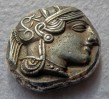
Roman republic, DidrachmDidrachm struck in Rome, circa 269-266 BC
Obv : diademed head of Hercules right, wearing lion's skin and with club on shoulder
Rev : ROMANO at exergue. She-wolf suckling Remus and Romulus
7.29 gr
Ref : RCV # 24
This silver didrachm is supposed to be the first silver coinage struck under the authority of the roman republic. Mr Crawford found 136 ex of this coin, with 18 different dies for the obverse and 24 for reversePotator II
|
|

GALBAGALBA
AR denarius. 69 AD. Laureate head right. IMP SER GALBA CAESAR AVG / Livia standing left, holding patera and scepter.DIVA AVGVSTA . RIC 186. RSC 55.
He showed marked respect to Livia Augusta, to whose favor he owed great influence during her lifetime and by whose last will he almost became a rich man; for he had the largest bequest among her legatees, one of fifty million sesterces. But because the sum was designated in figures and not written out in words, Tiberius, who was her heir, reduced the bequest to five hundred thousand, and Galba never received even that. Suetonius 5.2
With this coin Galba wished to demonstrate continuity with the Julio-Claudian dinasty that had ruled for the last century, through his close friendship with Livia.
benito
|
|

Legionary denarius.MARK ANTONY AR denarius. Patrae(?) mint. 32-31 BC. 3.79 grs, 6h . Praetorian galley sailing right , with sceptre tied with fillet on prow Mast with banners. ANT • AVG III VIR • R • P • C / Legionary aquila between two standards. LEG XIX below.
Crawford 544/35. RSC 55.
This coins were minted to pay the soldiers of Antony's armies some months before the battle of Actium.
benito
|
|

T.Quinctius Flaminius.AR denarius. 126 BC. 3.93 g, 3h. Helmeted head of Roma right; flamen’s cap to left, mark of value to right below chin / The Dioskori riding right; Macedonian shield between T Q below horses. ROMA in exergue. Crawford 267/1. RSC Quinctia 2
This coin by moneyer T.Q.Flaminius celebrates the Victory of the Consul of the same name,who in the battle of Cynoscephalae (197 BC)crushed the Macedonian Phalanxs of Philip V, making the Roman Legion the most potent fighting force in the Mediterranean world.benito
|
|

Faustus Cornelius Sulla.AR denarius. 56 BC. 3,66 grs. Craw 426/1. RSC Cornelia 59.
The moneyer was the son of the famous general and Dictator Lucius Cornelius Sulla (138-78 BC).The reverse of the coin represents the victory of his ancestor in the Jugurthine War. Sulla arranged with his ally Bocchus of Mauretania to have Jugurtha ,King of Numidia,ambushed and captured. On the scene represented, Bocchus offers an olive branch to a seated Sulla, while a bound Jugurtha kneels beside him.benito
|
|

Faustus Cornelius SullaAR denarius. 56 BC. 4.05 g, 9h. Head of young Hercules right, wearing lion's skin headdress, paws knotted below his chin; SC above FAVSTVS monogram behind. / Globe surrounded by four wreaths, the larger jewelled and tied with fillet; aplustre and stalk of grain below. Crawford 426/4a. RSC Cornelia 61 .
This coin is one of ten million denarii that the Senate of Rome commissioned for the purchase of wheat in the year 56 BC. All those extra denarii, struck alongside the normal coin issues, bear the letters S.C for "Senatus Consulto" (by decree of the Senate) on their obverse, behind the head of Hercules. The ligated letters FAVS refer to the moneyer, Faustus Cornelius Sulla.
The ear of grain on the reverse illustrates that this denarius was indeed minted in connection with the purchase of wheat. Gnaeus Pompeius Magnus, who transacted the business, was the father in law of the moneyer Sulla, and effectually used his son in law's position to advertise himself. Three of the wreaths on the reverse commemorate the three triumphs of Pompey: He was the first Roman to celebrate a triumph on each of the three then-known continents. With this Pompey had made Rome a world power, which is symbolized by the globe in the middle. The fourth wreath, larger than the others, stands for the extraordinary honor that Pompey was bestowed with in 63 BC, when he was allowed to wear a golden headdress when going to the circus or the theater.benito
|
|

Diocletion abdication follis.Follis, ca 305-306 AD, Serdica mint.
Obverse: DN DIOCLETIANO FELICISSIMO SEN AVG / Laureate bust of Diocletian, wearing the imperial mantle, olive branch in right hand, mappa in left hand.
Reverse: PROVIDENTIA DEORVM QVIES AVGG / Providentia standing, extending hand to Quies, also standing, holding branch and leaning on sceptre. S F in fields, &Gamma: between.
Mint mark: . SM . SD .
10.63 gm., 28 mm.
RIC #15a; Sear # 12940, PBCC #843.
On May 1, 305, Diocletian and Maximian retired. These coins were issued to commemorate that event.Callimachus
|
|

Domitius Domitianus, OctadrachmOctadrachm struck in Alexandria in 297 AD
Obv : ΔOMITI-ANOC CEB, radiate head of Domitianus right
Rev : LB (regnal year 2), Serapis walking right, palm behind
12.79 gr
Ref : Sear #4801, Alexandrian coins #4241/2 (the illustration is this ex)
Domitius Domitianus, stationed in Egypt, rebelled against Diocletianus in july 296 AD and was proclaimed emperor. He was defeated during spring 297 AD. Diocletian decided to close the alexandrian mint, so the coins of Domitianus are the last provincial coins from Alexandria. Also, Domitianus was the only ruler to strike octadrachms (in paralle with didrachms, tetradrachms and hexadrachms)Potator II
|
|

Maximianus abdication follis.Follis, 305-306 AD, Treveri mint.
Obverse: DN MAXIMIANO BAEATISSIMO SEN AVG / Laureate bust of Maximian, wearing the imperial mantle, olive branch in right hand, mappa in left hand.
Reverse: PROVIDENTIA DEORVM QVIES AVGG / Providentia standing, extending hand to Quies, also standing, holding branch and leaning on sceptre. S F in fields.
Mint mark: PTR
12.62 gm., 27 mm.
RIC #673b; Sear #13394.
On May 1, 305, Diocletian and Maximian retired. These coins were issued to commemorate that event.Callimachus
|
|

Abbasid Al-Mamun Citing Ali Ibn Musa as heirAl-Ma'mun AH 199-218 / AD 813-833. AR Dirham (27mm, 2.87 g, 3h). Citing 'Ali ibn Musa al-Rida as heir. Madinat Isbahan mint. Dated AH 202 (AD 817/8). Album 224; ICV 391
This coin is a very rare and historically important coin as it commemorates the significant event that Al-Mamun chose ali ibn musa (Known as Al-Rida) as his heir in order to control the shia rebellions and bring them under control as Al-Rida was leader of Shia muslims at the time. This was just a political move as he was only 2 years the heir . Al-mamun had him poisoned after 2 years in 203 AH . This coin cites the name of Ali Ibn Musa on it as the heir confessing Al-mamun to be Caliph of muslims and Al-Rida to be his heir.
arash p
|
|

Agrippina the Elder (ca. 14 B.C.-33 A.D)Agrippina the Elder (ca. 14 B.C.-33 A.D)
Sestertius
Daughter of Julia and Marcus Agrippa, wife of Germanicus and mother of Emperor Caligula. The most beautiful woman of all Caesars in the most incredible condition. The finest known specimen originally from the Morreti Collection.
Obv.Posthumous portrait ordered by Caligula to commemorate his mother who had tragically died in exile. Rev.The carpentum drawn by two mules, the vehicle reserved for the use of the women of the imperial family in the city.
Cohen 1 ; RIC 42
|
|

Antiochos VIII Epiphanes (Grypos)121/0-97/6 BC. AR Tetradrachm (30mm, 16.72 g, 11h). Sidon mint. Dated SE 196 (117/6 BC). Diademed head right / BAΣIΛEΩΣ ANTIOXOY EΠI-ΦANOYΣ, Zeus Ouranios standing left, holding star in extended right hand and scepter in left; to outer left; ΣIΔΩ/IEP/AΣ in three lines above monogram; C9P (date) in exergue. SC 2330.1; CSE 723; HGC 9, 1197g; DCA 268. Near EF, lightly toned. In 121 BCE, a very rare astronomical event occurred in the sky. The moon had eclipsed Jupiter, a significant celestial body of the ancient world. This phenomenon was visible from Antioch, the capital of the then-collapsing Seleucid Empire. Antiochos VIII saw this as a good omen, a harbinger that a great leader would come to Syria, so he struck symbols of the eclipse on the reverse side of Tetradrachms. The crescent above Zeus' head is the moon, and the star hovering above his hand is Jupiter.
ThatParthianGuy
|
|

144 AD: Antoninus Pius sestertius (rev. only) betrothal M.Aurelius and Faustina filia Orichalcum sestertius (28.4g, 35mm, 12h). Rome mint. Struck AD 144.
AN(TON)NVS AVG PIVS P P TR P COS III laur. head right
CONCORDIAE [/] S C [in ex.] M. Aurelius & Faustina Jr. clasping hands; large statues of Antoninus & Faustina behind
RIC 601 [S], Cohen 146, BMC 1236-40, Foss (Roman Historic Coins) 127/45a
This type was issued on the occasion of the betrothal of Marcus Aurelius and Faustina, which probably took place during the Hilaria festival celebrated on 25 March 144 (see RIC). The reverse represents Marcus Aurelius, l. and Faustina filia, daughter of Antoninus Pius and Faustina mater, r., as small figures, clasping hands over altar and before large figures representing statues on pedestals of Antoninus Pius and the late Faustina mater (died A.D. 141). The statues also clasp hands, and the that of Antoninus holds a Victory figurine.
The marriage took place the following year in A.D.145.Charles S
|
|

143 AD: The king of Armenia is appointed by Antoninus PiusOrichalcum sestertius (23.57g, 31mm, 11h). Rome mint. Struck AD 143-144.
ANTONINVS AVG PIVS P P TR P COS III laureate head of Antoninus Pius facing right
REX ARMENIIS DATVS [around] S C [in ex.] Antoninus Pius, togate, standing facing, head turned left, placing a tiara on the head of the Armenian king, standing left, wearing short tunica and cloak, his right hand raised and holding a roll in his left.
RIC 619 [R]; BMC 1272; Cohen 686; Foss (Roman Historical Coins) 126:42
ex The New York Sale XX jan 2009; ex Gorny & Mosch, Auction 147 lot 2159, March 2006
In A.D. 143, Antoninus Pius appointed kings for the Armenians and the Quadi and dedicated separate issues for both events. Charles S
|
|

142 AD: Antoninus Pius Victory in BritanniaOrichalcum sestertius (25.02g). Rome mint. Struck AD 142-144
ANTONINVS AVG PIVS P P TR P COS III Laureate head right
VICTORIA AVG / S C [in two lines in ex.] Victoria in quadriga r.
RIC 653 [S]; BMC 1326; Cohen 1082
Victory by Quintus Lollius Urbicus over the Brigantes in AD 142 in Britannia.Charles S
|
|
|
|
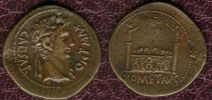
Altar of LugdunumCAESAR PONT MAX
Laureate head of Augustus, right.
ROM ET AVG
Altar flanked by two columns each surmounted by Victory.
Various sacred items on top; mystic symbols to front.
Copper As 22.5 mm 9.5 gm
Augustus took a risky break with tradition by allowing
himself to be the object of cult adoration. To minimize
the affront to his fellow Romans, he permitted the
practice only in the West. Interestingly, the year of
dedication in 10 BC saw the birth of Claudius in the same
place.
Massanutten
|
|

28 BC Colony established at Nemausus by Augustus' armymedium bronze (dupondius or as?) (12.6g, 25mm, 2h) Nemausus mint. Struck 10 BC - 10 AD.
IMP DIVI F Agrippa laureate head left and Augustus laureate head right, back to back
COL NEM crocodile chained to palm tree top bent to right, wreath at top.
RIC (Augustus) 158
Denomination uncertain. COL NEM stands for COLONIA AVGVSTA NEMAVSVS (present Nîmes, France), built by Augustus' army after their conquest and return from Egypt. The crocodile chained to the palm tree symbolizes the defeat of the Cleopatra and Marc Antony at Actium.Charles S
|
|

Augustus RIC I, 322Augustus 27 BC - AD 14
AR - Denar, 3.83g, 20mm, Rome 19 BC, by moneyer Q Rustius
obv. Q RVSTIVS - FORTVNA, ANTIAT (in ex., hard to see!)
Busts, draped, jugate, r., of Fortuna Victrix, helmeted, holding patera in l.
hand, and Fortuna Felix, wearing stephane;
both busts rest on bar terminating at each end in a ram' s head
rev. CAESARI . AVGVSTO
A highly ornamented rectangular altar with a bowl on it, inscribed in front
FOR.RE
ex.: EX.S.C.
RIC I, 322; BMCR 2
R2; about VF, toned
FORTVNA ANTIATIS, Fortuna of Antium, one of the most important places of Fortuna worshipping, as two goddesses, sisters, FORTVNA VICTRIX, more male, and FORTVNA FELIX, more female. Or as two aspects of only one goddess?
On the rev. the altar of FORTVNA REDVX, erected by the Senatus for the lucky return of Augustus 19BC with the 53 standards from the Parthians in Rome near the Porta Capuana.
Q Rustius celebrates Augustus and his own hometown Antium.Jochen
|
|

Augustus RIC I, 86aJochen's Augustus RIC I, 86a
Augustus, 27 BC - AD 14
AR - Denar, 3.74g, 19mm
Colonia Patricia(?), ca. 19 BC - 18 BC
obv. CAESAR AVGVSTVS
bare head r.
rev. SIGNIS above, RECEPTIS under round shield inscribed with CL.V between
eagle l. and standard r. S.P.Q.R. at the corners of the shield
RIC I, 86a; BMCR 417; RSC 265
good VF, toned
The eagle standards were introduced by Marius similar to the Ptolemaic eagle to each of his legions. This issue celebrates the recovery of the 3 eagle-standards 20 BC by Augustus (by negotiations), which were lost by Crassus 53 BC at the battle of Carrhae against the Parthians. The 3 eagles thereafter were erected in the new temple of Mars Ultor on the Forum of Augustus. The day of recovery was determined public holiday.
Jochen
|
|
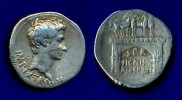
AUGUSTUS. AR Cistophorus (3 denarii) of Pergamum. Struck c.19 - 18 B.C.Obverse: IMP IX TR PO V. Bare head of Augustus facing right.
Reverse: Triumphal arch surmounted by Augustus in facing triumphal quadriga; IMP IX TR POT V on architrave; S P R SIGNIS RECEPTIS in three lines within arch opening, standards at either side.
RIC I : 510 | BMC : 703 | RSC : 298.
This coin commemorates Augustus' triumphant agreement with the Parthians in 20 B.C. under which they returned the legionary standards captured from Crassus who was defeated and killed at Carrhae thirty-three years earlier (53 B.C.) Augustus installed these standards in the Temple of Mars Ultor.
The reverse of the coin shows the triumphal arch which was awarded to Augustus on the occasion of his recovery of the standards. This was the second triumphal arch awarded to Augustus and, like the earlier arch which had been constructed in 29 BC to honour his victory over Cleopatra, this second arch, which archaeological evidence suggests may actually have incorporated the first arch, stood in close proximity to the Temple of Divus Julius at the southern entrance to the Roman Forum.
This is the rarest cistophorus struck during the reign of Augustus with the exception of the exceedingly rare issues featuring a sphinx.*Alex
|
|

SaladinSaladin (Salah al-Din)
Ayyubid
Dirham Halab (Aleppo) 580AH/1184AD
Recaptured Jerusalem from the crusaders and defeated their armies at Hittin in 1187.
|
|

POMPEY THE GREATAR denarius. (4.51 gr). 49-48 BC. Uncertain mint in Greece. Diademed head of Numa Pompilius right. CN PISO PRO Q. / Prow right, MAGN above, PRO COS below. Crawford 446/1; RSC 4. Smyth XII/35.
The obverse representes the head of Numa,second King of Rome,from whose son Calpus, the gens Calpurnia claimed descent.CN Piso was pro questor of Pompey 's army in Spain. The reverse,prow of a galley, conmemorates Pompey's victory over the Mediterranean pirates in
67 BC.benito
|
|

37 AD Dedication of the temple of Divus Augustusorichalcum dupondius (29mm). Rome mint. Struck AD 37.
CONSENSV SENAT·ET·EQ·ORDIN·P·Q·R Gaius seated left on curule chair
DIVVS AVGVSTVS S C radiate head of Augustus facing left
RIC (Gaius) 56; Cohen (August) 87; Foss (Roman historical coins) 60:4
ex old British (Oxford) collection
Minted under Caligula on the occasion of the dedication of a temple to Divus Agustus; the identity of the seated person is uncertain but probably Gaius. The legend 'ET EQ' refers to 'EQVES' (pl. EQVITES), 'horseman'. In the early empire, they were the holders of administrative posts of a class second only to the senators.
In the picture the obverse and reverse have accidentally been switched around.Charles S
|
|

Q. Cassius Longinus -- AR DenariusQ. Cassius Longinus -- AR Denarius. Head of Libertas right; LIBERT left, Q. CASSIVS right / Curule chair within temple of Vesta; urn to left and voting tablet inscribed AC to right. Crawford 428/2; Sydenham 918; Cassia 8. Triton VI, Lot 739.
CNG's historical take on these coins: The reverse of this attractive type alludes to an incident in 113 BC, in which the College of Ponftiffs acquitted two Vestal Virgins, allegedly improperly, on charges of incest, while condemning a third. An ancestor of the moneyer was called in to investigate the affair. The curule chair under the circular temple alludes to the judicial power given to the investigator; the urn to the left and the tablet to the right inscribed A/C (for Absolvo and Condemno) is the ballot used by jurors to vote for guilt or innocence.Joe Sermarini
|
|

Claudius II, AE Antoninianus, RIC V, I 252 variation, Normanby hoard 1108AClaudius II
Augustus, 268 – 270 A.D.
Coin: AE Antoninianus, commemorating Claudius' victory over the Goths at Naissus in Moesia, which earned him the cognomen "Gothicus".
Obverse: IMP CLAVDIVS P F AVG, radiate, draped and cuirassed bust facing right. ●● beneath.
Reverse: VICTORIAE GOTHIC, two bound Gothic captives, beneath a Trophy.
Weight: 2.95 g, Diameter: 21.2 x 21.5 x 1 mm, Die axis: 200°, Mint: Cyzicus, struck between 269-270 A.D. Officina: 2nd (●●), References: RIC V, I 252 variation (no SPQR in exergue), Normanby hoard 1108A
Note: Bust more in the style of the previous Emperor, Gallienus.Constantine IV
|
|

C. COELIUS CALDUSAR denarius. 51 BC. 3.91 gm, 8h . Bare head of the Consul C. Coelius Caldus right; C. COEL. CALDVS before, COS below, tablet inscribed L D behind / Radiate head of Sol right; S above oval shield ornamented with thunderbolt behind ; round shield below chin. CALDVS III VIR before . Crawford 437/1b; Sydenham 892; RSC Coelia 5.
The ancestor of the monneyer ,also named Gaius Coelius Caldus was a prominent political figure in the late 2nd century BC.Governor of Hispania as proconsul,Consul in 94 BC.He also won significant victories over the Gallic Salluvii in 90 BC,as alluded to by the shields.
As TR P ( Tribunus plebis) he passed the 'Lex Coelia Tabellaria' . The new law allowed jurors serving on cases of treason to decide by secret ballot, rather than 'viva voce' ,(word of mouth.). A tablet would be inscribed with either 'L' (Libero, I absolve) or a" D" (Damno - I condemn).
Himself a monneyer,see RSC Coelia 2 and 3.benito
|
|

gallienus DIANAE CONS AVGgallienus, 267-268 A.D., mint of rome..
OBV: GALLIENVS AVG, radiate head right.
REV: DIANAE CONS AVG, stag walking left. X in exergue.
this coin is historically important because it is believed that this coin was minted to commemorate vows to goddess diana and invoke her protection of gallienus against the revolt of aureolus... theres a whole series of these asking all kinds of different gods/goddesses for help. when i get more of these " zoo" coins ill post them here!
submitted by ancientcoins
|
|

(0177) Commodus (Concordia Militum)177 - 192 AD
Struck 185 AD
Sestertius 28mm 20.51 g
OBV: Laur Head R
REV: Concordia Militum standing L holding 2 legionary standards/SC
Coin was minted in 186 AD and refers to the unity of purpose among legions that enabled the suppression of Perennis' plot against Commodus in 185 ADlaney
|
|
|

CONSTANTINE I, AE Follis, RIC 435v, Sarmatia DevictaOBV: CONSTANTINVS AVG, laureate head right
REV: SARMATIA DEVICTA, Victory advancing right, holding trophy on right arm, branch in left hand, spurning captive seated on ground right, head turned back, STR(cresent) in ex (unpublished mintmark).
2.8g, 19.4mm
Minted at Trier, 323-4 AD
This coin alludes to the Sarmatian war and the victories of Constantine in the year of Christ 322. According to Zosimus, that great emperor drove back the routed Sarmatae beyond the Danube, and they pursued them to a place where they had rallied for the purpose of renewing the fight. He there again defeated and put them to flight, taking a great number of them prisoners, whom he doomed to captivity, and their King, Rausimodus being left among the slain.Legatus
|
|

Costantinus II AE 3CONSTANTINVS IVN NOB CAES, laureate, draped and cuirassed bust right.
ALAMANNI-A DEVICTA, Victory holding trophy and branch, stepping over captive.
RIC VII 050
Coin that celebrates victories over germanic Alamanni.
|
|

Constantius II RIC VIII, Alexandria 58Constantius II 324 - 361, son of Constantin I
AE - AE 3, 4.68g, 21mm
Alexandria 2. officina, 348 - 350
obv. DN CONSTA - NTIVS PF AVG
draped bust, pearl-diademed head l., holding globe with r.
rev. FEL TEMP - REPARATIO
helmeted soldier walking r., head l., holding reversed spear l. and
leading young barbarian out of his hut, tree behind
exergue: ALEB
RIC VIII, Alexandria 58; C.53
VF, sandpatina
added to www.wildwinds.com
This issue celebrates the fact that AD 342 under Constans the Franks were taken over the Rhine and settled in Taxandria (Belgium). This was a peaceful act (the barbarian would not been dragged but guided!) done by negotiations and the Franks had to fight for the Romans.
Jochen
|
|

Constantius II RIC VII, Antiochia 132Constantius II, AD 324-362, son of Constantin I
AE - AE3, 5.56g, 24mm, Antiochia 11.officina, AD 350-355
obv. DN CONSTAN - TINVS PF AVG
draped, cuirassed bust, pearl-diademed head r., necklace
rev. FEL TEMP RE - PARATIO
Soldier spearing falling horseman, which stretching arm against him
(so-called FH3 type)
field left: Gamma
exergue: ANAI
RIC VIII, Antiochia 132; LRBC 2625
nice EF, nearly uncirculated
The reverse clearly shows a Parthian identified by his headgear. This issue most probably celebrates Constantius' victory in the battle of Singara AD 344 against the Sassanides where the Romans succeeded in capturing the successor of the throne. Jochen
|
|

Domitian sestertius Secular GamesÆ Sestertius, 26.3g, Ø 36mm, 6h, Rome, AD 88-89
Obv.: IMP CAES DOMIT AVG GERM PM TR P VIII CENS PER P P, laurate head right
Rev.: COS XIIII / LVD SAEC / SVF P D / S C in ex., Domitian seated left on platform gives fumigant to citizen accompanied by child.
RIC 376 [R2]; BMCRE 428; C. 81; Sear RCV II 2761; Foss (Roman Historic Coins) 30
This issue is part of a series which commemorates major events of the Secular Games which took place in october AD 88: this scene depicts the distribution of purifying incense (suffimenta) to the people. This ceremony took place at the temple of Jupiter Capitolinus, which is visible in the background. Charles S
|
|

Domitian sestertius Secular GamesÆ Sestertius, 25.56g, Ø 35mm, 6h, Rome, AD 88
Obv.: IMP CAES DOMIT AVG GERM PM TR P VIII CENS PER P P, laurate head right
Rev.: COS XIIII LVD SAEC FEC / S C in ex., Domitian standing right, dictating prayers to three kneeling matrons; in the background a four-column temple.
RIC 377 [R2]; Cohen 80; Foss (Roman Historic Coins) 33
This issue is part of a series which commemorates major events of the Secular Games which took place in october AD 88: this scene depicts the distribution of purifying incense (suffimenta) to the people. This ceremony took place at the temple of Jupiter Capitolinus, which is visible in the background. Charles S
|
|

Domitian sestertius saecular gamesIMP CAES DOMIT AVG GERM PM TR P VIII CENS POT PP
COS XIIII LVD SAEC A POP / FRVG AC / SC
RIC 375a (R2), Cohen 83 (50 fr.),
Show a scene of the saecular's games, a distribution to people of fruits from harvest.
Collection Frederic Weber frederic W
|
|

Persian Satrap Sabakes perished opposing Alexander III the Great at Issos 333 BC.Egypt, Memphis (or Aswan?), Persian Administration, 343-332 BC, Sabakes as Satrap, AR Tetradrachm
Head of Athena right with punchmark X on cheek / Owl standing right, head facing, crescent and olive spray to left, crescent above a stylized thunderbolt(?) (Sabakes symbol) and SWYN (Aswan) in Aramaic script to right, countermark X on owl.
Nicolet-Pierre 6, D4/R-; SNG Copenhagen 3; Van Alfen Type I, O4/R-; Mitchiner 10a; Sear 6232. Van Alfen (AJN 14 2002) countermark 3 on obv. & rev.
(24 mm, 16.91 g, 9h)
Sabakes, to whom the issue of this coin type is attributed, was the penultimate Persian Satrap of Egypt. In 333 BC he led a contingent from Egypt to join the Persian army facing Alexander the Great at Issos, where he perished in battle. It is likely that this coin was struck under his governorship, perhaps for use as payment in preparations for the expeditionary force in support of Darius III. Countermarks are commonly present on these coins and most of the surviving examples are worn, indicating an extended period of circulation. This is consistent with the fact that the next coinage to be struck in Egypt was almost a decade later, shortly before the death of Alexander the Great.
|
|

Elagabalus.Denarius, 218-219 AD, Antioch mint.
Obv: ANTONINVS PIVS FEL AVG / Laureate bust of Elagabalus.
Rev: SANCT DEO SOLI ELAGABAL / Slow quadriga bearing the conical stone of Emesa, on which is an eagle, surrounded by four parasols.
2.41 gm., 17 mm.
RIC #195.
Elagabalus was a high priest of the local ba'al of Emesa, Syria, at the time he was proclaimed emperor. This deity was named El-Gabal, and was worshiped in the form of a large, black, conical-shaped stone, which was probably a meteorite. When Elagabalus moved to Rome, he took this god with him. After a long overland journey from Emesa, Elagabalus and his entourage entered Rome in 219. The black stone was carried on a cart pulled by white horses. It was decorated with an eagle, and shaded by four parasols. Elagabalus, dressed in his priestly robes, walked backwards in front of this cart to show his reverence for his deity.
The entry of their new emperor into the city shocked the people of Rome. They soon realized that he fully intended to continue in his duties as High Priest to El-Gabal, and that his worship was to be imposed on the whole Empire. The the temple of Jupiter (Jove) in Rome was turned into the temple of El-Gabal. The religious excesses of the reign finally ended with the murder of Elagabalus. Under the new emperor, Severus Alexander, the temple was cleansed, rededicated to Jupiter, and El-Gabal sent back home to Emesa.
This coin commemorates the journey of El-Gabal to Rome and his entrance into the city. The legend on the reverse translates "Holy Sun-God Elagabal." Silver denarii with this reverse type all seem to be in the "Eastern" style so numismatists generally assign them to the mint at Antioch. It is possible, though, that they could have been minted by a mint that traveled with Elagabalus on his journey from Emesa to Rome, spending the winter of 218-219 in Nicomedia. Callimachus
|
|

Athens Emergency Issue Plated Tetradrachm Circa 406-404 BCQuote from David Sear:
"Athens was the greatest power in the Greek world throughout most of the 5th century BC. Its famous 'owl' coinage, principally of silver tetradrachms, possibly commenced in 510 BC on the occasion of the downfall of the tyrant Hippias. On these celebrated coins the helmeted head of the goddess Athena was accompanied by her attendant owl and the first three letters of the ethnic 'AQE'. Later, a diadem of olive leaves was added to Athena's helmet and a cresent moon was placed in the reverse field, though the precise chronological significance of these changes remains uncertain. To the intense chagrin of the Spartans Athens became the leader of the Greek states, including those of Ionia, in the epic struggle against the expansionist policies of the Achaemenid Persian Empire. The victories at Salamis (480 BC) and the Eurymedon (circa 467) clearly established the Athenian supremacy in the Aegean world. Initially, the Delian League (founded in 477) was an alliance of independent states sharing a common cause under the leadership of Athens. It gradually developed into an Athenian maritime empire with the member cities obliged to pay an annual tribute into the League's treasury on Delos. In 454 this treasury, amounting to 5,000 talents of silver, was actually removed to Athens and the vast wealth was openly employed for the aggrandizement of the city, now under the leadership of the great statesman Pericles. Vast building projecdts, such as the monumental edifices on the Acropolis, were financed in this way. From 431, however, Athens became embroiled in the protracted Peloponnesian War and increasingly the wealth of the state was dissipated in this futile cause. This attractive tetradrachm belongs to the exceptionally large ouput of Athenian 'owls' made during the second half of the 5th century. In contrast to the artistic development taking place at mints in other parts of the Mediterranean world, the late archaic style of the earlier 5th century became 'frozen' on these issues which represent the first truly imperial coinage of the Greek world. As Athens restricted or forbade the issue of independent currency at many of the cities within her sphere of influence the 'owls' came to circulate over an increasingly wide area. But this all came to an end with the defeat of Athens by Sparta in 404 BC and during the period immediately preceding this catastrophe the Athenians were reduced to the desperate expedient of issuing bronze tetradrachms and drachms with a thin surface coating of silver. This specimen is an excellent example of this emergency coinage the production of which drew contemporary comment from Aristophanes who, in his play Frogs (717ff), compares the decline in the quality of the leading citizens with the recent debasement of the Athenian coinage."
|
|

Anonymous (Ezanas Christian)Obverse: Bust rt. Garment draped on shoulders, v-neck collar, wearing a head cloth. Within a beaded border. Greek inscription BAX ACA (Interpretation uncertain)
Reverse: Greek cross in beaded inner circle, cross inlaid with gold. Greek inscription outside circle TOYTOAP[CHTHXWPA (May this please the country/people)
Date : AD.330-358
Reference : M-H 50, V27
Grade : EF
Weight : 0.73g
Metal : Silver
Comments : AR 13mm, Die Axis 0°, Aksum has claims to be the first civilization anywhere to use Christian imagery on its coins. King Ezanas became a Christian early in his reign and quickly made Christianity the official state religion. Around A.D. 330 he began to use the cross on his coinage as propaganda to spread his new religion, this is type is thought to be the first of those issues.
Peattie
|
|

Q. Caecilius MetellusAR denarius. 125 BC. 3,91 grs. Helmeted head of Roma right, ROMA behind, mark of value below chin / Jupiter in biga of elephants left, Victory flying right above. In exergue C.METELLVS.
Craw 269/1. RSC Caecilia 14.
This coin commemorates the victory of Consul L.Caecilius Metellus in Panormus,Sicily, ( 251 BC ) against the Carthaginian troops of Hasdrubal in the first Punic war, and the capture of his elephants. On his return to Rome the Consul is granted the Triumph , for the first time in western history with some elephants.
benito
|
|

Phillipi AE 15 CommemorativeThis coin was struck at the Roman colony of Philippi, near the site of the battle. The colony was formed by troops from both sides who settled there after the conflict. The coins picture winged Victory on one side and three Praetorian Standards on the other. The bronze coin is approximately 18-19mm in diameter. It is a bit unclear when the coin was struck. Some attribute it to Augustus, who won the battle and ruled Rome from 29BC to 14AD. Others feel it was issued by Claudius in 42AD to commemorate the 100th anniversary of the battle and to honor the Praetorian Guards of his time, who helped assure his ascension as Emperor. Either way it is a fascinating and important ancient Roman commemorative coin.
|
|

Germanicus RIC I, (Gaius) 57Germanicus, died AD 19, brother of Claudius, father of Gaius Caligula
AE - Dupondius, 16.7g, 31mm, Rome AD 41-54
obv. GERMANICVS/CAESAR in two lines across field
Germanicus bare-headed and in military cloak standing r. in a slow-quadriga
ornamented with Victory holding wreath.
rev. SIGNIS - RECEPT/DEVICTIS - GERM/S- C in three lines, between them Germanicvs bare-headed in tunika standing l., r. hand raised for greeting, in l.
hand eagle-sceptre
RIC II, (Gaius) 57; C.7; BMCR. 94
VF, nice patina!
This issue commemorates the triumph of Germanicus AD 17 due to his rather poor successful campaigns against the Germans, where he regains 2 of the 3 signs of the 17., 18. and 19. legion which were lost AD 9 by Varus in the battle of Teutoburg Forest. On the battlefield he let collect the mortal remains of the dead and built a big tomb.
For Latin scholars: The grammar structure on the rev. is the infamous 'ablativus absolutus' and we find a nice Chiasmus, a crossing of words.Jochen
|
|

Germanicus, AE Dupondius, RIC I 57Germanicus
Caesar, 4 – 19 A.D.
Coin: AE Dupondius, commemorating the recovery, by Germanicus, of the Legionary Eagles (Aquilae) lost in the Battle of the Teutoburg Forest in 9 A.D.
Obverse: GERMANICVS CAESAR, Germanicus, in Triumph, in a Quadriga, going to the right, holding the reigns with his left hand and a Sceptre with his right.
Reverse: SIGNIS RECEP DEVICTIS GERM, Germanicus, cuirassed, advancing to the left, saluting with his right hand and holding an Aquila with his left. S-C across the fields.
Weight: 13.06 g, Diameter: 28.5 x 29 x 2 mm, Die axis: 200°, Mint: Rome, issued in the reign of his son, Gaius "Caligula", between 37 - 40 A.D. References: RIC I 57, BMC 94, Note: A metal detecting find at about 3 miles from Chinon, France, by Mr. Murray Jemison in 2010 at what was said to have been a Roman garrison site.Constantine IV
|
|

Claudius II Gothicus. 268-270 AD.IMPCMAVRCLAVDIVSAVG Exe: .. - Radiate, cuirassed bust right.
VICTORIAEGOTHIC Exe: SPQR - Trophy; seated captive on either side.
RIC 251v
This coin commemorates Roman victory at the Battle of Naissus (268 or 269 AD) and the defeat of a Gothic coalition by the Roman Empire under Emperor Claudius II near Naissus (Niš in present-day Serbia). The events around the invasion and the battle are an important part of the history of the Crisis of the Third Century.
The result was a great Roman victory which, combined with the effective pursuit of the invaders in the aftermath of the battle and the energetic efforts of the Emperor Aurelian, largely removed the threat from Germanic tribes in the Balkan frontier for the following decades.
The result was a great Roman victory which, combined with the effective pursuit of the invaders in the aftermath of the battle and the energetic efforts of the Emperor Aurelian, largely removed the threat from Germanic tribes in the Balkan frontier for the following decades.
|
|

HADRIANVS BRITANNICUSSestertius of Hadrian, AD 122. EXERC BRITANNICVS SC ("For the army of Britain, by order of the Senate") RIC 913.
The reverse shows Hadrian addressing the troops in England, standing on a low plinth, clearly showing the Roman soldiers with their standards.
Coin currently in the British Museum Department of Coins and Medals (gallery 49, case 14).
Obv. HADRIANVS AVG COS 111 PP ("Hadrian Augustus, three times consul, father of his country")
|
|

118 AD: Donative of Hadrian upon his first arrival as emperor in Rome to celebrate his accession.Orichalcum sestertius (24.3g, 34mm, 6h). Rome mint. Struck AD 118.
IMP CAESAR TRAIANVS HADRIANVS AVG laureate bust of Hadrian facing right
PONT MAX TR POT COS II around edge LIBERALITAS AVG / S C [in two line in ex.] donation scene with Hadrian seated left on a platform on the right and extending his right hand. In front of him, an attendant seated right giving something to a citizen, who is mounting the steps to the platform. In the background, Liberalitas standing left, holding a tessera
RIC 552 [R]; Cohen 914; Foss (Roman Historical Coins) 112:15 Charles S
|
|

118 AD: Hadrian relinquishes public debt worth 900 million sestertii Orichalcum sestertius (24.91g, 34mm, 6h). Rome mint. Struck AD 119-121
IMP CAESAR TRAIANVS HADRIANVS AVG P M TR P COS III laureate bust right, drapery on far shoulder
RELIQVA VETERA IIS NOVIES MILL ABOLITA / S C Lictor standing left, holding fasces, setting fire to heap of bonds on the ground to left with brand
RIC 552 [R]; Cohen 914; Foss (Roman Historic Coins) 112/15
CNG EAuction 202; ex White Mountain Collection; ex Mazzini Collection
While Hadrian was on a mission in AD 118, four high ranking senators were executed by the senate for conspiring against Hadrian, despite a promise by Hadrian not to execute members of the Senate. To calm the public, Hadrian granted an extra public largesse and relinquished the public debt to the state equaling 900 million sestertii. In a ceremony held in the Forum Trajanum, all records of these debts were set on fireCharles S
|
|

Heraclius, Follis, Ravenna mint, 630-631 AD (year 21), Sear 914, celebrating the defeat of the Sasanid kingdom and the restoration of the True Cross to Jerusalem. Heraclius (610-641 AD)
630-631 AD (year 21)
Follis
Obverse: DD NN HЄRACLIVS ЄT HЄRA CONST PP AVCC (or similar), Heraclius, crowned, in military attire and holding long cross, standing facing, foot on prostrate figure (a Persian?) below; to right, Heraclius Constantine, wearing crown and chlamys, holding globus cruciger, standing facing
Reverse: Large M; Above, cross; To left, ANNO; To right, XXI ; Exergus, RAV
Ravenna mint
This issue commemorates the victory of Heraclius over the Sasanid kingdom in 629 AD.
After years of war between Romans and Sasanids, in 612, Heraclius launched a major counter-offensive in Syria in 613. He was decisively defeated outside Antioch by Shahrbaraz and Shahin, and the Roman position collapsed. Over the following decade the Persians were able to conquer Palestine and Egypt and to devastate Anatolia. Meanwhile, the Avars and Slavs took advantage of the situation to overrun the Balkans, bringing the Roman Empire to the brink of destruction.
During these years, Heraclius strove to rebuild his army, slashing non-military expenditures, devaluing the currency and melting down Church plate, with the backing of Patriarch Sergius, to raise the necessary funds to continue the war. In 622, Heraclius left Constantinople, entrusting the city to Sergius and general Bonus as regents of his son. He assembled his forces in Asia Minor and, after conducting exercises to revive their morale, he launched a new counter-offensive, which took on the character of a holy war. In the Caucasus he inflicted a defeat on an army led by a Persian-allied Arab chief and then won a victory over the Persians under Shahrbaraz. Following a lull in 623, while he negotiated a truce with the Avars, Heraclius resumed his campaigns in the East in 624 and routed an army led by Khosrau at Ganzak in Atropatene. In 625 he defeated the generals Shahrbaraz, Shahin and Shahraplakan in Armenia, and in a surprise attack that winter he stormed Shahrbaraz's headquarters and attacked his troops in their winter billets. Supported by a Persian army commanded by Shahrbaraz, the Avars and Slavs unsuccessfully besieged Constantinople in 626, while a second Persian army under Shahin suffered another crushing defeat at the hands of Heraclius' brother Theodore. Meanwhile, Heraclius formed an alliance with the Turks, who took advantage of the dwindling strength of the Persians to ravage their territories in the Caucasus. Late in 627, Heraclius launched a winter offensive into Mesopotamia, where, despite the desertion of the Turkish contingent that had accompanied him, he defeated the Persians at the Battle of Nineveh. Continuing south along the Tigris, he sacked Khosrau's great palace at Dastagird and was only prevented from attacking Ctesiphon by the destruction of the bridges on the Nahrawan Canal. Discredited by this series of disasters, Khosrau was overthrown and killed in a coup led by his son Kavadh II, who at once sued for peace, agreeing to withdraw from all occupied territories. Heraclius restored the True Cross to Jerusalem with a majestic ceremony in 629.
Sear 914, D.O. 297, B.M.C. 452, T. 282, B.N. 5, M.I.B. 253a.
RRR
VF
6,98 g. L.e.
|
|

Trajan sestertius VIC DAC (to commemorate victory in the first Dacian war 101-102 AD)orichalcum sestertius (22.79g, 34mm). Rome mint. Struck AD 103.
obv:IMP. CAES. NERVAE TRAIANO AVG. GER. DAC. P.M.TR.P. COS. V P.P. rare bust of Trajan variation die flaw on 5 h.
rev:S.P.Q.R. OPTIMO PRINCIPI S.C. Winged Victory standing right, right leg on enemy helmet, holding shield insribed VIC DAC against a palm tree.
BMC 812, RIC 528, Sear 3201
|
|

Hadrian Denarius, 134-8, from the Ropsley (Lincolnshire) Hoard 2018, buried 150-2Hadrian (11 Aug 117 - 10 Jul 138 CE), Silver Denarius, Ropsley Hoard 21, RIC II 234d, RSC II 615, BMCRE III 608, Strack II 231, Hunter II -, SRCV I -, gEF, excellent portrait, well-centred and sharply struck on a tight flan, lightly toned, little wear, some hoard encrustations both sides, edge cracks, plain edge, weight 3.27g, composition Ag, diameter 18.0mm, thickness 2.62mm, die axis 210°, Rome mint, 134-8 CE; obverse HADRIANVS-AVG COS III P P, laureate head right; reverse FELICI-T-AS AVG (Happiness of the Emperor), Felicitas, draped, standing half-left, caduceus in right hand, olive branch in left; from the Roger Belmar Collection; ex Silbury Coins (15 Aug 2022); £350.00.
Sometime, during 150-2 CE in the North Eastern corner of the Roman province of Britannia, a citizen was compelled to bury his pot of 522 denarii, equivalent in value to around £12,500 ($15,684.99) in modern-day currency. A substantial amount given that a Roman soldier would have been paid around 300 denarii per year. The coins were reportedly found in a possible crude cist inside a Roman greyware vessel (complete but broken, with interior staining from coins).
The Ropsley (Lincolnshire) Hoard 2018 (LANCUM-F93E5B) comprised denarii, from Mark Antony (32 BCE) to Faustina II (152 CE), but many were of Hadrian (117-38 CE). The silver hoard was found in Lincolnshire on 16th March 2018 by a metal detectorist, not far from the Roman town of Ancaster (Causennis) and Ermine Street, the Roman road connecting London to Lindum Colonia (Lincoln) and Eboracum (York).
What compelled the citizen to bury the hoard we can only imagine; was it for safekeeping while he headed to market in nearby Ancaster (Causennis), just a short trip up Ermine Street or had he been asked to head north and help with the trouble caused by the Caledonians near Hadrian’s Wall? Perhaps they were stolen by a mischievous slave who was then caught, sold and could never return to recover his loot. Who knows for certain, but these coins were not recovered, at least not in Roman times. Intriguingly, burnt charcoal fragments were also recovered by British Museum conservators and scientifically identified as willow.Serendipity
|
|

Gens Licinia. Roman republic. With another coin of Gens Cassia, it's to my knowledge the only coin representing the democratic act of voting. A lesson of democracy for the other ancient countries, but even for us...
PliniusPLINIUS
|
|

Marcus Antonius AR denarius-3,93 grams- 18 mm-itinerary mint- 42 b.C. obverse: M.ANTONI IMP, bust of Marcus Antonius right
reverse: III VIR RPC, radiate & draped bust of Sol facing on a disk within distyle temple
Crawford 496/1- Cohen 12 (5fr.)- Sear 1467
This coin was minted during Antony's military campaign against Brutus and Cassius in Greece.
The tyrannicide Cassius gained some notoriety for robbing the temple of Helios in the city of Rhodes; he was said to have left untouched only the chariot of the sun. This type of Antonius reproaches Cassius for that robbery and constitutes a promise to avenge the god of the sun (see F. X. Ryan, SNR 84, 2005, 84–86).L.e.
|
|

Marcus Aurelius RIC III, 163Marcus Aurelius AD 161-180
AR - Denar, 3.53g, 18.1mm, Rome summer-Dec. 166
obv. M ANTONINVS AVG ARM PARTH MAX, laureate head l.
rev. TRP XX IMP IIII COS III, Victoria standing facing, holding palmbranch in l., and with r. put shield with VIC PAR on a palmtree
RIC III, 163; C.878
The war against the Parthians AD 161-166:
The tension between Rome and the Parthians were growing due to the control over Armenia, the important buffer state, after the death of Antoninus and the uncertainties in Rome (two emperors!). Volagaeses III put his candidate on the throne. So Marc Aurel decided to send Lucius Verus, who has a bad reputation, and his best general Avidius Cassius. They succeded in catching and destroying towns and fortresses, f.e. Seleucia and Ctesiphon. The Roman advance was so quick that it reminds on Alexander the Great. AD 166 the Parthians surrendered and Rome could put his candidate on the Armenian throne. Jochen
|
|

Marcus Aurelius RIC III, 338AR - Denar, 3.25g, 18.8mm
Rome, Dec. 175 - Dec. 176
obv. M ANTONINVS AVG GERM SARM
head laureate, r.
rev. TRP XXX IMP VIII COS III PP
Pile of arms
in ex: DE GERM
RIC III, 338
Scarce; VF(?)
added to www.wildwinds.com
Early in 169, the Marcomanni and Quadi crossed the Danube, penetrated the intervening provinces, and entered Italy. The culmination of their onslaught was a siege of Aquileia. The effect upon the inhabitants of the peninsula was frightful. This was the first invasion of Italy since the late second century B.C., when the Cimbri and Teutones had been separately crushed by Marius.
After a rapid mobilization of forces MARCUS AURELIUS turned north and began his counterattacks against the barbarians. First and foremost, the enemy had to be driven out of Italy and then into their own territory beyond the Danube. But it was a time-consuming and expensive operation. 23 Nov. 176 he held the triumph over Germans and Sarmati. Raetia and Noricum became Roman provinces.Jochen
|
|
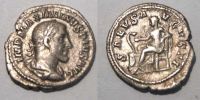
MAXIMINUS I denarius AD235obv:IMP MAXIMINVS PIVS AVG
rev:SALVS AVGVSTI (Salus seated left, feeding from patera a serpent arising from altar)
ref:RIC14, C.85
2.80gms
The reverse of SALVS AVGVSTI means the Health of the Emperor – should commemorate the Emperor’s survival through two conspiracies against his life. (from RIC IV i)
The ex-consul Magnus had entered into a conspiracy with a number of soldiers and centurions to stab Maximinus, wishing thereby to get the imperial power for himself. Maximinus wished to make a bridge (through the Rhine at Mogantiacum) and cross over against the Germans, and it was resolved that the conspirators should cross over with him and then, breaking the bridge behind them, surround Maximinus on the barbarians' side and kill him, while Magnus seized the throne. (from Historia Augusta)
There was an another uprising by disgruntled soldiers who accompanied Severus Alexander from the East and who championed the recently dismissed provincial governor Quartinus as a rival emperor.
berserker
|
|

Philip I Antoninianus RIC IVc 24CPhillip I AR Antoninianus
2.95g, 22.3mm, 345 degrees, Rome mint, 249 CE.
Attribution: RIC IVc 24C. Cohen 193.
O: IMP PHILIPPVS AVG, bust, radiate, draped and cuirassed, right.
R: SAECVLARES AVGG / COS III, low column inscribed COS III.
Minted as part of a commemorative series of coins celebrating the Ludi saeculares in 248 AD honoring the 1000th anniversary since the founding of the city of Rome.Ron C2
|
|

PLOTINA, The lady that changed history.(An incredible PORTRAIT in the format of a Sestertius of PLOTINA)
The most influential of all Roman Empresses, she was interested in philosophy and in the doctrines of Epicurus, virtue, dignity and simplicity. She provided Romans with fairer taxation, improved education, assisted the poor, and tried to make Roman society ever more tolerant. Plotina was well known for her high moral standards and her kindness, as well as for her support for her husband: she travelled with him to the East and was present at his deathbed. It is said that when Plotina entered the imperial palace after her husband Trajan had become Emperor, she turned to those gathered at the steps and declared “I enter here such a woman as I would wish to be when I leave.” Plotina was instrumental in ensuring that Hadrian, who she greatly liked and was Trajan’s ward, succeeded peacefully to the throne on Trajan’s death
|
|

Abduction of the Sabine women.AR denarius. 89 BC. 3,65 grs. Bare-headed, bearded head of King Tatius righ. TA (ligate) below chin. SABIN behind / Two Roman soldiers, each carrying off a sabine woman in his arms. L TITVRI in exergue.
Crawford 344/1a. RSC Tituria 1.
Livy. History of Rome. 1.9.
The Roman state had become strong enough to hold its own in war with all the peoples along its borders, but a shortage of women meant that its greatness was fated to last for a single generation, since there was no prospect of offspring at home nor any prospect of marriage with their neighbours. Then, in accordance with the decision of the senate, Romulus sent messengers to the neighbouring peoples to ask for alliance and the right of marriage for the new people: cities, like everything else, start small but later if their own excellence and the gods assist them, they grow in strength and in fame. It was certain that at the beginning of Rome the gods had been propitiated and that it would not lack in valour. Therefore, men should not disdain to join blood and family ties with other men.
But nowhere were the emissaries given a fair hearing. Some scorned, others feared the great power growing in their midst, both for themselves and for their descendants. In more than one place the emissaries were asked, even as they were being sent packing, why they hadn't offered asylum to women (criminals) too: that way they'd have had their marriage and with others of their own rank! The youth of Rome took this insult badly and began to think seriously about the use of force. Romulus, to gain time till he found the right occasion, hid his concern and prepared to celebrate the Consualia, the solemn games in honour of equestrian Neptune. He then ordered that the spectacle be announced to the neighbouring peoples. He gave the event great publicity by the most lavish means possible in those days. Many people came, some simply out of curiosity to see the new city, and especially the nearest neighbours, from Caenina, Crustuminum and Antemnae; the entire Sabine population came, wives and children included. Received with hospitality in the houses, after having seen the position of the city, its walls, and the large number of buildings, they marvelled that Rome had grown so fast. When it was time for the show, and everybody was concentrating on this, a prearranged signal was given and all the Roman youths began to grab the women. Many just snatched the nearest woman to hand, but the most beautiful had already been reserved for the senators and these were escorted to the senators' houses by plebeians who had been given this assignment. The story goes that one woman, far and away the most beautiful, was carried off by the gang of a certain Thalassius, and because many wanted to know where they were taking her, they repeatedly shouted that they were taking her to Thalassius, and that it how the nuptial cry came to be.
The party was over, and the grieving parents of the girls ran away, accusing the Romans of having violated the laws of hospitality and invoking the god who was supposed to have been honoured at that day's festival. Nor did the girls themselves hold much hope. But Romulus went among them in person to assure them that none of this would have happened if their fathers hadn't been so inflexible in not letting them marry their neighbours. But now they would have the status of wives with all the material rewards and civil rights of citizenship and they would have children, than which nothing is dearer. They should cool their anger and give their hearts to the men who had already taken their bodies. A good relationship often begins with an offence, he said. And their husbands would treat them with extra kindness in hope of making up for the parents and country they so missed. The men added their blandishments, saying that they'd been motivated by love and passion, entreaties which are very effective with women.
benito
|
|

Aurelian Antoninianus CoinThis type refers to Aurelian's defeat of Zenobia's Palmyrene Empire in the east. The captives wear Parthian caps and are typically attributed as Persians. The real captives were more likely Palmyreans. Typical of Roman propaganda, Zenobia's Sasanian supporters are depicted to glorify Aurelian's victory and mask that this was an internal revolt and civil war.
RS52117. Silvered antoninianus, RIC V 151, gVF, Ticinum (Pavia, Italy) mint, weight 4.178g, maximum diameter 24.1mm, die axis 180o, 270 - 275 A.D.; obverse IMP C AVRELIANVS AVG, radiate and cuirassed bust right; reverse ORIENS AVG, Sol advancing left, raising right hand, globe in left, two bound captives at feet, TXXT in exergue; near full circles strike, extensive silvering remainingColby S
|
|

The First Alexander III Tetradrachm to be Struck in Sidon during the Siege of TyreKings of Macedonia, Alexander III The Great, 336-323 BC, AR Tetradrachm - Sidon
Head of young Herakles right in lion-skin headdress, paws tied at neck. / ΑΛΕΞΑΝΔΡOΥ Zeus left seated on a backless throne, eagle in right hand, scepter held in left hand, Phoenician date (letter Alaph) indicating Year 1 (333/2 BC) beneath throne, indistinct Phoenician letter Sadhe (being the initial of Sidon) in outer left field.
Price 3467a (same dies); Newell Sidon 8, dies I/α.; Le Rider pl. 4, 1 & 2. The first Alexander tetradrachm emission from Sidon mint 333/2 BC from the first Alexander dies used at the mint.
This is amongst the first Alexander coinage struck at Sidon and dated to Year 1 of his Asian reign, being the year in which he defeated the Persian King Darius at the battle of Issos, which was shortly followed by the surrender of Sidon. This coin is from the first Alexander dies to be used at Sidon and would have been struck during Alexander's siege of nearby Tyre probably as part of the funding for the siege effort.
|
|

88 BC - In Celebration of the Slaughter of 80,000 Romans in Asia Minor Ionia, Smyrna, 88-85 BC, AE 25
Diademed head of Mithradates VI of Pontos right.
ZMYPNAIΩN right, EPMOΓENHΣ/ΦPIΞOΣ to left of Nike standing right, palm frond over one shoulder while crowning the city’s ethnic with wreath.
Milne, Autonomous Smyrna 340; Callataÿ pl. LI, P-Q; SNG Copenhagen 1206.
(25 mm, 14.86 g, 12h)
This coin was struck in the First Mithradatic War, at a time when Mithradates VI had all but expelled the Romans from Asia Minor. A civic issue from Smyrna, it was an overt statement of the city’s support for Mithradates in his campaign against Rome as well as a celebration of Mithradates success in freeing most of Asia Minor from the Roman yoke. The issue probably commenced shortly after Mithradates had organised the murder of 80,000 Roman citizens in a single night across the cities of Asia Minor in the Spring of 88 BC. The issue was short lived, as the tide of military fortune quickly turned against Mithradates when he had to face Sulla. Ultimately, he was forced to negotiate a truce (the Treaty of Dardanos) with the Romans in 85 BC, bringing Asia Minor firmly back into the Roman Empire. This brought this coinage to an end. However, the peace was short lived and hostilities between Rome and Mithradates resumed two years later, continuing intermittently for the next twenty years until Mithradates death in 66 BC following a succession of military defeats at the hands of Pompey the Great.
|
|

The First 'Alexander'Macedonian Kingdom, Tarsos, Alexander III The Great, 336-323 BC, AR Tetradrachm
Head of young Herakles right in lion-skin headdress, paws tied at neck. / ΑΛΕΞΑΝΔΡOΥ Zeus left seated on a backless throne, eagle in right hand, scepter held in left hand, pellet under throne.
Price 2990; Le Rider Pl. 1, 1 (same obverse die); Newell Tarsos 1 (Newell’s Officina A, dies III/5). Tarsos mint 333/2 BC.
(25 mm, 17.22 gm, 2h)
This coin bears what is variously described as a pellet (Newell), or globule (Price), beneath the throne on which Zeus is seated, with no other mint control marks. It is from the first emission (Newell Tarsos 1) of Alexander tetradrachms from Tarsos, which is now understood to have been the mint from which Alexander the Great produced the first coins of what were to become his distinctive standard type. It comes from the third obverse die made for the type and dates to 333 BC, effectively amongst the first ‘Alexanders’ to be struck. Such being the case, this coin was probably minted in the period Alexander the Great was resident in the city and certainly preceding his advance to the Battle of Issos in November 333 BC.
|
|

Tiberius Asia earthquake relief sestertiusÆ Sestertius, 28,3g, Ø 35mm, 12h, Rome, AD 22-23
Obv.: TI CAESAR DIVI AVG F AVGVST P M TR POT XXIIII around large S C
Rev.: CIVITATIBVS ASIAE RESTITVTIS, Tiberius laureated seated left, feet on stool holding a patera and a long sceptre
RIC 48 (S); Cohen 70; Sear (RCV I) 1764; Foss (Roman Historical Coins) 56:15
This type publicizes the measures undertaken by Tiberius for the relief of those cities of the province Asia which had been affected by a devastating earthquake in AD 17 centered near the city of Sardis (Sear RCV I and Foss RCH)
Charles S
|
|

Titus RIC II, 23Jochen's Titus RIC II, 23
Titus 79 - 81
AR - Denar, 3.51g, 17mm
Rome 80
obv. IMP TITVS CAES VESPASIAN AVG PM
laureate head r.
rev. TRP IV IMP XV COS VIII PP
winged thunderbolt on nice draped table ('pulvinar' of Jupiter and Juno?)
RIC II, 23(b); C.314; BMCR.51
EF nice portrait
These issues show pulvinaria (pl.) prepared for the solemn lectisternium followed the eruption of Vesuvius in AD 79 which destroyed Pompeji and Herculaneum.
PULVINAR, seat, on which goods were offered to the gods at a lectisternium, a banquet.
LECTISTERNIUM, a 'laying out of couches', the name for a sacrifice conducted by the Romans at times of great public distress. Couches were set out and tables placed before them, and then images of the gods were laid upon the couches and a banquet set before them.
The thunderbolt, like the eagle, one of the main attributes of Jupiter.Jochen
|
|

Trajan RIC II, 219Trajan AD 88 - 117
AR - Denar, 3.15g, 19.9mm
Rome AD 103 - 111
obv. IMP TRAIANO AVG GER DAC PM TRP COS V PP
bust laureate, r.
rev. SPQ.R. OPTIMO PRINCIPI
Dacian, in mourning attitude, seated on shield; below curved sword
RIC II, 219; BMCR cf.175
uncirculated
This issue celebrates the triumph of Trajan in the war against Dacia. The 1. Dacian war started AD 101 and by clever strategy, building of bridges over the Danube, AD 102 the Dacian king Decebalus choosed to capitulate and sweared obedience. He was to become a client king. Trajan gained the title DACICVS.
But then Decebalus started new offensives against Rome and Trajan took the field again AD 106. This 2. Dacian war was a brutal struggle. Decebalus committed suicid. The triumph in Rome lasted 123 days. Dacia with its vast wealthy becomes Roman province. Most of the inhabitants were killed or enslaved, their place taken for immigrants. Appolodorus built the huge Trajan column for propaganda.Jochen
|
|

115 AD: Trajan's eighth proclaimation as imperator after his conquest of MesopotamiaSestertius (25.5g, 33mm, 6h) Rome mint. Struck 115-117.
IMP CAES NER TRAIAno OPTIMO AVG GER DAC P M TR P COS VI P P laureate draped bust of Trajan right
IMPERATOR VIII / S C [in ex.] Trajan seated right on platform with two officers, a commander, six soldiers and a horse before the platform.
RIC 656 [R]; Foss (Roman Historical Coins) 105/72
Charles S
|
|

106 AD: Trajan triumph in the second Dacian warorichalcum sestertius (24.9g, 35mm, 6h). Rome mint. Struck AD 106-111.
IMP CAES NERVAE TRAIANO AVG GER DAC PM TR P COS V PP laureate bust of Trajan with aegis (note the detail of the Medusa head on Trajan's chest)
SPQR OPTIMO PRINCIPI [/] S C [in field] Winged Victory standing right, holding shield insribed VIC DAC against a palm tree
RIC 528 [common]; C 454; Foss (Roman Historical Coins) 101-31bCharles S
|
|

109 AD: Improvement of the water supply of Rome under TrajanOricalchum sestertius (24.4g, 33mm, 6h) Rome mint. Struck AD 110.
IMP CAES NERVAE TRAIANO AVG GER DAC PM TR P COS V P P laureate head of Trajan right
AQVA / TRAIANA [in ex.] SPQR OPTIMO PRINCIPI [around edge] S C [left and right in ex.] River god reclining l. in arched grotto supported by two columns; left arm resting on urn; reed in right hand.
RIC 463 [S]; Cohen 20; Foss (Roman Historical Coins) 103:53
This type celebrates the construction of the Aqua Traiana which was dedicated on 20 June 109 constructed to improve the water supply of Rome. A branch of the Anio Novus was carried over the valley between the Caelian and the Aventine.
A lofty arcade was built upon the 'agger' of Servilius Tullius and passing over the Via Appia and the Porta Capena to the Piscina Publica. Terra-cotta water pipes with the name of Trajan and a leaden pipe inscribed AQVA TRAIANA have been found in excavations.Charles S
|
|

115 AD: Trajan's ninth proclaimation as imperator after his conquest of MesopotamiaSestertius (27.3g, 33mm, 6h) Rome mint. Struck 115-117.
IMP CAES NER TRAIAno OPTIMO AVG GER DAC P M TR P COS VI P P laureate draped bust of Trajan right
IMPERATOR VIIII / S C [in ex.] Trajan seated right on platform with two officers, a commander, six soldiers and a horse before the platform.
RIC 658 [R]; Foss (Roman Historical Coins) 105/73
Charles S
|
|

114 AD: Trajan's comprehensive political settlement in the EastOrichalcum sestertius (25.16g, 34mm, 6h) Rome mint. Struck AD 116.
IMP CAES NER TRAIANO OPTIMO AVG GER DAC PARTHICO PM TRP COS VI PP laureate draped bust, rricht
REGNA ADSIGNATA / S C [in ex.] Trajan seated left on platform, prefect and soldier standing; three kings standing before
RIC 666 [R]; Cohen 325; BMC 1043; Foss (Roman Historic Coins) 104/67
Trajan assigns kingdoms to client princes in the East in AD 114. The three kings are presumably of Armenia, Mesopotamia and ParthiaCharles S
|
|

109 AD: Road construction by Trajanorichalcum sestertius (26.3g, 33mm, 6h). Rome mint. Struck AD 112-114.
IMP CAES NERVAE TRAIANO AVG GER DACPM TR P COS VI P P laureate draped bust of Trajan
VIA TRAIANA [in ex.] SPQR OPTIMO PRINCIPI [around] S C [below] woman reclining left holding a wheel and a branch
RIC 637 [S]; BMC 988; Foss (Roman Historical Coins): 103/54
ex CNG mail bid sale 57
This type records the construction of a road at the Emperor's expense in AD 109 from Beneventum to Brundisium. Charles S
|
|

115 AD: Trajan's conquest of Armenia and Mesopotamia Orichalcum sestertius (26.2g, 33mm, 7h). Rome mint. Struck AD 116-117.
IMP CAES NER TRAIANO OPTIMO AVG GER DAC PARTHICO PM TRP COS VI PP laureate and draped bust of Trajan facing right
ARMENIA ET MESOPOTAMIA POTESTATEM PR REDACTAE [around] S C [in field] Trajan standing right, holding spear and parazonium; on the ground, the reclining figures of Armenia, the Euphrates and the Tigris
RIC 642 [R]; Cohen 39; Foss (Roman Historical Coins): 105/71
Coin minted between 116 spring and 117 aug (PARTHICO in legend) on the occasion of the conquest of Mesopotamia in 115. Beginning in 114 AD, Trajan began his campaign against Parthia which had deposed the pro-Roman king of Armenia. By 115 AD Trajan had turned Armenia into a Roman province. He then moved southward through Mesopotamia, capturing the Parthian capital, Ctesiphon, in 116 AD.Charles S
|
|

106 AD: Annexation of Arabia by TrajanOrichalcum sestertius (25,41g, 33mm, 6:30h). Rome mint. Struck AD 106-111.
IMP CAES NERVAE TRAIANO AVG GER DAC P M TR P COS V P P laureate bust of Trajan facing right, draped over left shoulder
SPQR OPTIMO PRINCIPI [around edge] ARAB ADQVIS [in ex.] S C [in field] Arabia standing facing, with her head turned left and holding a branch and a bundle of cinnamon sticks. At her feet, a camel.
RIC 466 [scarce]; Cohen 32; Foss (Roman Historical Coins) 102:46b
VF with beautiful smooth natural yellow brown river patina with minor adhesionsCharles S
|
|

102 AD: Triumph of Trajan in the first Dacian war and dedication of triumphal arch to Jupiter Optimus Maximus orichalcum sestertius (20.83g, 33mm, 6h). Rome mint. Struck AD 103-104.
IMP CAES NERVAE TRAIANO AVG GER DAC P M TR P COS V P P laureate head of Trajan facing right.
S·P·Q·R·OPTIMO PRINCIPI [r.b.,] S C [in ex.] monumental richly decorated triumphal arch; in the panel above pediment inscribed IOM (= Iovi Optimo Maximo)(nearly invisible on this specimen)
RIC 572 [R]; BMC 844; Cohen 547; Foss (Roman Historical Coins) 100:18
Ex CNG eAuct. 266; ex Deyo CollectionCharles S
|
|

Lucius Verus sestertius REX ARMEN DATRoma, 163-164
L AVREL VERVS AVG ARMENIACVS
REX ARMEN DAT / TR P IIII IMP II COS II / SC
RIC 1371 (R); Cohen 161 (30 fr.)
Frederic Weber's collection
frederic W
|
|

70 AD: Vespasian - Defeat of the Jewish revolt and fall of JerusalemSestertius (28.6g, 37mm, 6h). Roman mint. Struck AD 71.
IMP CAES VESPASIAN AVG PM TR P P COS III laureate head right
IVDAEA CAPTA / S C [in ex.] Judaea seated, in attidue of sorrow, at the foot of a palm tree; behind Vespasian standing in military dress holding spear and parazonium; left foot on a helmet.
RIC 427 (scarce); BMC 543; Cohen 239Charles S
|
|
|
|
|